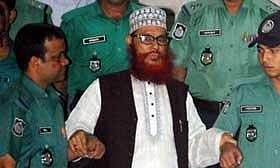
Document anomalies impede ICT proceedings
The tribunal did not allow the prosecution to record Delwar Hossain Sayedee's name as a Razakar as those records were not supplied to defence.
bdnews24.com News Service
bdnews24.com
Published :
08 Apr 2012, 02:38 PM
Updated :
09 Aug 2022, 03:38 PM
Dhaka, Apr 8 (bdnews24.com) — Anomalies in page numbers and missing pages in the prosecution's documents continued to impede proceedings against Jamaat leader Delwar Hossain Sayedee on Sunday.
The war crimes tribunal did not allow the prosecution to record Jamaat-e-Islami executive council member Sayedee's name as a Razakar because the prosecution had not provided those records to the defence.
The ongoing deposition of the investigation officer of the case will continue on Monday as the court was adjourned till then at the close of the day.
The International Crimes Tribunal – 1, set up on Mar 25, 2010 to deal with crimes against humanity during the 1971 Liberation War, indicted Sayedee on Oct 3, 2011 on 20 counts of crimes against humanity including charges like murder, rape, arson and loot.
RAZAKAR…OR NOT
The three-judge tribunal, headed by Justice Mohammad Nizamul Huq, agreed with the defence plea that the records could not show that Sayedee's name was found on the Razakar list since it was not given to them.
The prosecutor of the case, Syed Haider Ali protested saying that the investigation officer of the case was merely stating what he had seen in the course of the investigation.
"He found something during the course of his investigation. Can't he merely state that?" Ali posed the question.
Nizamul Huq said, "He could have done that if he recounted complete from the memory. But in this case he is referring to a document, which the defence has not received. We won't allow it."
The tribunal was not convinced and said that the man in the dock was not recounting something from his memory but reading out from a document, and that document had not been given to the defence.
The Razakar was mobilised as a group through the Jamaat-e-Islami and its student wing Islami Chhatra Sangha in 1971 to actively thwart the liberation efforts and collaborate with the Pakistani Army.
This vigilante group, along with other similar organisations, like the Al Badr and Al Shams, were notorious for their collaboration and atrocities committed during the nine-month war.
The prosecution has thus far claimed that Sayedee was among founding members of the Razakar unit of Parerhat under Pirojpur district.
Prosecutor Syed Haider Ali is in the process of deposing investigation officer of the case, Mohammad Helaluddin as potentially the last prosecution witness testifying against Sayedee.
However, Helaluddin's deposition has only been proceeding in hiccups due to an anomaly of page numbers in the volumes of documents that the prosecution has provided the defence and the tribunal.
This anomaly in fact triggered brief but heated spats of argument involving the defence, prosecution and the tribunal.
On one occasion the prosecution referred to a list of mass graves and execution grounds of the Liberation War and said they were listed on page 3521, the tribunal chairman, Justice Nizamul Huq said, "No according to my set of documents it is on page 3510."
Defence counsel Mizanul Islam said, "I have the Razakar Ordinance on page 3510. The referred item begins from page 3512."
This was followed by the defence asking the tribunal how to solve the problem since the references had to be in sync with the documents of the tribunal and the prosecution's documents did not have corresponding page numbers. This question eventually led to a heated argument.
On another occasion the prosecution referred to page 3565 but the defence said their volumes did not have that page. In fact pages numbered 3528 to 3898 were missing, the defence pointed out.
Helaluddin went on to summarise a report of a Bengali daily of Mar 5, 2001 which said 'Deilla Razakar of 1971 has now become Maulana Sayedee.'
He went on to cite the report's main contention pointing out that the accused was among the founding members of Parerhat's Razakar unit, and was later charged with forming the local Al Badr unit.
Sayedee, was allegedly responsible for murder of Faiz Ahmed, father of noted author Humayun Ahmed. The Jamaat leader was also said to be responsible for murders of many freedom fighters and torture of innocent civilians.
This time, the prosecution managed to have the court records reflect Helaluddin's statements but not before strong objections from Mizanul Islam, a defence counsel.
2 NEW VOLUMES
The investigation officer's deposition began with the prosecution producing two volumes that would act as a guide for what is set to be lengthy affair. Prosecutor Syed Haider Ali said, "I myself lost about how to proceed and from where to begin. So here are two documents."
He then gave sets of these documents to the defence and the tribunal saying that one would guide them through the deposition of the investigation officer and another one was a report on how Helaluddin's progression and how he collected evidences against Delwar Hossain Sayedee.
The upbeat sense about the utility of the two new volumes were soon done away with after the defence pointed out that the volumes contained heretofore undisclosed material that they pointed out would not be admissible.
Mizanul Islam, who leads the defence cross examination, said that the 48-page documents had numerous items that had not been provided to them beforehand and thus would have to be ignored by the court.
Upon prosecutor Haider Ali's admission that those materials had not been provided to the defence beforehand, Justice Huq ordered that none of the new material would be admissible.
After lunch there was another bout disagreement over two exhibits of the prosecution that according to the defence were not mentioned in the records.
Prosecutor Haider Ali said that the investigation officer was submitting some material to the court and it was up to the court what to do with it.
Mizanul Islam said that two maps of Pirojpur district, a compilation of mass graves and killing grounds of the district, were not mentioned as such in the documents previously provided to the defence.
Eventually after much discussion the tribunal decided to receive those two maps but not as exhibits. To Mizanul Islam's pleas that the court records reflect his reservation about the move, the tribunal said the fact that the court had not 'exhibited' the documents implied his reservations.
Also on Sunday, the tribunal decided to adjourn further proceedings in Jamaat chief Matiur Rahman Nizami's case to Apr 15.
FIRST CASE TO TRIAL
Sayedee's is the first case to proceed to the trial stage at the tribunal. The prosecution on Sept 4, 2011 proposed framing of charges against him on 31 counts of crimes against humanity and genocide.
On Oct 3, 2011, the tribunal indicted Sayedee on 20 counts.
The tribunal also sent Jamaat's former chief Ghulam Azam to jail on Jan 11 this year. His indictment hearing began on Feb 15 and the tribunal rejected his second bail petition on Thursday.
Besides Sayedee, Jamaat chief Matiur Rahman Nizami, secretary general Ali Ahsan Mohammad Mujaheed and assistant secretaries general Mohammad Kamaruzzaman and Abdul Quader Molla, and Bangladesh Nationalist Party's standing committee member and MP Salauddin Quader Chowdhury have been detained on war crimes charges.
The tribunal granted conditional bail to former BNP lawmaker and minister Abdul Alim on Mar 31 last year. The bail was extended further on Jan 16, ordering him to be present in the court on Mar 15 when the prosecution has been directed to submit formal charges against the BNP leader.
bdnews24.com/ta/sk/2025h