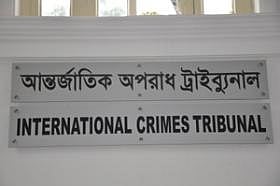
Defence objects to new ICT rules
The International Crimes Tribunal–1 recently amended some rules to expedite the pace of proceedings, reports Tanim Ahmed
bdnews24.com News Service
bdnews24.com
Published :
08 May 2012, 04:52 PM
Updated :
09 Aug 2022, 03:45 PM
Tanim Ahmed
Dhaka, May 8 (bdnews24.com) — Abdur Razzaq, a senior counsel representing top Jamaat-e-Islami leadership facing war crimes charges, has raised objections to the new rules that the International Crimes Tribunal–1 has recently adopted.
The tribunal amended some of its rules based on its experience to expedite the proceedings ensuring that none of the parties are prejudiced. These include a provision that allows the tribunal to dismiss a petition upon perusal and another one limits the number of review petitions to just one.
The International Crimes Tribunal–1, set up on Mar 25, 2010 to deal with crimes against humanity during the 1971 Liberation War, amended its rules of procedure changing all references from 'Tribunal' to 'Tribunal -1'.
A second tribunal was set up more recently and framed its own set of rules on Mar 29 adopting the original rules of procedure almost entirely with minor exceptions based on presumably the experience of proceedings in the first tribunal.
Justice A T M Fazle Kabir, ICT-2 chairman, was a member of the first tribunal and Judge Shahinur Islam, a former district judge, was the tribunal's registrar.
Tuesday saw the senior Jamaat defence counsel taking up one rule after another and go through them explaining his reservations.
Tribunal-1 chairman Justice Mohammad Nizamul Huq only partially agreed with Razzaq's opinion regarding one amendment that allows the tribunal to convict a person on the basis of appropriate evidence without being indicted for that specific crime.
The amendment, to be inserted as 39A of the rules, reads, "If the accused is charged with one offence, and it appears in evidence that he committed a different offence for which he might have been charged under the provisions of that section, he may be convicted of the offence which he is shown to have committed, although he was not charged with it."
Razzaq said the tribunal must frame charge before convicting the person for an offence.
Justice Huq's reply suggested that the tribunal might give it a second thought. "I don't think so. But we shall see," he told the senior counsel.
The tribunal chair clarified to Razzaq in between his deliberations on other points that the tribunal would exercise its authority judiciously and with the sole objective of a fair trial.
When defence counsel drew the tribunal's attention to its new rule regarding examination of the witnesses, tribunal member Judge A K M Zaheer Ahmed told him, "Why don't you just wait and see how the cross-examination proceeds?"
Razzaq had voiced his apprehension that using the authority of the new rules, the tribunal could limit the flexibility during cross-examinations. Judge Zaheer assured him saying, "You have seen the cross-examinations before we amended the rules, you see them now too. You can judge for yourself."
Justice Huq said with conviction, "Yes! Let us be tested."
The new rule (53.2 of the rules of procedure) states, "The cross-examination shall be strictly limited to the subject-matter of the examination-in-chief of a witness but the party shall be at liberty to cross-examine such witness on his credibility and to make contradiction of the evidence given by him."
The tribunal has on a few occasions urged the defence cross-examination trio —Mohammed Kafil Uddin Chowdhury, Manjur Ahmed Ansari and the senior counsel Mizanul Islam — to wrap up their apparently lengthy questioning.
In some cases, the tribunal expunged some questions saying that the subject matter was too personal and amounted to nothing but private scandal that had nothing to do with the case on hand.
Currently the defence is in the process of cross-examining the investigation officer of Jamaat-e-Islami executive council member Delwar Hossain Saydee's alleged war crimes.
The new set of rules also provides the tribunal with the authority to conduct a trial in the absence of an accused if that person proves to be uncontrollably unruly.
Justice Huq has thus far mentioned in his order that BNP MP Salauddin Quader Chowdhury, indicted on 23 charges of war crimes and crimes against humanity, had shouted in his court.
The relevant section, to be added as 43 B of the rules states, "At any stage of the proceedings or trial of a case, if the Tribunal sees unruly behaviour of the accused which is not easy to control or manage, then the Tribunal may, for its safety and dignity, dispense with the personal attendance of the accused, and direct him to appear by his Counsel."
Another newly adopted rule, 38.1 states, "Provided that if the accused does not reply either as guilty or not guilty or remains silent or if he says such things which is not relevant, then the accused shall be deemed to have replied as not guilty."
The rules also state that the accused can only reply either 'guilty' or 'not guilty'. In case the accused states something irrelevant then it will be deemed that the accused has pleaded 'not guilty'.
Justice Huq had actually failed to elicit either from SQ Chowdhury despite repeatedly asking him the same question a few times when the tribunal indicted him on Apr 4.
Razzaq said that an accused could very well have something to state before pleading. "He might speak for a few minutes and then state his plea."
Justice Huq readily agreed, saying, "Absolutely! And we won't stop that at all."
"But what if the accused says all that but refuses to give a plea? In that case we will consider the plea to be 'not guilty'."
He asked the counsel if the tribunal's decision to note 'not guilty' would prejudice the accused in any way. "That would be acceptable then."
Razzaq also agreed and said no matter what the tribunal did, he was worried about one thing. "You must ensure that we are not prejudiced."
bdnews24.com/ta/nir/2244h