


Published : 20 Aug 2019, 01:13 PM
Updated : 08 Apr 2022, 02:20 PM


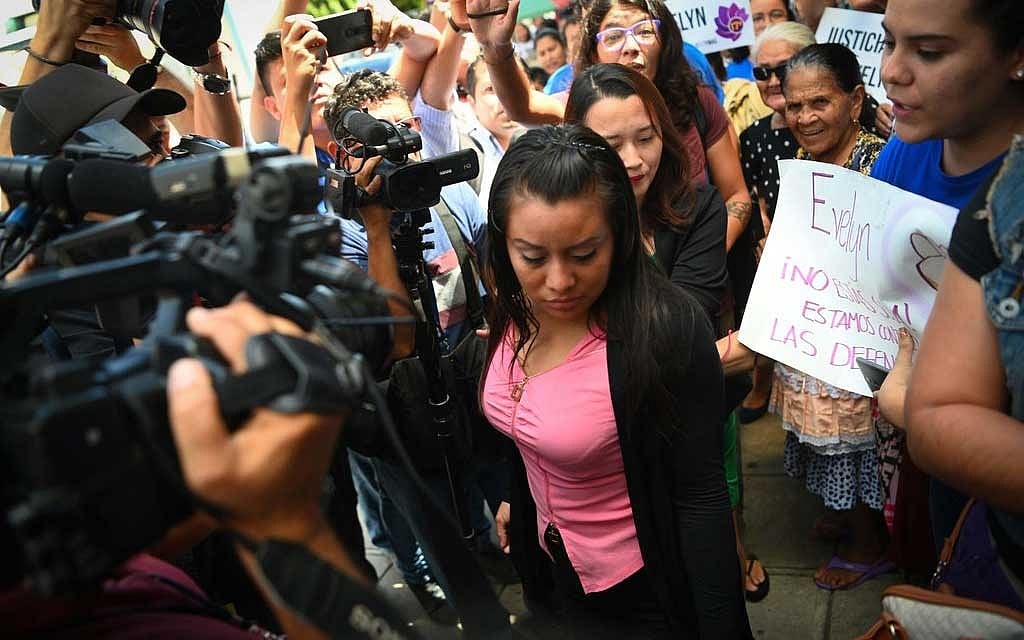
Hernández said she was raped by a gang member and was not aware she was pregnant. The courts in El Salvador, a country with one of the world’s strictest abortion bans, found her guilty in 2017 and sentenced her to 30 years in prison.
On Monday, a Salvadoran judge in a new trial acquitted Hernández, a decision hailed as a victory for advocates in a country where prosecutors have pushed beyond the harsh abortion laws to criminalise obstetric emergencies in some cases. Hernández had spent 33 months in prison before she was released this year pending the second trial.
The case has tapped into deeper concerns over social inequalities and discrimination, testing the willingness of the courts to accept homicide prosecutions of low-income women who lose their babies, often when giving birth at home without access to medical care.
El Salvador prohibits abortion under any circumstances, even to save the life of the mother. The law has evoked suspicion of women who experience complications during pregnancy.
Dozens of women who have had miscarriages or stillbirths have been accused of homicide or attempted homicide. Those charges carry a sentence as long as 40 years, compared to the maximum sentence of eight years for abortion. The weight of those prosecutions has fallen on poor and marginalised women with little education or access to health care.
Hernández, now 21, was found unconscious in April 2016, covered in blood after a stillbirth. Her mother took her to the hospital in Cojutepeque, a town about 25 miles east of San Salvador, El Salvador’s capital. The hospital authorities called the police.
The original verdict along with the 30-year sentence were overturned last year on procedural grounds and an appeals court ordered a second trial. The prosecutors in the second trial asked for a 40-year sentence.
During the trial last week, prosecutors argued that Hernández, who was attending high school at the time, should have known she was pregnant and sought prenatal care. After going into labour, they said, she also should have gone to the hospital.
The court ruled Monday that there was not enough evidence to convict her. The prosecution, it said, had failed to prove that Hernández was in any condition to protect her baby.
In a statement, Morena Herrera, of the Citizen Group for the Decriminalisation of Abortion, said that the acquittal was “a sign of hope for all women who remain in jail for crimes they did not commit for health problems that should never have been brought to court.”
“No woman should go through the ordeal that Evelyn did,” she added.
Women’s groups are likely to seize on the acquittal as they push to overturn other cases.
Advocates have identified 25 women who were sentenced to as much as 40 years for homicide or attempted homicide after suffering obstetric emergencies. As many as two dozen more were charged and jailed while they awaited trial before the charges were eventually dropped or they were acquitted.
Paula Avila Guillén, a lawyer and director of Latin American initiatives at the Women’s Equality Centre in New York, who works closely with Salvadoran women’s groups, said the harsh anti-abortion law sets the homicide prosecutions in motion.
“The problem is that once the word abortion is out there, it completely stigmatises the process,” Avila Guillén said. “There is no presumption of innocence against a woman once the word abortion is thrown out.”
In July, the Citizen Group, the Women’s Equality Centre and two other human rights groups presented four cases, including Hernández’s, to the United Nations Working Group on Arbitrary Detention.
“With these four emblematic cases, we hope the United Nations Group determines that El Salvador persecutes and arbitrarily detains women who suffer obstetric emergencies and/or births outside the hospital, particularly poor, rural women,” said Herrera of the Citizen Group.
In El Salvador, the political environment remains difficult.
An attempt last year to permit abortion in cases of rape and to protect the health of the mother failed in El Salvador’s congress. The chances of easing the 1998 anti-abortion law then became more remote as conservatives became dominant in the legislature.
President Nayib Bukele, who took office in June, has said that poor women should not be targeted unfairly in these cases. But he has remained silent in the case of Hernández, the first woman to be prosecuted under his presidency.
Advocates, though, have found slow progress in the courts.
In March, the Supreme Court commuted the sentences of three women, who had each spent almost a decade in prison for aggravated homicide, and ordered their release. The court ruled that the women’s rights were violated because prosecutors and lower courts failed to take into account the social and gender barriers they faced.
In December, a court declared another woman, Imelda Cortez, not guilty of attempted homicide after she was accused of abandoning her baby girl.
Cortez, who had been raped for years by her stepfather, said she had not known she was pregnant when she lost consciousness during the birth. She spent 17 months in pre-trial detention.
In the ruling, the judge noted that Cortez needed a blood transfusion when she arrived at the hospital. As such, he found that there was no way that Cortez could have intended to abandon her baby, who was born healthy.
Avila Guillén said it was “the first time that a judge recognised that giving birth by yourself after being raped for six years is a traumatic experience.”
Although judges have begun to revise their approaches, prosecutors have largely continued to file charges, Avila Guillén said.
“Sometimes it feels as though we are on a hamster wheel,” she said.
© 2019 New York Times News Service













