


Published : 16 Dec 2015, 04:42 PM
Updated : 19 Oct 2022, 07:06 PM


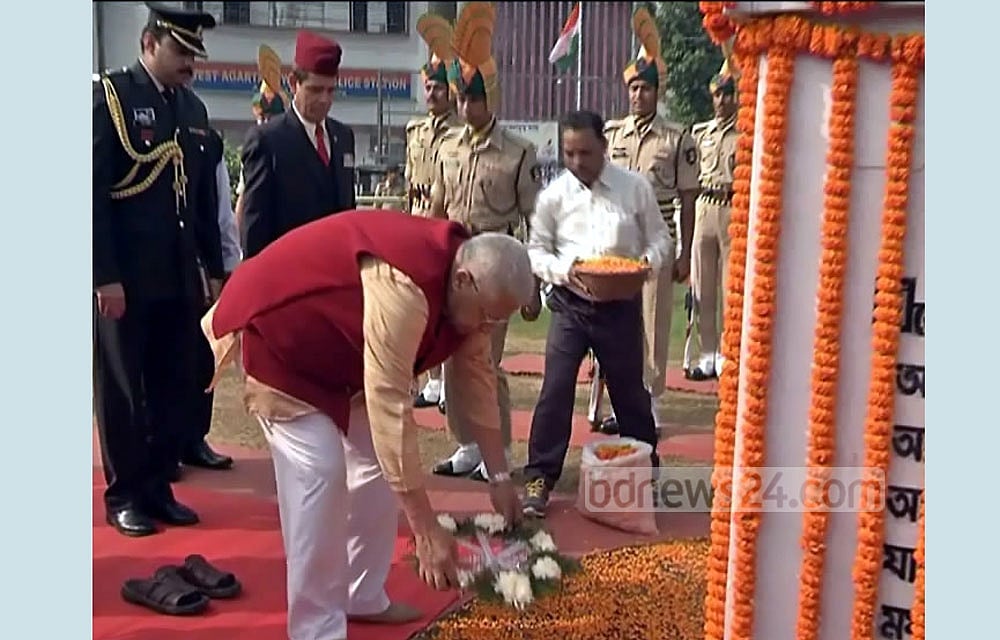
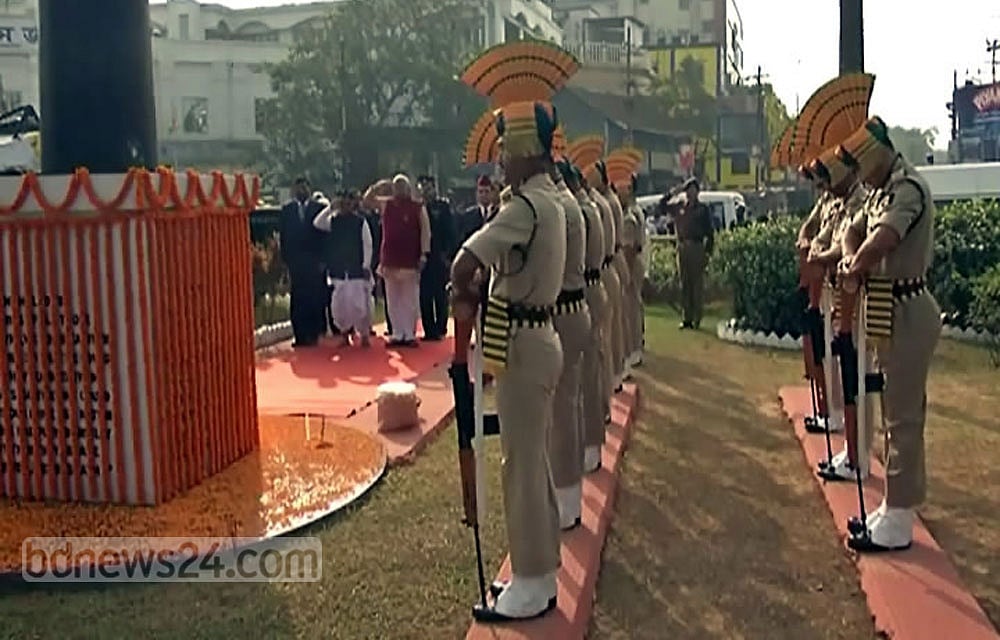
Governor Tathagata Roy, Jail Minister Manindra Reang and top officials paid tribute at the martyrs’ column in Agartala's Post Office Chowmhuni here.
“I was in Bangladesh three days ago and met Prime Minister Hasina. She recalled that for the first time in human history, an army of a foreign nation had come and liberated another country and gone back," said Tathagata Roy.
"The people of Bangladesh gratefully recognise the role of the Indian army and none more than PM Hasina. I am truly grateful for her acknowledgement and I am proud today to be here to commemorate this occasion,” said Governor Roy after laying a wreath at the martyr’s column.
He also thanked the people of Bangladesh for acknowledging India's role in helping them defeat the brutal Pakistani army.
Observed on December 16 every year, Bijoy Dibosh marks India's decisive military victory over arch-rival Pakistan that led to the creation of Bangladesh as an independent nation nine months into a war of liberation.
Security forces personnel; retired army, navy and air force officers; Bangladesh Liberation freedom fighters and civil administration officials were present to pay tribute to the war heroes on Wednesday.
Similar arrangements were also made at the Lichubagan 1971 war memorial where army personnel paid their tributes.
At the Bangladesh Assistant High Commission Office here Victory Day was celebrated with enthusiasm.
In the morning, the national flag of Bangladesh was hoisted as the national anthem of the country was played and floral tributes were paid to Bangabandhu as well as to all those who sacrificed their lives for the liberation of Bangladesh.
Later, special prayers were offered for the brave heroes of India and Bangladesh (then East Pakistan) who laid down their lives in the 1971 war.
It was also on this day that the largest military surrender after World War II took place, when the General Officer Commanding-in-Chief Eastern Command, Lt Gen Jagjit Singh Arora, accepted the instrument of surrender from Lt Gen AAK Niazi of the Pakistan Army at Dhaka.
Altogether 93,000 Pakistani troops and officers surrendered to the joint command of the Indian army and Mukti Bahini.
Bangladesh’s President Abdul Hamid, in an interview with bdnews24.com, recently spoke of how he had first turned up in Agartala to organise the resistance.
Former foreign minister Dipu Moni has described Agartala as 'the war capital of the Bangali nation' in the foreword of a book by journalist Subir Bhaumik called "Agartala Doctrine: Proactive Northeast in Indian foreign policy", published by Oxford University Press.
Forty-four years after the state of Tripura sheltered 1.8 million refugees and scores of freedom fighters when its own population was just 1.5 million, nostalgia about Bangladesh's liberation remains a potent sentiment in Tripura.
Old timers fondly recall the experiences of 1971 when they rubbed shoulders with many who later would go on to play bigger roles in independent Bangladesh.












