


Published : 27 Jun 2015, 02:15 PM
Updated : 19 Oct 2022, 06:49 PM


It’s their moment of tryst with destiny with both India and Bangladesh deciding to complete the process of handover of enclaves by July 31.
To workout, the modalities of the handover and study the ground situation West Bengal Home Secretary Basudev Bandhopaday will be on a three-day visit to some of these enclaves in Cooch Behar from June 29.
The celebration has already started.
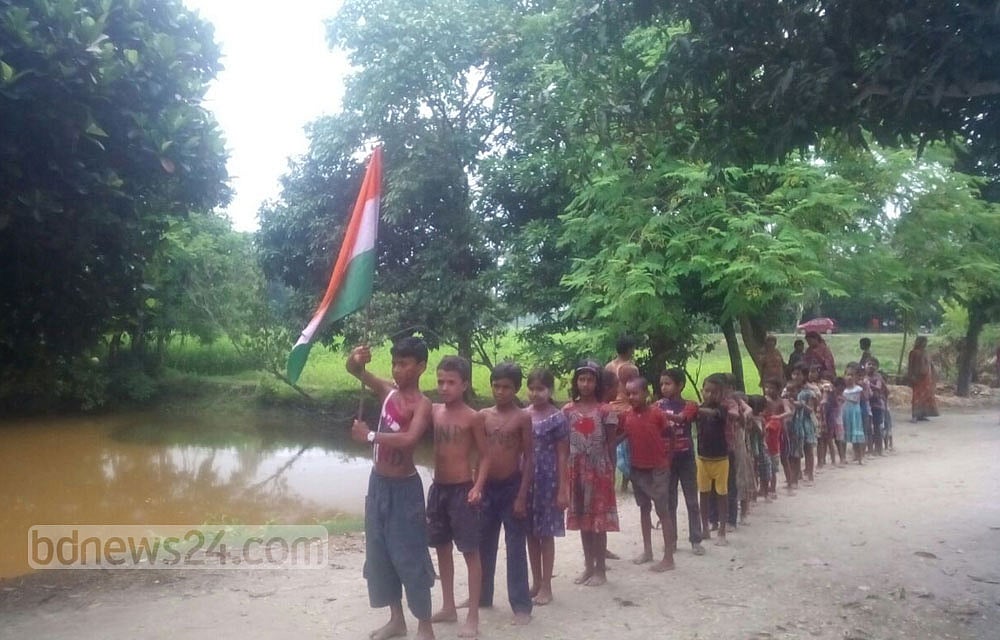
The tri-colour has not stopped fluttering at Madhya Masaldanga since Indian Prime Minister Narendra Modi and his Bangladeshi counterpart Sheikh Hasina witnessed exchange of instruments of ratification of the 1974 Land Boundary Agreement in Dhaka on June 6.
The agreement mandates the transfer of 111 border enclaves to Bangladesh in exchange for 51 that will become part of India, finally ending the stateless limbo of over 50,000 people living in these landlocked islands embedded deep inside the territory of the other country.
Finally, they will have an identity, a nation and a flag.
According to local folklore, this unique landmass is the result of a series of chess games in the eighteenth century between two kings who put villages at stake on their chessboards.
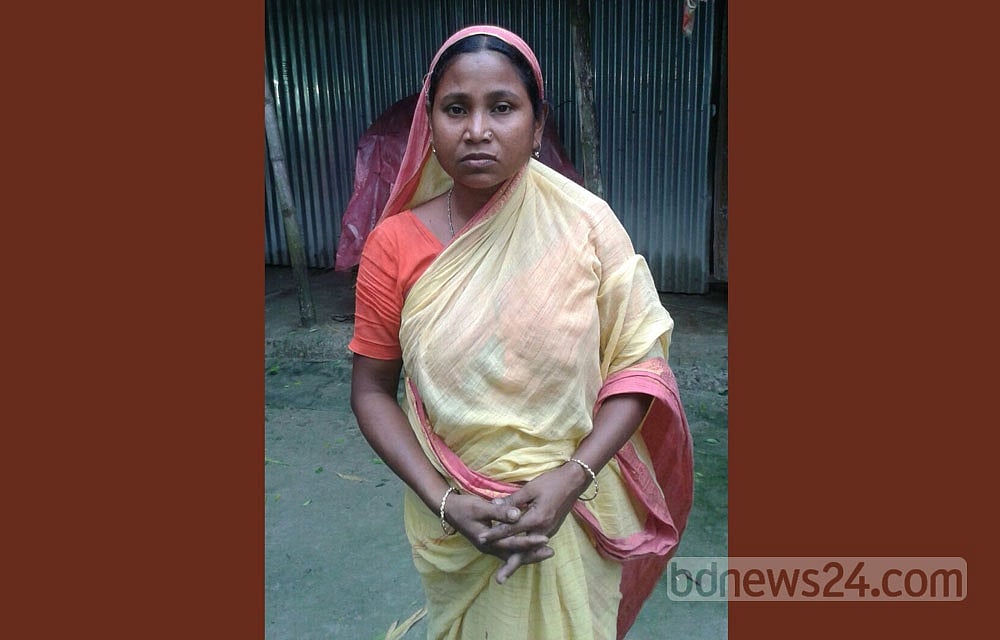
Enclave dweller Moymana Khatun
“In 1947 India got freedom and we lost our identity. Since then we have been leading a life of being neither here nor there,” said Ajgar Ali arguably the oldest enclave dwellers, believed to be 105.
Madhya Masaldanga is one of the 51 Bangladeshi enclaves to be transferred to India.
This village with a population of 3,870 seems to be stuck in a time warp.
The paved road and the overhead electric transmission line that bypassed it to connect a nearby Indian village with Cooch Behar, a bustling town in Indian state of West Bengal, only serve as a grim reminder of how things have changed around it.
These Bangladesh enclaves, trapped inside Indian territory, have remained virtually ungoverned for decades due to procedural complexity.
All along the enclave dwellers had been denied basic amenities, voting rights, ration cards, jobs and more importantly an identity.
"We have no hospital, no school, no road, no electricity..... We don’t figure in any government’s scheme of things," said Saddam Miah of Poyaturkuthi enclave.
Poyaturkuthi is another typical enclave, epitomised by backwardness and poverty.
The cluster of ramshackle tin-walled and tin-roofed houses has never seen modern amenities like lights, fans televisions or even tap water.
For the 470 odd families, expectation of a school or such government facilities within the village is simply unexpected. They just want access to them.
Because of their complex citizenship status, their children are not admitted to any school unless they give up their real identity.
Saddam, a postgraduate student of Rabindra Bharati University’s north Bengal campus had to fudge his address and parents’ identity to pursue education.
“We are forced to lead this humiliating life of deceit for decades. We have to borrow the identity of our neighbour from the mainland to admit our children to a school in India. I am happy that this humiliation will now end. I can die as an honourable citizen,” said Mansur Ali Miah,76.
Medical facility too was out of bound until 2010, when a collective agitation by all the enclave dwellers forced a local Indian hospital to admit Asma Bibi of Madhya Masaldanga to give birth to her third child without faking the identity of her husband.
Cryptically, the child has been named ‘Jihad’, meaning struggle in Arabic.
Fear and duplicity have been their constant companions as police and Border Security Forces often harassed and arrested them on charges of “illegal trespassing” into India.
But being surrounded by India from all sides, the villagers have no other choice but to ‘trespass.’
“We get all our essentials from nearby Indian markets. We also sell our produces there. We just can’t avoid going into Indian territory,” said Moymana Khatun, a housewife from Poyaturkuthi.
But all these will soon be past. In fact, the enclave dwellers say they have already started enjoying some freedom.
“For the first time I ventured out of my village without any fear on that evening (June 6) after the instruments of LBA was exchanged,” Joynal Abedin of Madhya Masaldanga recalled.
According to a joint survey conducted by India and Bangladesh, there are 14,000-odd people in the former Bangladeshi enclaves that have come into India’s possession. Around 37, 000 live in Indian enclaves transferred to Bangladesh.
The agreement has given the residents an option to choose their nationality.
Diptiman Sengupta, assistant secretary of the India-Bangladesh Enclaves Exchange Coordination Committee, told bdnews24.com that all residents of former Bangladesh enclaves had preferred to stay back.
His claim was endorsed by villagers.
“We have been living here for generations. Our relatives and friends are all here. We have been living so cordially with the people from mainland for years, so why should we leave all these and go anywhere else,” Moymana Khatun said.
Khatun, whose parents are from mainland India, came to live in Poyaturkuthi after she was married off to an enclave dweller in 1997.
The coordination committee, comprising residents from both mainland and enclaves, has been spearheading the movement for ratification of boundary agreement since 1994.
As per the indication it is getting from across the border, 700 odd people from former Indian enclaves might opt to retain their Indian nationality and migrate to West Bengal.
To rehabilitate them, villagers on the Indian side of the enclaves have already earmarked 100 acres of land. They have already handed over 10 acres of land to West Bengal government for resettlements of anyone migrating from enclaves across the border.
According to a senior official of the Cooch Behar district administration the entire handover process is expected to be completed by November this year.
The centre has offered to West Bengal government a financial package of Rs 33 billion for the development of these 'islands' of underdevelopment.











