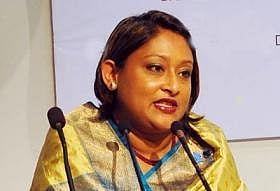
Bangladesh is planning to equip its community clinics to detect development delays in children at an early stage.
Saima Hossain Putul, Chairperson of National Advisory Committee on Autism and Neuro-developmental Disorders, said once detected, children with ‘moderate to severe’ development delays would be referred to specialised centres for further diagnosis and treatment.
“Those with mild problem will be referred to facilities available in their localities”.
She was speaking at a session, on the sidelines of the World Health Assembly in Geneva, to woo global support for an autism resolution Bangladesh would place before the WHO’s Executive Board meeting next week.

She listed her country’s initiatives for the healthcare services for the children with autism at a session jointly organised by Bangladesh, Botswana, Brazil, India, Qatar and Romania and said other developing countries could ‘emulate’ Bangladesh.
The resolution Bangladesh proposed to move will call for a ‘comprehensive and coordinated efforts’ for the management of autism spectrum disorders.
Earlier, the United Nations and WHO South East Asia Region adopted two separate resolutions on autism moved by Bangladesh.
A US-licensed school psychologist Putul, daughter of Prime Minister Sheikh Hasina, spearheads the campaign in Bangladesh.
She hoped that everyone would agree that “no matter what physical and mental challenges we are born with or acquire, we all have the rights to realise our full potential as human beings”.
Putul said in the past ‘emphasis’ was given only on tackling infectious diseases, non-infectious diseases like mental health disorders and development disabilities were “left untreated debilitating life across the social strata causing immense social, economic and emotional harm.”
She said until recently autism was considered ‘a low prevalence disability’. But today it is a global health crisis, affecting 1 in 88 children. The rate of autism is now higher than that of juvenile diabetes, cancer and AIDS combined.
“We need to establish interagency cooperation and collaboration and incorporate early detection programmes and culturally appropriate intervention services within the existing health, educational and social support systems,” she said as she stressed on multi-sectoral strategies that Bangladesh had already initiated.
Also a Chairperson of Global Autism Public Health Bangladesh Initiative, she said that they had completed the comprehensive situation analysis of the disorder in Bangladesh.
“What we have learnt, in order to fully address the needs of those with neuro-developmental disorders, our approach has to be multi-faceted, comprehensive and integrated with other community based programmes”.
She said complex disorders like autism were “not only faced with limited understanding and social stigma but also a significant shortage of trained professionals, intervention programmes and research centres” in Bangladesh due to “poverty, poor health infrastructure and frequent political unrest”.
Like many other developing countries, she said, “Whatever little services we have, it exists only in large urban settings”.
She said if implemented successfully, the community clinic approach would ensure that “families are able to access specialised care at an early age through an effective referral process”.
Early detection of developmental disorders like autism is a challenge in resource-starved countries, due to lack of adequate infrastructure.
The current government has so far built more than 13,000 community clinics, pledging to build a facility for every 6,000 population.
Putul said they had undertaken ‘a pilot programme’ that would guide the plan –screening at community clinics.
Under the pilot programme, the Ministry of Health had already trained about 8,000 community health workers from seven districts to screen development disabilities using tailor-made tools.
If succeeded, she said, “Community clinics across Bangladesh would be equipped to detect developmental delay by the time a child is two years old”.
She said “it would not only ensure that child development services are incorporated with the primary healthcare services, but will also enable the early detection, intervention and management of development disabilities such as autism in a manner that is consistent with current research in brain development”.
She said this is just one of the programmes of the five-year ‘strategic action plan’ Bangladesh has developed.
She said countries with low resources need awareness campaigns to educate the public and the professionals, a lesson, she said, Bangladesh had learnt on its own.
“We need to train health professionals on screening, assessment and intervention techniques that are evidence based.
“We need to standardise the training of relevant professionals. We need to integrate developmental disabilities within the primary public health services.
“And we urgently need legislations and policies that adequately support families and ensure that the human rights of those with autism spectrum disorder are promoted, protected and realized,” she said.
She called for urgent technical support for the developing countries in their efforts to ensure that developmental disorders and autism are “seamlessly included in all aspects of society”.
As many developing countries do not have necessary data to verify the extent of the problem, she said, that should not in any way preclude us from addressing this global health crisis.
“Families living in poverty have neither hope nor opportunity for accessing services unless and until we incorporate these programmes within our existing government health, education and social support systems.
Health Minister AFM Ruhal Haque, Prime Minister’s Health Advisor Syed Modasser Ali, Vice-Chancellor of Bangabandhu Sheikh Mujib Medical University Pran Gopal Datta, Bangladesh’s Ambassador and Permanent Representative (PR) to the UN Office in Geneva Md Abdul Hannan, and Bangladesh Medical Association’s Secretary General Prof Iqbal Arslan were present, among others, during Putul’s speech.