Published : 25 Sep 2026, 11:25 AM
Updated : 25 Sep 2026, 11:25 AM


Bangladesh's only specialised government neurosciences hospital has doubled its bed capacity, but a staff shortage of more than 40 percent means patients still cannot get the care the expansion promised.
National Institute of Neurosciences and Hospital Director Md Nuruzzaman Khan says the staffing gap should be filled and full services rolled out within the next month and a half to two months.
According to doctors and hospital officials, the facility has 2,728 approved posts for doctors, nurses, officials and other employees. Of these, 1,619, or 59.35 percent, are filled.
That leaves 1,109 posts vacant, or just over 40 percent of the approved workforce.
Prime Minister Tarique Rahman inaugurated a new 500-bed building at the hospital on Aug 15.
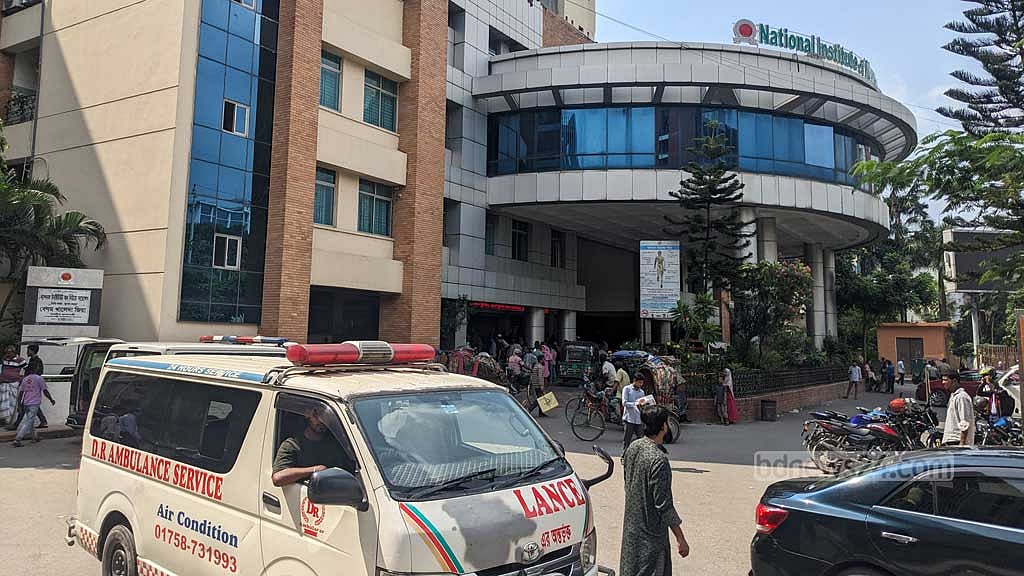
Added to the existing 500 beds, that takes the hospital’s capacity to 1,000, yet patient pressure remains so heavy that many arriving on any given day still cannot be admitted.
The hospital opened on Sept 12, 2012 with 300 beds, before growing demand prompted an expansion by another 200.
Visits to the hospital this month found patients and relatives struggling to secure beds.
Doctors were seeing patients in the outpatient wing of the new building, but its general wards were not yet admitting patients.
Monir Hossain travelled from Jashore on Sept 15. Four months ago, he suffered a brain haemorrhage in a motorcycle crash and has since largely recovered.
His younger brother Manik Hossain said doctors had asked for two reports after an appointment on Tuesday, Sept 15, but the results had yet to come through.
“We’re stuck waiting outside for them,” he said.
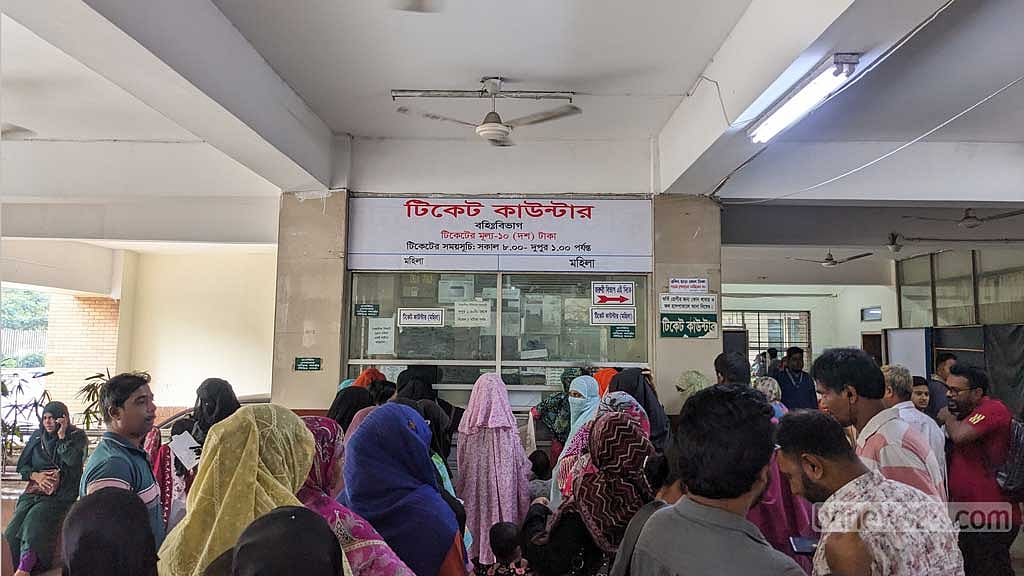
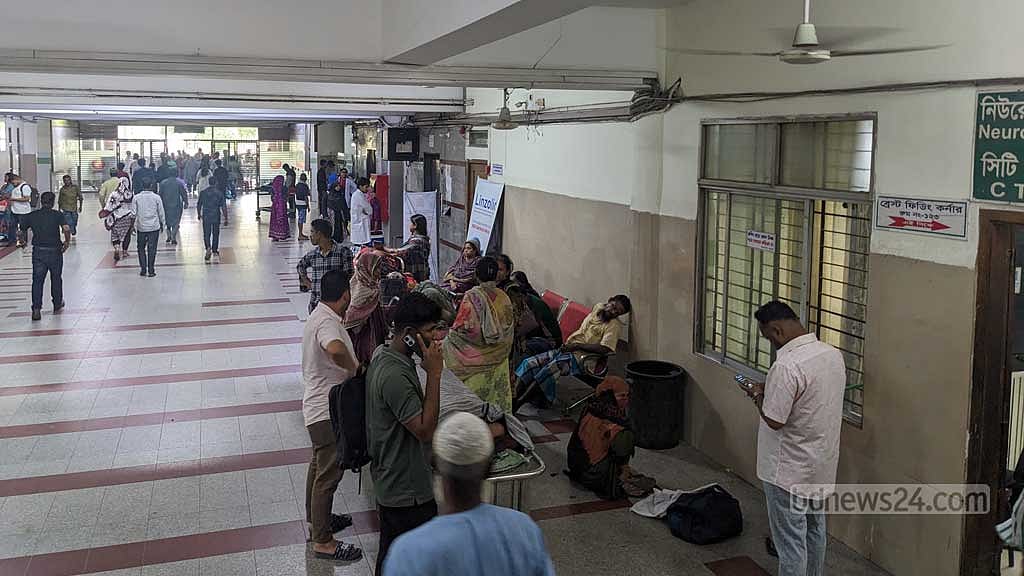
Long queues stretched from the ticket counters at both the old and new buildings, with around 50 people waiting at each.
Patients and relatives had laid out makeshift bedding in spare corners of the hospital, while several critically ill patients waited on stretchers for beds to become available.
Doctors said outpatient services were running on the first and second floors of the new building, while an operating theatre and post-operative ward were also functioning.
Its general wards and intensive care unit have yet to open.
Staff Shortage Tops 40 Percent
The hospital previously had 203 approved posts for doctors and officials, with another 446 later added, taking the total to 649.
Only 286 of those posts are currently filled, leaving more than half vacant.
The service wing had 527 approved posts, with another 337 added, taking the total to 864. Of these, 677 are filled.
For outsourced staff, 656 posts were previously approved and another 559 added, taking the total to 1,215. Only 656 are currently filled.
What Patients Say
Rashid Hasan arrived from Cox’s Bazar on Sept 24 with his mother and brother.
His brother Himel Hasan said Rashid has a spinal tumour that requires surgery and doctors have recommended admission.
“We still can’t find a free bed, so he can’t be admitted. And surgery isn’t possible before admission,” he said.
“They say the hospital will call once a bed opens up. We’re trying to find one ourselves too.”
Chan Mia’s family has been renting a place near the hospital for six days.
He has a degenerative spinal condition and can no longer stand, according to his elder brother Abdur Razzak.
“We got some tests done in Rangpur and came here with those on Saturday to see a doctor. Two more tests were done; we got one result and came in today to show it,” Razzak said.
“The patient can’t stand on his own, so we have to bring him in on a stretcher. Even so, they’re not admitting him. We’re told there’s no bed free.
“This is what it’s like coming here to see a doctor. We end up having to stay outside.”
Doctors said patient pressure has continued to rise even after the country’s only full-fledged neurosciences hospital expanded to 1,000 beds.
Around 2,000 patients now visit each day, most with complex or serious conditions, and many end up seeking treatment elsewhere because no bed is available.
No Polytrauma Management System
Despite being billed as a full-fledged neurosciences hospital, the facility has no polytrauma management system.
Doctors said the staff shortage compounds the problem because patients with injuries involving multiple organs cannot receive all their treatment under one roof, forcing families to move between hospitals.
Asif-Ur-Rahman, a specialist in the hospital’s anaesthesia, neuro trauma and neuro critical care department, said: “Some of the country’s most critical patients are treated here. But there’s no specialist team for polytrauma management, so many patients end up at other hospitals too.”
Polytrauma management refers to coordinated treatment for patients with injuries affecting multiple organs.
For example, a road crash victim may have a head injury, broken ribs, lung damage and a fractured leg at the same time, requiring an integrated treatment system.
“In many road accidents, patients suffer damage not just to the head but to multiple organs. But here, only the head gets examined,” Asif said.
“If the hospital had a few more specialists on a dedicated team, polytrauma management could be handled together,” he added.
What the Hospital Says
Assistant Professor and Resident Physician Mazharul Islam said: “This is the country’s only full-fledged neurosciences hospital, so a huge number of patients come here.
“With the staff shortage, we can’t yet deliver full-fledged services. Very soon, patients will receive the kind of care available at hospitals in developed countries.”
Director Nuruzzaman struck a similarly hopeful note, saying full services should be available within the next month and a half to two months.
The biggest issue right now is staffing, particularly the need for specialist doctors, according to him.
"We can't simply pull in a doctor from another hospital, because they're needed there too. We also need more first-class officers, who are appointed through the ministry and the directorate. Beyond that, we need technical specialists to run the lab and the ICU.
"We're trying to bring in doctors from across the country, and outsourced recruitment is also under way. Patients should see the full benefit within the next month and a half to two months," the director added.