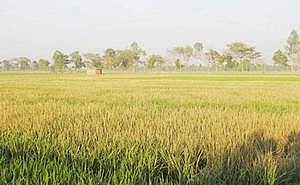
Experts see the trend as a threat to food security.
A study by the Soil Resources Development Institute (SRDI) found that farmlands diminished by 68,700 hectares, or 0.738 percent of the total, every year on an average in the past decade. Three decades ago, the average annual rate of decline was 13,412 hectares.
The study says housing is depleting around 30,809 hectares, urbanisation and industrialisation 4,012 hectares, and fish farming 3,216 hectares of farmlands annually.
The study, first of its kind in Bangladesh, was done under the Food Policy Capacity Strengthening Programme (NFPCSP) with financial assistance from the United Nations Food and Agriculture Organisation (FAO), European Union and USAID.
According to the study, led by SRDI Chief Scientific Officer Nazmul Hasan, the amount of farmlands was 9,761,450 hectares in 1976 but declined by 321,909 hectares in 24 years to 9,439,541 hectares in 2000.
The amount went down further by 687,604 hectares in the next 10 years to 8,751,937 hectares in 2010.
Though the annual rate of decline was 0.137 percent during the 1976-2000 period, it increased more than four times to 0.728 percent in the past one decade.
Experts see such an ‘abnormal’ decrease in farmlands as a threat to the food security.
National Research Grants Administrator of FAO Nur Ahamed Khondaker told bdnews24.com that the findings were worrisome.
“The farmland decline would have impacted food security had high-yielding verities of crops not been invented. Still, the diminishing of farmlands is a threat to food security.”
Study team leader Nazmul Hasan told bdnews24.com that urbanisation and industrialisation would increase future, as the country was attaining over 6 percent GDP growth.
“But if we can have a combined management of urbanisation, industrialisation and agriculture land, farmland decline rate will drop,” he said.
The study considered farmlands, forests, rivers, lakes, marshlands, tea gardens and salt-producing areas agriculture lands.
It found that the total amount of agriculture lands was 13,303,654 hectares, 91.83 percent of country’s total land area, in 1976.
The amount diminished to 12,742,274 hectares in 2000 and to 12,176,904 hectares in 2010. The rate of average annual decline was 0.38 percent during the 1976-2000 period and 0.416 percent in the following 10 years.
Non-agriculture lands
The study discovered that the percentage of non-agriculture lands in the total land area rose to 16.47 from 8.17 in the 34 years since 1976.
The total amount of non-agriculture lands was 1,183,605 hectares in 1976 and it rose to 1,788,307 hectares in 2000 and to 2,400,867 hectares in 2010. The average annual increase rate was 2.13 percent in the first 24 years and 0.416 percent in following decade.
Rural habitation areas, urban and commercial areas and non-fertile barren lands were considered non-agriculture lands in the study.
It found that rural housing took away 0.288 percent of total land area annually on the average in the last one decade to raise the amount of lands used for the purpose to 1,766,123 hectares, 12.12 percent of country’s total land area.
The total area of lands covered by rural housing was 1,458,000 hectares in 2000 and 885,637 hectares in 1976.
The study report said the country saw a high expansion rate of urbanisation and industrialisation during the past decade. The land area covered by cities and towns and industries was only 26,799 hectares in 1976 but it rose to 47,495 hectares in 2000 and to 87,616 hectares in 2010.
The study identified Dhaka, Chittagong, Sylhet and Rangpur as the division where urbanisation is expanding fast.