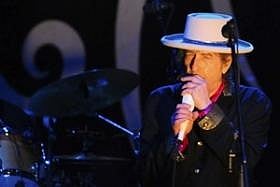
At 70, Dylan remains inscrutable
Everyone has their own version of pop icon
bdnews24.com News Service
bdnews24.com
Published :
24 May 2011, 10:05 AM
Updated :
10 Aug 2022, 04:51 PM
Dhaka, May 24 (bdnews24.com)—Bob Dylan, who turns 70 on Tuesday, is the most obsessively scrutinised and discussed artist in pop history. Yet the man himself resists being mythologised.
Of all the several hundred songs that Dylan has recorded over the past 50 years, there is one which I have found myself playing a lot lately.
A relic from Dylan's distant past, it seems somehow to be a song that vividly prefigured his future, reports The Daily Telegraph.
I Was Young When I Left Home was recorded in December 1961, one of two dozen that Dylan recorded in the apartment of a girlfriend, Bonnie Beecher, when he was returning home to Minnesota after his first year in New York. Dylan was just 21, but he had already created a stir on the New York folk scene, and a month earlier had completed his first album for Columbia Records, which would be released in March 1962.
I Was Young When I Left Home is a reinterpretation of a standard, 900 Miles. It is a song far beyond his years, and it carries portents of some of the themes that would come to define Dylan, with its intimations of twists of fate, the need to move on and not be tied to the past -not be tied to anything. "Gonna make me a home out in the wind," as Dylan sings.
Dylan's voice is not yet fully formed -there are whoops and slurs that he seems to have borrowed from somewhere else that he is trying on for size -yet it is utterly distinctive, that plangent, high, lonesome, nasal twang that became his first identifying thumbprint, and that when I first heard it made me think, like most people, who the hell is that?
Beecher would later describe how, after recording the songs, Dylan had told her that she should never let anyone else make copies of the tapes, "so that when someone from the Library of Congress asks you for them, I want you to sell them for $200." As a mixture of prescience and audacity it is hard to beat. "What kind of remark is that to make," Beecher wondered, "to somebody that is shoplifting food for someone who is so incompetent that he can't even shoplift his own food?"
The newspaper reports that Beecher did not get her $200 from the Library of Congress. The tape was apparently stolen and I Was Young would go on to become a staple on any number of Dylan bootlegs. (It eventually received a bona fide release, 40 years after it was recorded, on a limited edition of Love and Theft.)
I first encountered the song through a CD burned by a friend, a collection of "almost and never released" tracks, a beautifully designed and packaged artefact, with photographs and meticulously researched sleeve-notes that would put most professionally produced CDs to shame; in short, a labour of obsessive devotion.
It occurs to me that only Dylan fans do this. Not only is he the most bootlegged artist in the history of popular music, as demonstrated by the academic conference at Bristol University that marks his 70th birthday, he is also the most avidly discussed, the most rigorously scrutinised, the most fervently admired. Everybody has their own version of Bob Dylan, and everybody thinks they know him better than anybody else.
Dylan realised early on that the best way to cope with the heavy burden of his own mythology -and to avoid being the prisoner of other people's expectations -was to throw up a smokescreen, and give away as little as possible.
"Do not create anything. It will be misinterpreted. It will not change. It will follow you the rest of your life," he wrote in a 1964 prose poem, Advice For Geraldine on Her Miscellaneous Birthday.
The following year, asked at a press conference whether it was true that he'd changed his name, he confessed that indeed he had. His real name, he said, was actually Knezelwitz. "Knevevitch?" the reporter asked. "Knevovitch, yes," Dylan replied. "That was the first name. I don't really want to tell you what the last name was."
The sly evasion, the straight-faced put-down and the outright lie became his first line of defence. Dylan may be, as one friend put it, a man with "so many sides he's round." But then again, how can anybody get an angle on a circle?
What is important, as Dylan himself says, has been "for me to come to the bottom of this legend thing, which has no reality at all. What's important isn't the legend, but the art, the work." If Dylan had died in that famous motorcycle accident in 1966, his legacy would still surpass by a country mile that of any other performer in postwar music: the brilliant creative flowering of the early years, the protest (or, as he put it, "finger-pointing") songs, the amphetamine poetry of Bringing It All Back Home, Highway 61 Revisited and Blonde on Blonde -three of the greatest albums in the pop music canon released in the space of just 18 months in 1965 and 1966 -nobody could possibly have sustained that.
Critics, academics and home theorists have picked their way through the layers of allegory and ambiguity in his songs -is Like a Rolling Stone about Joan Baez? Edie Sedgwick? Dante's Beatrice? Or Dylan himself? Biographers have attempted to hack through the thickets of his tangled love life, his substance abuse and personal peccadillos. But he remains inscrutable. Do you know where Bob Dylan lives? Who he is married to? How many children he has? Neither do I.
I have met him only once. It was 1984, a time when Dylan was emerging from his born-again Christian phase which had so bewildered his fans. Infidels, released the year before, had been welcomed as a return to secular themes of love and loss. Dylan was performing in Madrid and I had been sent by a newspaper in the (very slim) hope of securing an interview.
After making contact with his management, I was told to stay in my hotel room and await a call that might or might not come. At the moment when it finally became clear that I would not be interviewing Bob Dylan, the telephone rang. I was told to be at the Cafe Alcazar at 7:30pm. It was 7pm. I arrived at 7:40pm. No sign.
Obviously, he had come and gone. Forty minutes late, he came through the door, alone. A slight, grizzled-looking figure, he was wearing a Hawaiian shirt and a straw hat that looked like a disguise. He walked quickly to my table, head down, looking neither left nor right.
He ordered coffee and lit a cigarette -the first of a stream he would smoke over the next hour. His manner was courteous and accommodating. Every question he had heard before, but he treated them all with good grace.
"For me, none of the songs I've written have really dated," he said. "They captured something I've never been able to improve on, whatever their statement is. People say they're 'nostalgia,' but I don't know what that means really. A Tale of Two Cities was written 100 years ago; is that 'nostalgia'? This term, 'nostalgic,' " he said, "is just another way people have of putting you someplace they think they understand" -another one of the labels that people had been putting on him since he started out -"and not one of them has ever made any sense."
"Born-again Christian" was another one. Why all the furore about his religious views, he wanted to know. "Like I was running for Pope or something. I mean, nobody cares what Billy Joel's religious views are, right? What does it matter to people what Bob Dylan is? But it seems to, right? But why? Why only me? I'd like to know."
He talked enthusiastically about poetry -Yeats and Shelley -and the gospel music he loved -the Swan Silvertones, the Highway QCs and Sister Rosetta Thorpe. When I asked what he was reading right now he replied, "Seneca, Cicero, Machiavelli." He paused. "Last year I read John Stuart Mill.
"I don't feel obliged to keep up with the times, I'm not going to be here that long anyway. So I keep up with these times, then I gotta keep up with the '90s. Jesus, who's got the time to keep up with the times?"
As we talked, more people in the café had come to see through the disguise. A steady stream had made their way to the table, scraps of paper in hand. Dylan signed them all in carefully deliberate hand but his discomfort at being on view was becoming more apparent. As suddenly as he had arrived, he rose from the table and made his excuses and left.
It was a few years later that he set off on the so-called "Never Ending" tour, which continues to this day -proof that for Dylan, performing is less a living than a life, The Daily Telegraph added.
Whatever expectations people may have of him, Dylan at least has proved utterly faithful in his determination to confound them, whether it's advertising women's lingerie for Victoria's Secret, or suddenly popping up as the host of his own radio show -a delightful illustration of his dry humour and impeccable musical taste.
When the controversy blew up recently over his appearances in China and Vietnam, with fatuous accusations that he had "sold out" by not performing Blowin' In the Wind -as if it was Dylan's responsibility to be the conscience of the world -I was reminded of something he had told me sitting in that café in Madrid.
"What you gotta understand is that I do something because I feel like doing it. If people can relate to it, that's great; if they can't, that's fine, too. But I don't think I'm gonna be really understood until maybe 100 years from now. Because what I've done and what I'm doing, nobody else does or has done."
bdnews24.com/pks/1600h