Published : 05 Apr 2023, 12:33 AM
Updated : 05 Apr 2023, 12:39 AM


Even though Bangladesh is not currently facing a crisis like Sri Lanka and Pakistan, the World Bank has recommended that the country address the current "distortions" in its economy to achieve sustainable growth.
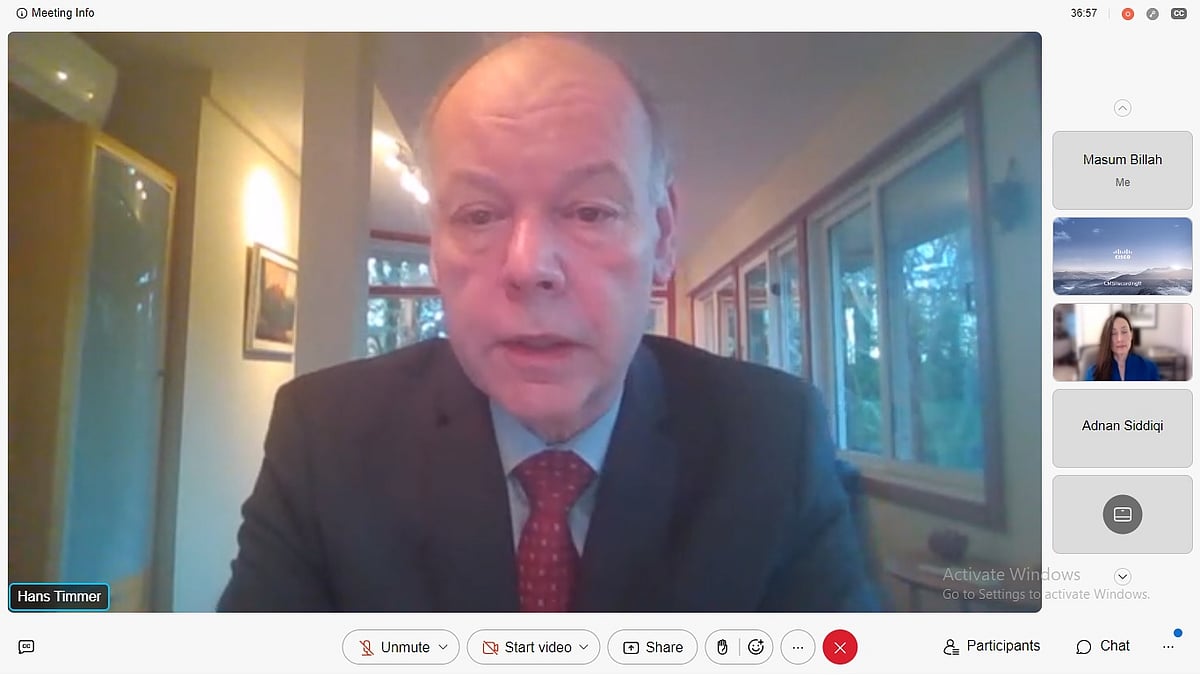
The focus has to be on resolving tensions in the financial sector and stabilising the balance of payments, Hans Timmer, World Bank Chief Economist for the South Asia Region, said during a virtual press conference to launch the Spring 2023 edition of the economic update report on Tuesday.
The economist further emphasised the need to overcome the distortions caused by these tensions and government responses.
There is no crisis and also not an imminent crisis in Bangladesh, especially not after an agreement was reached with the IMF to support the country, Hans said.
“At the same time, there are challenges in Bangladesh, and they are very much concentrated also on the balance of payments and the financial sector.”
In 2022, there was a lot of pressure on the currency, causing its value to go down and creating economic problems because of a system with multiple exchange rates, he said, adding that It's good news that Bangladesh is now working with the IMF to get rid of this system.
“But also, you see in Bangladesh, an informal exchange market being developed to circumvent some of the capital controls that were put in place.”
Furthermore, there are ongoing tensions in the country's financial markets, which may escalate in the future, he said.
According to Hans, Bangladesh was the last South Asian country to withdraw the COVID-19 support measures that aided both firms and domestic banks. As a result, the true quality of loans and assets was hidden.
“And very likely, the nonperforming loans were much larger than it was officially recognised, and we see now also slowly an increase in those nonperforming loans. So the challenges are there.”
Hans believes the key to Bangladesh moving away from ad hoc measures is to decrease economic distortions.
“Whether that is supporting firms or supporting individual banks or whether that is import restrictions or capital controls, they have created distortions in the economy, which makes it very difficult to put a country on a sustainable growth bus.”
Hans said that the recent report from the World Bank highlights that approximately 1 percent of foreign currency exchange and 3.6 percent of remittances are flowing into the country's informal sector.
It is crucial to make the country more inclusive and to have more people involved in the economy, Hans said.
Hans said that Bangladesh has achieved considerable success in the readymade garment sector, generating employment opportunities primarily for women and earning export revenues.
However, despite a dynamic economy, the country's export pattern has remained unchanged over time, with no new initiatives in other sectors - a typically uncommon situation.
Bangladesh Development Update April 2023, entitled Trade Reform: An Urgent Agenda, says that accelerating the implementation of structural reforms, including trade reforms and export diversification, will help Bangladesh navigate the current challenges and sustain growth momentum.
Growth in Bangladesh is expected to accelerate over the medium term, as inflationary pressure eases, external conditions improve, and reform implementation gains momentum, the World Bank said in a statement on Tuesday.
Real GDP growth is expected to decelerate to 5.2 percent in FY23 due to rising inflation, tighter financial conditions, disruptive import restrictions, and global economic uncertainty. In FY24, growth is expected to pick up to 6.2 percent.
“Russia’s invasion of Ukraine and global uncertainty have impacted countries around the globe. Bangladesh’s post-pandemic recovery has been disrupted by elevated commodity prices, rising interest rates, and slowing global growth,” said Abdoulaye Seck, World Bank Country Director for Bangladesh and Bhutan. “The World Bank stands ready to support Bangladesh with reforms to accelerate growth and strengthen resilience.”
Higher commodity prices have contributed to inflationary pressure. The balance-of-payments deficit reached $7.2 billion in the first half of FY23, up from $5.3 billion in FY22, creating considerable pressure on foreign exchange reserves, the statement said.
“The ready-made garments sector accounts for about 83 percent of Bangladesh’s exports. The COVID-19 pandemic underscored the risk of overreliance on a single sector,” said Bernard Haven, World Bank Senior Economist and co-author of the report.
“Diversifying exports and improving competitiveness will help Bangladesh achieve upper-middle income status by 2031. For this, it will be important for Bangladesh to reduce both tariff and non-tariff barriers. A comprehensive reform programme can strengthen regional integration, particularly with South Asia and Southeast Asia.”