Published : 10 Oct 2016, 04:34 PM
Updated : 19 Oct 2022, 05:30 PM


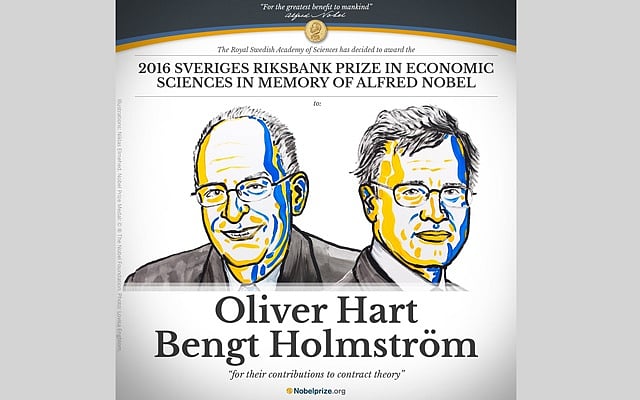
Their findings on contract theory have implications in such areas as corporate governance, bankruptcy law and political constitutions, said the Royal Swedish Academy of Sciences, which announced the 8 million Swedish crown ($928,000) prize.
"This theory has really been incredibly important, not just for economics, but also for other social sciences," said Per Stromberg, a member of the prize committee and professor at the Stockholm School of Economics.
Contract theory considers, for example, whether managers should get paid bonuses or stock options, or whether teachers or healthcare workers should be paid fixed rates or by performance-based criteria.
Holmstrom, a 67-year-old professor of economics and management at the Massachusetts Institute of Technology, said he had been friends with Hart for decades and was thrilled to be sharing the award with him.
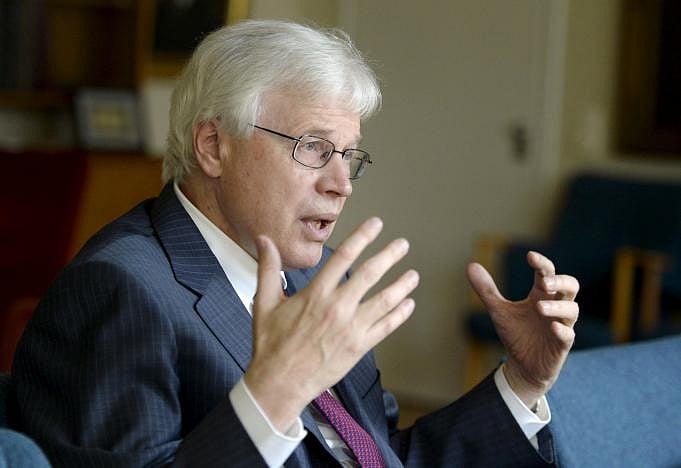
Finnish Professor Bengt Holmstrom of Massachusetts Institute of Technology MIT speaks during a business seminar in Helsinki, Finland, November 2, 2015. Lehtikuva/Jussi Nukari/via Reuters
'Hug my wife'
Hart, an economics professor at Harvard University, has focused on understanding which companies should merge and with what mix of financing, and when institutions such as schools, prisons and hospitals should be privately or publicly owned.
At Harvard since 1993, Hart has argued that the incentives for cost reductions in privatised services, such as private prisons in the United States, are typically too strong.
Hart thought his research could win him the prize at some point. He said he awoke about 4:40am EDT and wondered whether it was getting too late to get a telephone call.
"Then fortunately the phone rang," Hart was quoted as saying on the official Twitter account of the Nobel Prize. "My first action was to hug my wife, wake up my younger son."
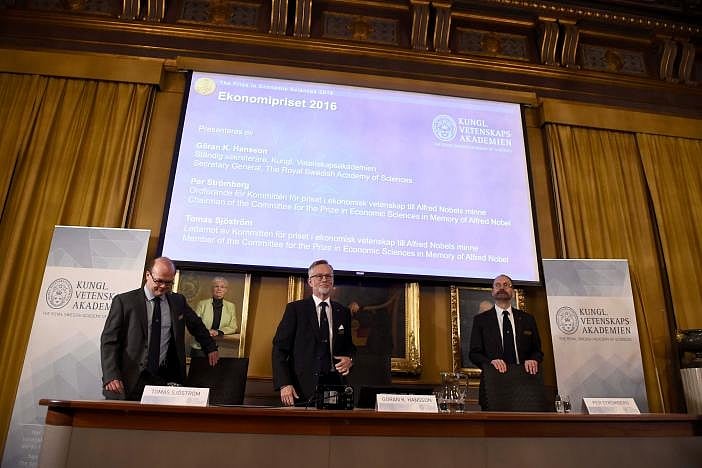
Tomas Sjostrom, member of the Committee for the Prize in Economic Sciences in Memory of Alfred Nobel, Goran K. Hansson, Secretary General of the Royal Swedish Academy of Sciences and Per Stromberg, Chairman of of the Committee for the Prize in Economic Sciences in Memory of Alfred Nobel, arrive for a news conference, in Stockholm, Sweden, October 10, 2016. TT News Agency/Stina Stjernkvist/ via Reuters
Asked at a Cambridge, Massachusetts, news conference about the current high level of executive pay, Holmstrom said, “It is somehow demand and supply working its magic.”
But he said he was concerned about the state of income distribution and the unhappiness of many workers about stagnant wages and incomes.
“I’d much rather live in a society where this wasn’t happening,” he said. “But I’m not prepared to speak about the question about how to repair it” because it would mean tinkering with complex markets.
The nine academics who won Nobel prizes this year in medicine, physics, chemistry and economics included five Britons, a Frenchman, a Finn, a Dutchman and a Japanese.
Six of the winners, including all five Britons, are based at US universities.
($1 = 8.6231 Swedish crowns)