


Published : 01 Mar 2022, 03:59 AM
Updated : 18 Jul 2022, 02:30 PM


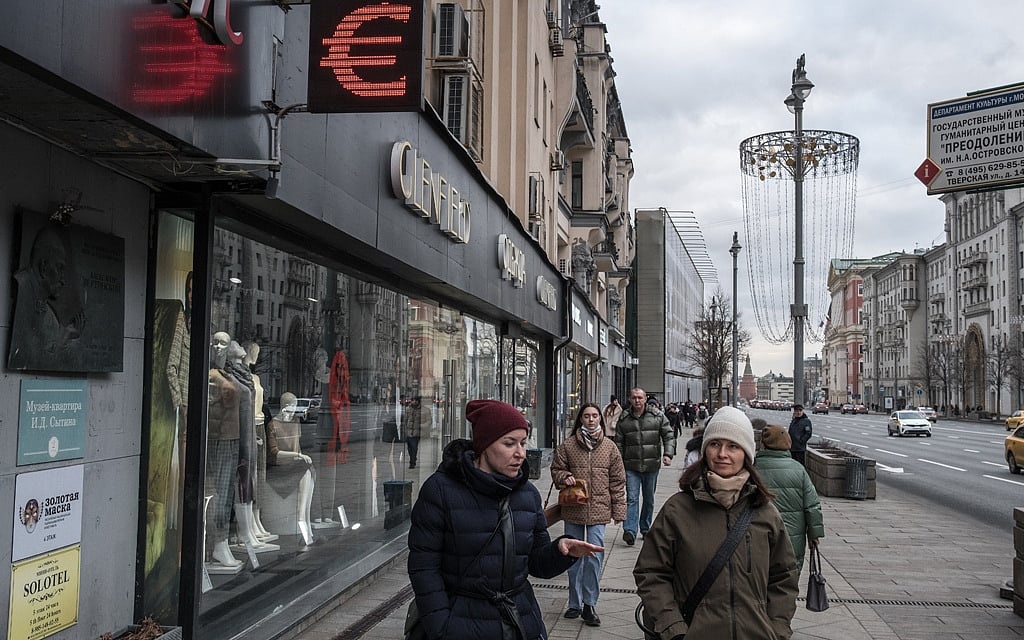
As the day began, Russia’s currency lost as much as one-quarter of its value within hours. Scrambling to stem the decline, the Russian Central Bank more than doubled its key interest rate, banned foreigners from selling Russian securities and ordered exporters to convert most of their foreign-currency revenues into rubles. It closed the Moscow stock exchange for the day because of the “developing situation.”
“The economic reality has, of course, changed,” the Kremlin’s spokesperson, Dmitri Peskov, told reporters, announcing that Putin had called an emergency meeting with his top finance officials.
Even as Russian and Ukrainian delegations met for talks at the Belarus border, Moscow’s military offensive showed no sign of letting up, and the hectic moves offered the first signs that the sanctions imposed on Russia by the West over the weekend were shaking the foundations of Russia’s economy. The decisions by the United States, Britain and the European Union restricting the Russian Central Bank’s access to much of its $643 billion in foreign currency reserves have undone much of the Kremlin’s careful efforts to soften the impact of potential sanctions.
And with dozens of countries closing their airspace to Russian planes, major foreign investors pulling out and the West placing debilitating restrictions on Russia’s biggest banks, it was becoming clear that Putin’s invasion of Ukraine was ushering in a period of international isolation for Russia unseen since the Cold War.
“So, has Russia become Venezuela or is it still Iran?” the morning-show host on the liberal-leaning Echo of Moscow radio station asked an economist Monday.
“We’ll go through the Iran phase,” Yevgeny Gontmakher of Moscow’s Higher School of Economics responded, referring to sanctions placed on Iran because of its plans for uranium enrichment, “but what happens after that is hard to say.”
Elvira Nabiullina, the widely respected governor of the Russian Central Bank, was expected to speak to the public at 4 p.m. Moscow time.
On Sunday, Putin called the West’s sanctions “illegitimate” in a televised meeting with his defense minister and top military commander. Putin then told them to place Russia’s nuclear arsenal on high alert; some analysts fear that Russia’s economic instability could lead Putin to escalate his conflict with the West using new military threats or other means, such as cyberattacks.
But there was also extreme uncertainty inside Russia as the value of people’s savings evaporated and the interconnections with the Western world that Russians had come to take for granted in the last three decades rapidly broke away. It was not immediately clear whether most Russians would blame Putin for the crisis — or whether they would take cues from Kremlin propaganda and blame the West.
“Times change, much has happened, but one thing has not changed,” a reporter on the state-run news channel Rossiya 24 said Sunday. “When a united Europe tried to destroy Russia, this always ended up bringing about the opposite result.”
©2022 The New York Times Company













