Published :
29 Jun 2013, 08:33 PM
Updated :
09 Aug 2022, 10:51 AM

The Finance Bill-2013 was passed in Parliament on Saturday night.
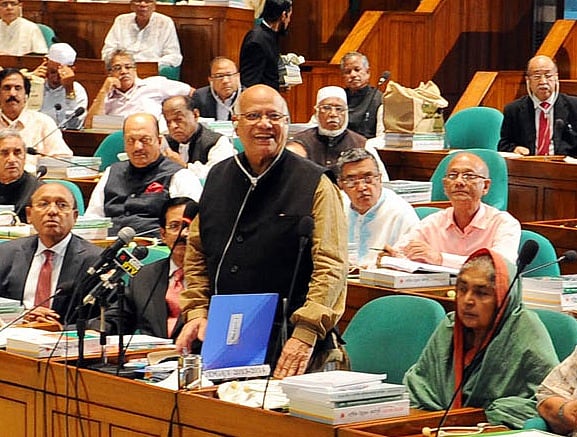
Finance Minister AMA Muhith brought some changes to the proposed budget for the 2013-14 fiscal, providing a chance to launder black money through investing in any sector by paying a 10 percent fine.
The minister said, “If any taxpayer did not show his actual income in the past or could not give the real amount of wealth in the assets statement due to any reasons, he/she can announce the income optionally according to the existing law.”
“In this case a 10 percent extra fine is mandatory. A taxpayer can invest his undisclosed income in any sector including industries and commerce by showing it and paying the tax including the fine.”
Muhith added, “The tax department cannot ask any question about such announced income and investment if the taxes are paid in line with the rules. I propose this amendment in a bid to encourage such investment.”
The Bill was later passed with several other changes including this one.
But it was passed by scrapping the proposal of the ‘special facility’ to allow purchase of land with undisclosed income by paying a 10 percent fine.
During his concluding speech in Parliament on the proposed 2013-14 outlay, the Finance Minister said, “It was proposed in the Finance Bill-2013 to consider investment of undisclosed income in purchasing land by paying a 10 percent tax. But this facility in this sector will raise the price of land and it will be a waste of money in an unproductive sector.”
“The Prime Minister had suggested scrapping the proposal in a bid to discourage investment of undisclosed income. I am cancelling this proposal,” he added.
Prime Minister Sheikh Hasina and Leader of the Opposition Khaleda Zia were present in the House at the time with Speaker Shirin Sharmin Chaudhury in the chair.
In his budget speech on June 6, Muhith had said that the ‘special facility’ to legalise undisclosed income through purchase of plots and flats was being suggested to tackle last year’s ‘crisis’ in the real estate sector.
The budget session on Saturday had begun at 3:15pm. The minister started his speech at 8pm after the Prime Minister and opposition chief spoke.
His speech ended at 10:45pm and the Bill was passed at 10:50pm.
After her speech, the Prime Minister also asked Muhith to change eight proposals regarding tax and duty in the proposed budget for 2013-14 fiscal.
The minister on Saturday also proposed hiking the import duty on newsprint to 10 percent from 3 percent. The proposed budget for 2013-14 fiscal had suggested increasing the import duty by 25 percent.
“Following the Prime Minister’s recommendation, I propose to import newsprint by paying 10 percent duty instead of the regular 25 percent and 5 percent supplementary duty.”
The two percent import duty on printing plates for the printing press was reinstated by scrapping the proposal to hike the tax by 9 percent.
The budget had proposed a 10 percent tax on the commission or fee of a distributor for the marketing of goods, which was made 5 percent.
The changes in the proposed budget also upheld the VAT on plastic utensils, household goods, kitchen tools and utensils made of aluminium and enamel.
The proposed tariff on bidi was reinstated by scrapping the hiked supplementary tax, because of which the reduced price of filter-less 25 bidis will be Tk 5.36 and 20 bidis with filter will be Tk 6.06.
However, the advance VAT on the import of two costly cancer medicines - Imatinib Capsule (Glivec) and Nilotinib (Tasigna) – were also withdrawn.
The proposed additional 5 percent regulatory duty of the 10 percent import duty on 43 items was also withdrawn.
The import duty on items for ensuring fire safety on the ready-made garment industry was reduced to 5 percent.