


Published : 22 Oct 2015, 12:48 AM
Updated : 08 Aug 2022, 05:02 PM


The ‘Diagnostic Trade Integration Study’ launched by the global lending agency on Wednesday lays down a roadmap to strengthen Bangladesh’s trade competitiveness and develop policy to make the best of international markets.
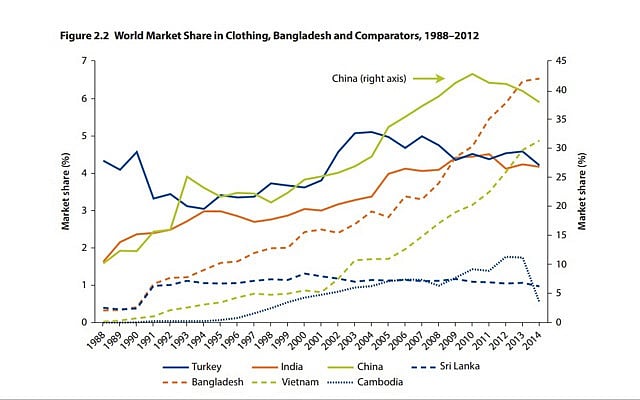
The bank in a media release on the report says, “Bangladesh’s exports have doubled their world market share between 1995 and 2012, largely due to the strong export performance in the ready-made garments sector.”
It notes that, since 2009, Bangladesh has become the world’s second largest garment exporter after China and points to the RMG sector’s “ample room” for expansion and the need for overall export product diversification.
If Bangladesh were to capture just about 20 percent of China’s current garment exports, its total export volume would more than double, increasing by $29 billion and creating 5.4 million new jobs and about 13.5 million new indirect jobs, says the release.
“To accelerate GDP growth, Bangladesh needs higher volumes of exports to larger and richer markets, beyond its relatively smaller domestic market,” said Johannes Zutt, the Country Director for Bangladesh.
“Bangladeshi firms have succeeded in garments, and they can also succeed in other industries with demonstrative competiveness such as jute-based industries, footwear, information and communications technology, shipbuilding, pharmaceuticals, light industry such as bicycles and others.”
The study identifies a number of reform initiatives in high priority areas to enhance the country’s trade capacity and competitiveness, says the release.
Bangladesh must focus on regional and global markets diversification, spread the export base wider, improve worker and consumer welfare, and strengthen institutions while sustaining sound economic fundamentals, the study observes.
It also calls for an inter-ministerial committee to help the country’s exporters succeed in a globally competitive environment.
It mentions pharmaceuticals, bicycles, and shipbuilding as areas that could benefit from such investments.
The report, says the release, stresses Bangladesh’s need to increase linkages with neighbours China and India as well as other Asian countries such as Japan and South Korea to access underexploited markets and attract greater FDI.
In order to do this, the country needs to remove bottlenecks such as the availability of serviced land, uninterrupted power supply, congestion at Chittagong port, the Dhaka-Chittagong road and rail corridor, customs clearances at land and sea borders, and ease of access to finance.
“A trade policy regime that is more neutral between exports and production for the domestic market, would support the development of new export sectors and small and medium firms,” said Sanjay Kathuria, Lead Economist, Trade and Competitiveness Global Practice, World Bank, and co-author of the report.
The report also draws attention to the need to give the country’s youth a solid foundational education and vocational skills to be productive in export-oriented industry.
Bangladesh needs to act urgently to tap into regional and global trade as well as FDI to boost its economy and reduce poverty, says the report.













