


Published : 27 Jan 2016, 01:54 AM
Updated : 19 Oct 2022, 05:05 PM


Nielsen Bangladesh conducted the research for US-based International Republican Institute (IRI). It was done over the period between Oct 30 and Nov 13, and included the views of 2,550 persons from 64 districts.
Among them, 30% described their economic situation as good, while 49% said it was ‘good in one way or the other’. Only 7% said it was ‘really bad’ and 12% said it was ‘bad in one way or the other’.
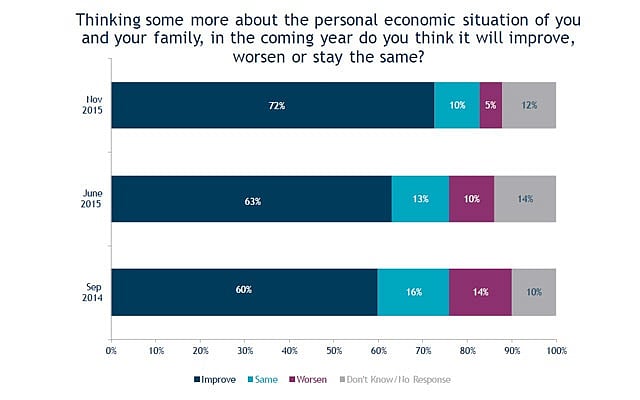
As for increased individual and family income, 72% of the participants said it was true in their cases, while 10% said their situations were unchanged and 5% said it was worse than before.
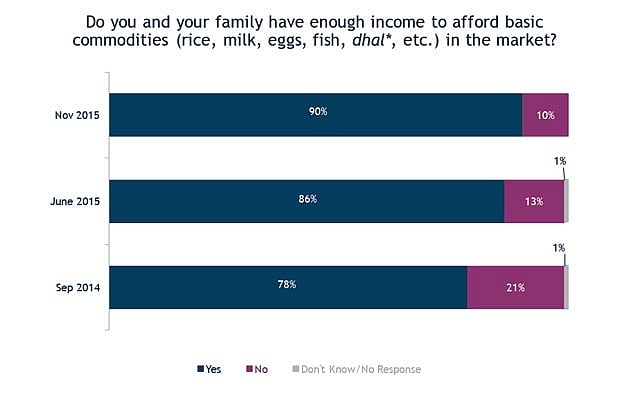
A staggering 90% have said they can afford to buy their necessities. The remaining 10% said they were struggling to buy the items.
But despite the numbers showing progress, most people do not believe that the market will be stable. More than half, 61%, said prices of commodities will rise, while 12% believed it will remain unchanged and 14% were hopeful that prices will go down.
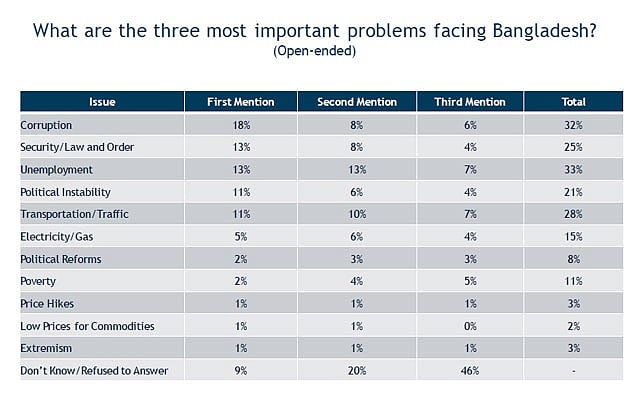
Most of them saw unemployment as Bangladesh’s most severe problem. Unemployment rated at 33%, corruption at 32%, traffic gridlocks at 28%, law and order situation at 25% and political instability at 21%.
A total of 77% said they were satisfied with Prime Minister Sheikh Hasina’s work. As for the Election Commission, 62% were happy with its work. The numbers appreciating the police were lower in comparison, as only 42% believed they were functioning properly.
Most believed there was stability in Bangladesh. It was ‘very stable’ according to 21%, ‘stable in some manner’ for 49% while 21% believed it was ‘unstable’.
Half of them, 50%, believed the political situation will ‘improve’ by 2016, while 17% said it will remain ‘unchanged’ and 13% said it will ‘deteriorate’.
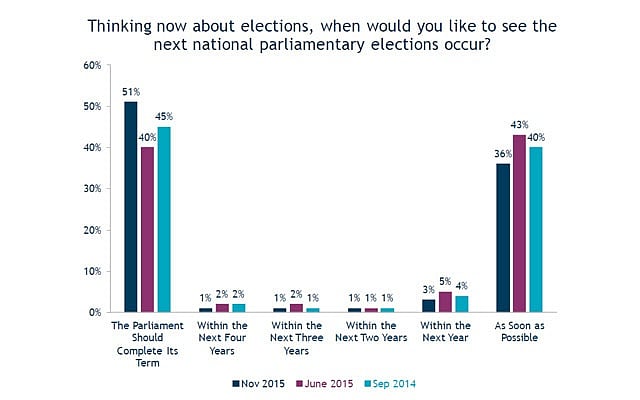
A total of 51% wanted the national election only after the tenure of the present government was over. But 36% wanted the election as soon as possible. One percent wants the election in the coming 2 or 3 years, while 3% wanted it in 2016.
Among the participants, 84% said they were looking forward to vote in the next election. But 1% said they were not interested.
The opinions of family members were important in deciding who to vote for, said 47% and 25% said no one could influence their decisions.
The Election Commission was completely free and fair according to 59%, and 34% among them were absolutely certain while 29% had doubts.
As for the scrapped system of holding general elections under a non-partisan caretaker government, 68% said they wanted it reinstated while 29% opposed it.
The ruling Awami League was ahead with support from 48% and 24% said they supported BNP as a political party.
The education qualification of the majority of the survey’s participants: 79% did not go beyond 9th grade, while 22% were illiterate. But 59% said they get their news from television with Somoy TV rating at 23%, BTV, 18%, ATN 14%, NTV 10%, RTV 7%, Channel i 6%, ETV 4% and Ekattor 3%.
Many people consider IRI as the unofficial arm of the right wing part of the US government and the Republican Party headed by John McCain.












