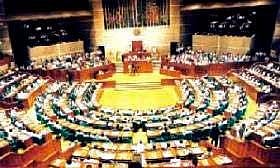
VAT Bill 2012 passed
It will replace VAT Act, 1991 and fulfil a condition by the IMF to get the next instalment of about $1 billion credit
bdnews24.com News Service
bdnews24.com
Published :
27 Nov 2012, 04:24 PM
Updated :
09 Aug 2022, 04:33 PM
Dhaka, Nov 27 (bdnews24.com)—Parliament on Tuesday passed the Value Added Tax Bill, 2012 to expand the scope of VAT, supplementary duty and turnover tax and simplify the process.
It will replace VAT Act, 1991 and enactment of the new law is one of the conditions the International Monetary Fund had set for Bangladesh to get the next instalment of about $1 billion credit.
Piloted by Finance Minister AMA Muhith, Value Added Tax Bill, 2012 was passed by voice vote. The MPs had rejected by voice vote motions for sending the bill to scrutiny committees and seeking public opinions before passage.
It provides for 15 percent VAT rate on taxable products and import under destination principles and establishment of an authority to implement the laws.
The destination principle is a concept of international taxation, which allows value added taxes to be retained by the country where the taxed product is being sold. They are collected on imports and rebated on exports.
The law says the government can exempt VAT partially or fully in times of emergency through a gazette notification, but it must be incorporated in the Finance Bill of the next fiscal.
Another provision says if international aid or credit agreements incorporate a clause to exempt VAT on import of materials or supply, the government can do it through a gazette notification.
The new law also stipulates three percent turnover tax.
The rate would be zero if the product is meant for export and if the imported products sent outside Bangladesh without being used in the country.
Products imported under back-to-back LCs and supplied under finance lease will be exempted from VAT.
Muhith said distortions made way into the VAT Act 1991 and prevented a standard VAT system from implementing.
"It is needed to have a business and revenue-friendly VAT system incorporating internationally accepted best practices, and I hope everybody will like it," Muhith said.
VAT authority
The authorities will be comprised of officials including Chief Commissioner, Commissioner (VAT), Commissioner (Appeals), Commissioner (LTU), and Director General of Central Intelligence Cell.
The National Board of Revenue through a gazette notification empowers VAT commissioners to perform any duty, but the Board will have the authority to change or amend or reverse any decision taken by the VAT authorities.
The law allows any official with a status of Assistant Commissioner or above to enter any business premises and search and examine records and documents.
If anybody violates the laws, the VAT officials can confiscate goods and settle the disputes.
The VAT officials would issue a notice for hearing while confiscating goods or impose any penalty.
Commissioner or Chief Commissioner will have the authority to deal with products valued over Tk 2 million and assistant commissioners with products worth less than Tk 2 million but more than Tk 1.5 million.
A Joint Commissioner is authorised to deal with goods that cost between Tk 1.0 million and Tk 1.5 million and a Deputy Commissioner can handle products worth between Tk 0.5 million and Tk 1.0 million.
The revenue officials will deal with products valued at less than Tk 0.2 million.
All the information and documents will be kept secret under the Right to Information Act, 2009.
Penalty
Dishonest taxpayers would have a maximum penalty of one year in jail or financial penalty worth the amount of tax dodged or both.
Appeal and revision
Aggrieved taxpayers can lodge complaints with Commissioner (appeal) within 90 days of the decision taken by the VAT officials.
But the taxpayers will have to deposit 10 percent of decided tax amount or, in absence of tax amount, 10 percent of the penalty amount while filing the appeal.
The Commissioner (Appeal) will give verdict within one year of the filing of the complaint.
Aggrieved taxpayers or Commissioner or Director General or any tax officials above the ranks can apply to the High Court of Supreme Court for revision of any decision taken by the National Board of Revenue or the appeals tribunal.
However, taxpayers can resort to alternative dispute resolution for settlement.
bdnews24.com/ssz/jr/bd/2153h