Published : 14 Sep 2013, 11:35 PM
Updated : 09 Aug 2022, 11:06 AM


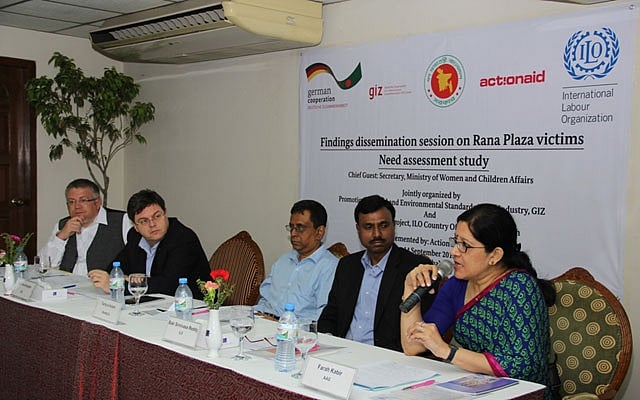
Garment industry stakeholders worked on strategies on Saturday to strengthen efforts to rehabilitate victims of the worst-ever factory building collapse and their families, the German development arm, GIZ, has said.
It said a needs assessment was carried out to guide the rehabilitation work.
The collapse of a factory building at Savar in April had killed more than 1,100 people, mostly garment workers, and left many injured and maimed.
The tragic incident swung the international community into action on Bangladesh’s factory safety issues. The United States punished Bangladesh by suspending its GSP privilege, while the European Union rolled out a roadmap to improve factory conditions.
The government has signed a tripartite agreement with guidance from the International Labour Organisation to ensure workers safety.
GIZ said their initiative was supported by a joint project of the Bangladesh and German governments. ILO and Action Aid Bangladesh supported them in doing the assessment.
It said the rehabilitation strategies were focused on three major areas: health and rehabilitation; livelihoods, skills development and employment, and education justice and empowerment.
The responsibility for implementation would be shared by all including government, employers, trade unions, NGOs, civil society bodies, international buyers and research units, it said.
“We will be working in close cooperation with industry associations and organizations to ensure reintegration of victims and injured workers, who have acquired disabilities due to the incident,” Olaf Handloegten, Country Director, GIZ, was quoted as saying in the media release.
Secretary for Women and Children’s Affairs Tariq-ul-Islam said the government had “already paid compensation to the families of 782 deceased workers in the last 100 days, and the payments for other commitments were underway”.
ILO Country Director Srinivas Reddy said the needs assessment would be used “to guide our continuing response”.
“Bringing the range of involved organizations together for a well-coordinated rehabilitation effort will avoid duplication and ensure coverage,” he said.
ActionAid Bangladesh’s Country Director Farah Kabir stressed the need of implementing these commitments as soon as possible.