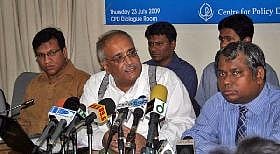
Monetary policy didn't address microfinance: CPD
The monetary policy that the central bank recently announced left out 'the vital issue of integrating microfinance', says private research organisation Centre for Policy Dialogue (CPD).
bdnews24.com News Service
bdnews24.com
Published :
23 Jul 2009, 01:34 PM
Updated :
12 Aug 2022, 01:30 PM
Dhaka, Jul 23 (bdnews24.com)--The monetary policy that the central bank recently announced left out 'the vital issue of integrating microfinance', says private research organisation Centre for Policy Dialogue (CPD).
Microcredit accounted 7.1 percent of the total credit to private sector and 2.7 percent of the GDP in the past 2008-09 fiscal year, according to CPD distinguished fellow Debapriya Bhattacharya.
"This is quite surprising as the Bangladesh Bank has shown a great deal of sensitivity to loans for farmers and the poor people," he told a press briefing on Thursday on the monetary policy at the CPD office.
Bangladesh Bank announced its July-December monetary policy on Sunday, which the governor Atiur Rahman termed as a "pro-active accommodative" policy.
Bhattacharya, however, said that CPD found the monetary policy "well-adjusted."
"We do not differ with the basics of Bangladesh Bank's guidelines."
The CPD says the announced policy also missed issues like energising industrial term loan, addressing non-performing assets or bad debts and reducing interest spread.
Industrial credit would spur manufacturing sector growth, which would ensure margin realisation of GDP growth prospect, said the former executive director.
"It would have been useful if the central bank would attached adequate attention to this issue."
On the Tk 23,586 crore classified loans, which is 11.12 percent of the total outstanding loans, Bhattacharya said measure to resolve the issue was badly needed.
Citing the central bank's decision to introduce 13 percent cap on lending rate as a "timely decision", he said the step has resulted in a cut on fixed deposit rates by 1.5 percent.
"So, the interest spread widened to 5.5 percent in May this year from 4.8 percent at the end of FY09."
The issue "regrettably" was not mentioned in the monetary policy, he added.
Highlighting on the policy stances, CPD says the declared accommodative monetary policy is in line with the 'moderately expansionary policy' of the last national budget.
Due to the current large liquidity, overhang in the system, the central bank believes it can adequately serve demands of both public and private sectors, according to the CPD analysis.
"But there are no specific initiatives on how the central bank will strengthen its oversight on liquidity, capital adequacy and risk management in financial institutions to safeguard them from instabilities that are now seen in advanced economies," said Bhattacharya.
He lauded the BB's decision to use foreign exchange inflows in import financing and productive sector, but said it was needed to be more specific.
He cautioned about the possibility of an upturn of commodity prices as developed and growing economies are showing signs of recovery.
CPD stressed attaining targeted growth in crop production as food inflation usually drives the inflation.He however, said that inflation would not be the major challenge this time but accelerating the growth.
It found the BB's target of 4.7 percent agriculture production growth "pretty challenging". "Natural calamities might hinder the farm output," said Bhattacharya.
Excess liquidity and agricultural credit policy are the key features of the announced policy, according to the CPD study.
Lack of investment demand, business community's conservative stance in business decisions and moderate credit requirement of the government to gap fiscal deficit are the reason behind the excess liquidity, he said.
He said scheduled or specialised banks better take care of rural credit flow in the economy.
He suggested a high-level independent body on banking reforms for a strong financial sector.
"Such an initiative would help to create an efficient monetary policy, ease financial management and spur good governance."
bdnews24.com/rhn/bd/1923h.