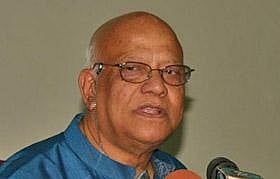
INTERVIEW'No salary issues, inflation will ease'
The finance minister tells Abdur Rahim Harmachi there is no problem with paying the salaries of government employees. >>
bdnews24.com News Service
bdnews24.com
Published :
12 Jan 2012, 07:43 PM
Updated :
09 Aug 2022, 03:17 PM
Abdur Rahim Harmachi
Chief economic correspondent
bdnews24.com
Dhaka, Jan 12 (bdnews24.com) – The finance minister has said there is no problem with paying the salaries of government employees.
"The economy is heading in the right direction, thanks to realistic and timely macroeconomic policies led by the prime minister," A M A Muhith told bdnews24.com on Thursday.
He also said that the inflation was going down due to some measures taken and it can reach an expected level soon.
"We are presenting periodic reports in parliament on the state of the economy," the minister said.
Dhaka Chamber of Commerce and Industries president Asif Ibrahim at a news conference on Sunday claimed the economy was in a tailspin. "If the situation remains so, the government will not be able to pay salaries after four to five months," He said.
Opposition leader Khaleda Zia had also made similar remarks recently. Economists have also been making identical comments.
SALARIES
Regarding the salaries of government officers, the finance minister told bdnews24.com, "The revenue raised by the government from taxes is used not only to pay the salaries of its officers and workers but also to alleviate poverty and for various other development works such as social safety net programmes."
He added that in the past three years the government's total tax revenue was worth Tk 2,332.68 billion. The government spent only Tk 501.27 billion to pay off the salaries of its officials and workers from this.
"The rest of the revenue is used for poverty alleviation, social security programmes and other development schemes," said the minister.
While mentioning the fact that in the current fiscal Tk 216 billion is needed to pay the salaries of government officers and workers, Muhith said, "Up to November Tk 400.19 billion have been raised in taxes."
He said if taxes continued to be realised at the current rate a total of Tk 1180 billion can be raised in the current fiscal.
"In the last three years," he said, "tax generation through internal sources has doubled and the salaries of government workers have risen by 62 percent."
"Therefore, statements like the government shall not be able to pay the salaries of its officers and workers are absolutely baseless and provocative."
INFLATION WILL BE TOLERABLE
The finance minister sought to assure that inflation would soon come down to a reasonable level.
"The global inflation in fuel and food has struck Bangladesh and our neighbouring countries," he said.
"To tackle this problem, the government is cutting costs, reducing subsidies, raising internal revenue, utilising foreign resources, using contractionary monetary policy and reducing import pressure."
He pointed at the increasing influx of remittance and export earnings and said that the foreign reserve will improve as a result.
He brushed off the criticism that the banks were running out of reserves because of excessive government borrowing. ""The internal credit flow grew by Tk 973.31 billion during last year. Of this, credit to the government was Tk 387.02 billion and to the private sector, it was Tk 586.2 billion," he said.
He added that the government borrowing had been falling since December.
DOLLAR PRICES
Regarding the high price of the dollar, the minister said, "The pressure that is being observed in the exchange rate of foreign currency due to the repayment of import prices of capital equipment in the power and other infrastructure sectors is temporary."
"Due to investments directed towards production and increased ability to compete in the export sector, and an upward trend in the flow of remittances the pressure will soon subside and there will be a positive impact on inflation."
Muhith said that short-term foreign loans have been arranged for the money needed to import the excess refined oil (petroleum products).
"The decision to raise the prices of power and fuel products is extremely necessary, timely and far-sighted," he remarked. "In the face of the economic realities this has been a brave step on the government's part. Otherwise, due to a rise in subsidy expenditures there would have been a direct, multi-dimensional and long-term pressure on the inflation.
"Moreover, the way increased subsidies disrupt equality arrangement systems amongst the strata of the beneficiaries in these matter, reduction of subsidies helps to improve those policies of equality. Adjusting the domestic prices of fuel products according to the rise and fall of their prices in the international market is the most logical method to adopt."
"In the last year neighbouring India raised fuel prices eight times," Muhith said. "And we have adjusted prices three times. Even so there is a huge difference between international prices and ours," he added.
"We must remember that increasing subsidies are unacceptable and they greatly encourage inefficiency," he added.
"Under a financial sector reform initiative, Bangladesh Bank has introduced a flexible interest rate policy," Muhith said.
bdnews24.com/arh/sh/bd/2245h