


Published : 18 Oct 2015, 01:05 AM
Updated : 23 Apr 2022, 01:12 PM


Bangladesh’s apex business body, the FBCCI, first mooted the idea of forming an ‘India-Bangladesh Investment Forum’ primarily to draw Indian investments in Bangladesh to narrow down the trade gap.
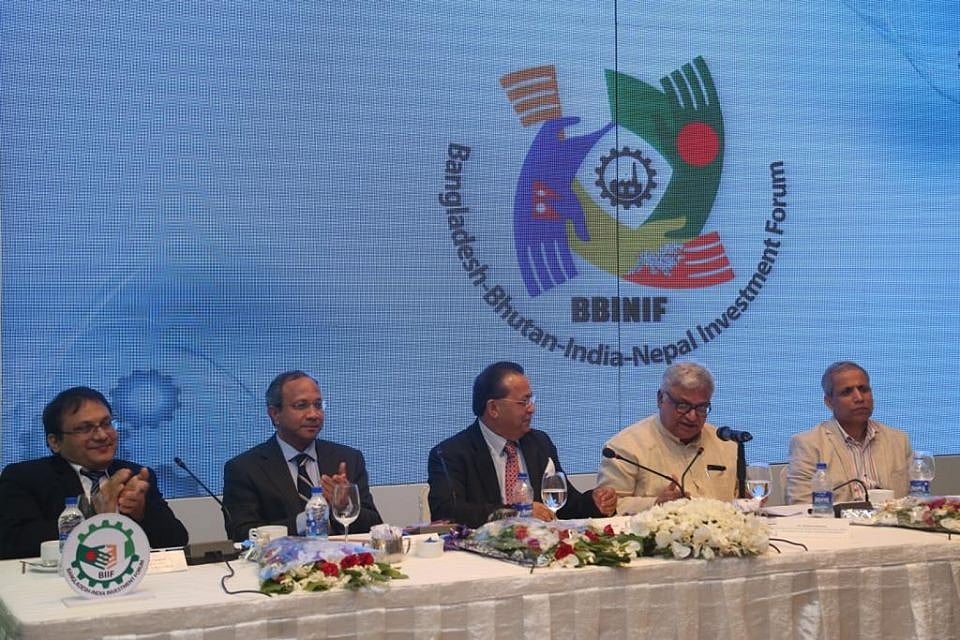
But before the launching on Saturday evening at a Dhaka hotel both Indian and Bangladeshi businessmen agreed to expand the forum by taking on board both Bhutan and Nepal, and named it Bangladesh-Bhutan-India-Nepal (BBIN) Investment Forum.
Prime Minister’s Economic Affairs Adviser Mashiur Rahman, Indian High Commissioner in Dhaka Pankaj Saran, and Deputy Chief of Mission of the Nepalese embassy, Sushil Kumer Lamsal, welcomed the move while speaking at the launch.
FBCCI President Abdul Matlub Ahmad said the idea was “to address the challenges of investors collectively”.
“It’s an independent forum that will have only industrialists as it members and its purpose will be to encourage investment in each other’s country.”
It is not clear how the forum will be run or where the Secretariat will be based.
A form has been distributed among the participating industrialists, mostly Indians and Bangladeshis, to seek forum membership.
Mashiur Rahman, however, said was better to work with chamber houses in all capitals instead of making any secretariat.
Lift investment restriction
The forum has been conceived by India and Bangladesh businesses as the two-way trade is close to $6 billion.
This is heavily tilted in favour India, despite Bangladesh enjoying duty-free and quota-free export regime.
Bringing Indian investment is being seen as a new way of increasing exports, though India itself is an investment-hungry country.
Bangladesh also offers incentives to woo investors. It has a special economic zone for India.
But Bangladesh’s investors cannot, in general, take money out to invest outside the country, a rule adopted to restrict money flight.
Exemptions are granted only “case by case”, a provision that businessmen at the launching ceremony said should be lifted.
“Why is this (limitation to invest outside Bangladesh)?” asked Latifur Rahman, chairman of Transcom Group, “We are still holding on to the 70s and 80s mentality.”
He said Bangladesh’s businessmen should urge their own government to lift the provision.
Delhi’s role is shrinking
High Commissioner Saran said this new forum indicated that Bangladesh’s businesses “want to find a solution to address the trade gap”.
“Once invested, the production can be re-exported to India and other countries,” he said, adding that it was “hard fact” that foreign direct investment helps to grow economy.
He, however, said Indian investors would come only when local businesses consider them as an “opportunity”.
“In India, once FDI was seen as a direct threat to Indian businesses (by businessmen). Today, India has moved to an opposite direction”.
He, however, suggested the Bangladesh’s investors must know the rules of a state where they intend to invest or export.
“Delhi’s role is shrinking. Please pay more attention to the condition at the local level. FDI depends on individual states and conditions vary from one state to another,” he said.
He also suggested that Bangladesh officials sit and talk with different Indian state officials like the High Commissioner himself does in Bangladesh to facilitate trade and investment.













