


Published : 04 Oct 2019, 05:56 PM
Updated : 05 Aug 2022, 05:59 PM


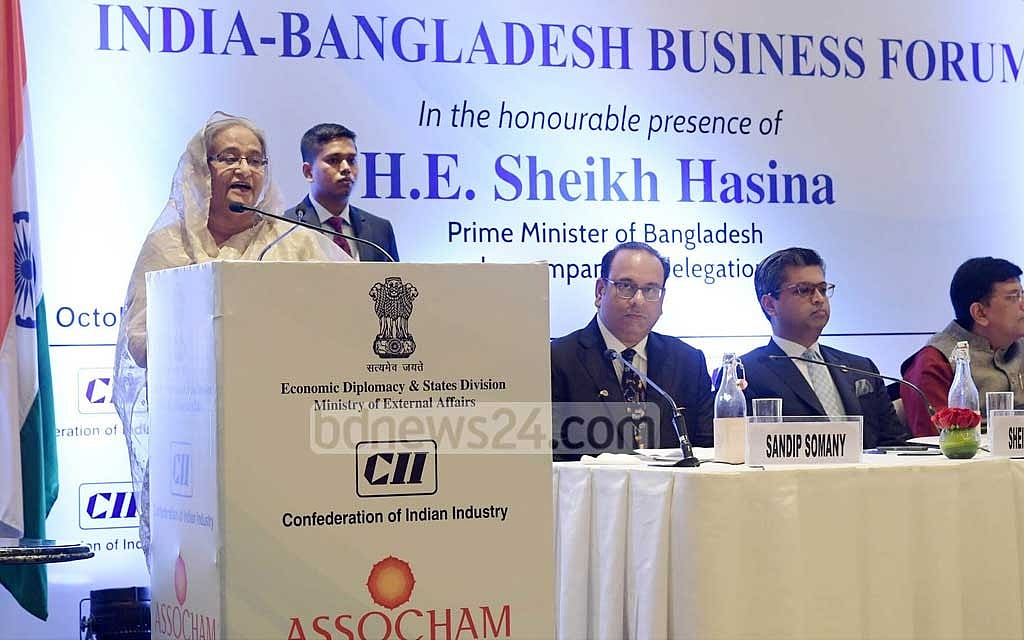
The prime minister made the call during her address to the India-Bangladesh Business Forum in New Delhi on Friday.
“Our relations with India have reached the best ever stage, which Modiji (Indian Prime Minister Narendra Modi) himself has termed as a “Sonali Adhyay” (golden chapter),” said Hasina.
“We are confident that in the coming years, we would further lift our relations to new heights.”
Tracing the roots of the Indo-Bangladesh cooperation back to the Liberation War in 1971, the prime minister said the relations between the countries have been consolidated by the principles of “mutual benefit” and “a shared future”.
Noting that the bilateral cooperation has since encompassed all areas, including security, energy, connectivity, trade and investment, defence, culture and interpersonal contact, Hasina emphasised the importance of trade and investment between neighbouring countries for further economic prosperity.
“In a similar manner, Indian business leaders could play a very big role in furthering our economic prospects and together we would build “Sonar Bangla” or Golden Bangladesh, as dreamt by the Father of our Nation, Bangabandhu Sheikh Mujibur Rahman.”
“That would also be the best tribute we can pay to our martyrs and freedom fighters.”
Bangladesh's economy has gone from strength to strength, reaching a GDP growth of 8.1% last year and predicted to be 8.3% in the current fiscal, said Hasina.
“A projection by Price Waterhouse Coopers tells us that Bangladesh will be the 29th largest economy in the world by 2030. A recent World Bank publication has included Bangladesh in the five fastest growing economies in the world,” the prime minister noted.
“HSBC in its report of 2018 predicts that Bangladesh will be the 26th largest economy becoming one of the three fastest economies of the World by 2030. Asian Development Bank Outlook 2019 mentioned that Bangladesh is the fastest growing economy in the Asia Pacific region.”
These achievements are attributed to strong leadership, good governance, continued political stability and sound macroeconomic policy, underpinned by the government’s “zero tolerance” policy to corruption and terrorism, according to the premier.
“Bangladesh is a progressive, secular democracy with a homogenous population of 162 million. With a large population, young people mostly under the age of 25 are ready to be engaged at very competitive wages.”
Rapid urbanisation fed by increasing consumption of electricity and burgeoning growth of the middle class also indicates the market potential in Bangladesh for investors, according to the prime minister.
Although the volume of bilateral trade has steadily grown over the years, Hasina pointed out that the balance of trade is still largely in India’s favour.
“The volume of trade between two countries is nearly 10 billion dollars. In 2018, Bangladesh was India’s eighth largest export destination with $8.8 billion worth of exports and our export to India also crossed the $1 billion mark for the first time last year,” she said.
“So, the progress is visible, but there is lot of scope for further deepening our relations in the area of trade and investment.”
The Bangladesh leader highlighted “the increasing confidence of the foreign investment in Bangladesh” as evidenced by the persistent growth of global FDI since her government took over in 2009.
She reiterated Bangladesh’s potential to become a regional economic hub due to its “strategic location.”
“With India on the west, China on the north and South-East Asia on the east, Bangladesh is in the middle of a combined market of 4 billion people,” she said.
Hasina also underscored the multitude of investment opportunities in the country, facilitated by the “most liberal investment policy in South Asia”.
“Foreign investment is protected by relevant acts of Parliament and bilateral investment treaties. We are in the process of establishing 100 Special Economic Zones.”
“About a dozen of them are ready with four allotments to three countries. A number of high-tech parks are also ready for technology and innovative enterprises.”
Highlighting three Special Economic Zones for Indian investors at Mongla, Bheramara and Mirsarai, Hasina said, “Substantial investment from Indian investors in these three Indian Economic Zones in Bangladesh would help broaden our exportable base.”
“We also want to see trade and investment together where Indian big investors can set up industries in Bangladesh and export the products to the north-eastern states of India and to the South-East Asian countries taking advantage of the improved connectivity between us.”
SOUTH ASIA'S ONION TEARS
Hasina also drew attention to the plight of the common people in South Asia due to India's ban of onion export.
She urged India to consider the interests of its neighbours and allow them ample time to prepare before taking such a course of action in future.
The prime minister also quipped about the impact of the ban on her own household.
"We are facing a little problem regarding onions. I don't know why you stopped exporting onions! I've told the cook to stop using onions while cooking," she said in Hindi, sparking raucous laughter and applause from the business community.
From Kathmandu to Colombo, onion prices have skyrocketed since India, the world’s biggest seller of the Asian diet staple, banned exports after extended Monsoon downpours delayed harvests and supplies shrivelled.
The price of the commodity doubled in Dhaka, prompting the government to start importing onions from Myanmar, Egypt, Turkey, Pakistan and some other countries to contain the price hike.













