


Published : 09 May 2015, 09:14 PM
Updated : 23 Apr 2022, 12:41 PM


After Tuesday’s ECNEC meeting, several newspapers quoted the prime minister as saying that Muhammad Yunus was responsible for World Bank’s withdrawal of funds for the Padma Bridge project.
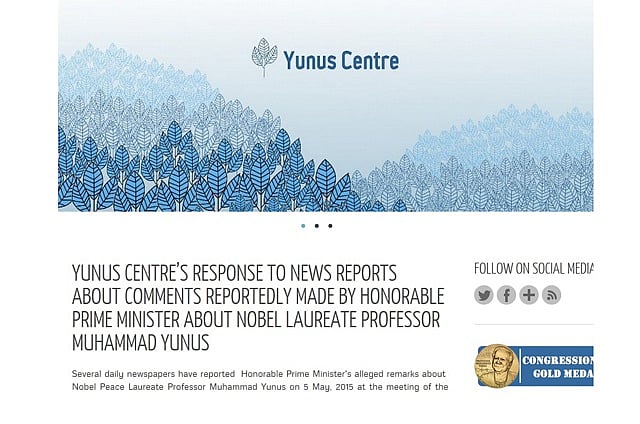
Reacting to the reports, the centre posted a statement on its website on Friday claiming that Muhammad Yunus had nothing to do with the World Bank’s decision.
“Professor Muhammad Yunus had already given a statement, when Honorable PM first made the allegation, stating that Padma Bridge is a dream of the people of Bangladesh, and that he would never stand in the way to realize that dream,” the statement read.
While clarifying its position, the Yunus Centre, however said it hoped that the prime minister did not actually make ‘these comments’.
The reports attributed the comments to prime minister without quoting any source.
The centre said it was reacting to the reports, though their veracity was not established, as they were widely published.
On Wednesday when Planning Minister AHM Mustafa Kamal was asked to react to the reports, he skirted the issue.
“I won’t comment on the prime minister’s remark,” he had said, adding, “Why he (Yunus) is not clearing his position since the controversy is involving him. This controversy has been going on for a long time. Why he is not coming forward to clear his position?”
The reports also quoted the prime minister as saying that the Implementation Monitoring and Evaluation Division (IMED) found widespread irregularities and corruption in Grameen Bank’s associate Grameen Fisheries and Livestock Foundation’s project in Nimgachhi.
The Foundation leased 800 ponds and gave loans to local people at a high interest rate.
The Yunus Centre in its statement said Grameen Fisheries leased the ponds for 25 years in 1986 and handed them over to the government after the deal had ended.
“When the ponds were under its management, the Grameen Fisheries developed those derelict water bodies into fisheries increasing the number of ponds under fish culture from 339 to 615, and fish production from 46 tons to 20,400 tons,” according to the statement.
As per the reports, Prime Minister Hasina told the ECNEC meeting that poor people were trapped in microcredit system and that Grameen Bank charged high interest rates.
To dismiss the allegation, the Yunus Centre pointed out that many impact studies had shown that “microcredit provides opportunities” for poor people to improve their lives “through loans that do not require collateral.”
Grameen Bank’s interest rate was the lowest among all microcredit organisations operating in Bangladesh, the statement further claimed.
“GB is overwhelmingly owned (75 percent) by borrowers. They are majority members of the board. There is no scope for the bank to harm its owners,” it said.
According to the statement, Grameen Bank disbursed Tk 1.1 trillion since its inception.
A ‘major daily’ also reported that the prime minister at the meeting cited an example of a woman who borrowed Tk 5,000 from the Grameen Bank but was asked to pay Tk 16,000.
Refuting the report, the centre said, “This is not possible as Grameen Bank’s rules do not allow total interest to exceed total principal under any circumstances.”
“There are important implications of Honorable Prime Minister’s comments for the country and personally for Professor Yunus. They create wrong impressions in the minds of people within and outside the country,” the statement further said.












