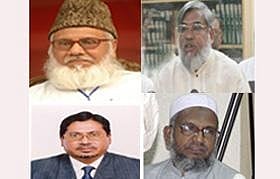
WAR CRIMES Charge against Jamaat leaders on Dec 5
Tribunal fixes next date of hearing for cases against Nizami, Mojaheed, Kamaruzzaman and Kadar Mollah Updates-1
bdnews24.com News Service
bdnews24.com
Published :
01 Nov 2011, 06:48 AM
Updated :
10 Aug 2022, 05:44 PM
Dhaka, Nov 1 (bdnews24.com) — The war crimes tribunal has ordered the prosecution to submit formal charges against four top Jamaat leaders, in prison for alleged involvement in crimes against humanity during the 1971 liberation war, on Dec 5.
In another order on Tuesday, the International Crimes Tribunal rejected a bail petition of Jamaat-e-Islami chief Motiur Rahman Nizami, secretary general Ali Ahsan Mohammad Mojaheed, assistant secretaries general Mohammad Kamaruzzaman and Abdul Kadar Mollah, who are currently behind bars.
They were all present at the courtroom.
Upon submission of the voluminous investigation reports against the four Jamaat leaders and the party's former chief Ghulam Azam, the prosecution's Syed Haider Ali asked for a month's time to bring formal charges.
Haider told the court that the investigations reports established prima facie cases.
The judges inquired how the prosecution would proceed, specifically about the number of charges.
Haider said, "We have not decided about that yet. And we can only decide once we have gone through the reports in further detail."
Tribunal chief, Justice Nizamul Huq asked the counsel whether a month's time that he had asked for would be sufficient.
Tribunal judge A K M Zaheer Ahmed asked for further clarification, "Do you need one month separately for each charge or one month together for all the charges?"
Haider Ali replied that the prosecution needed one month's time for all the cases regardless of their number. "We just need one month for formal charges altogether."
The tribunal chairman fixed Dec 5 for submission.
Defence counsel, Tajul Islam, who also represents Delwar Hossain Sayedee, argued on behalf of the four Jamaat leaders and pleaded for their bail.
He said his clients had been held behind bars since Aug 2, 2010 and still did not know why. Speaking on behalf of his clients he told the court, "I have been imprisoned for 15 months and kept completely in the dark. I don't know what are the charges against me."
He pointed out that the prosecution had only submitted the investigation reports on the day and were yet to bring charges.
Islam also said that the tribunal could consider bail for the accused since it has been over a year that they have been kept behind bars. He also offered that his clients would abide by all kinds of conditions.
"These are respectable people, two of them former ministers, and they are political persons. There is no possibility that they will go into hiding," he said.
Tajul Islam said the court could impose all kinds of restrictions too. "The court have their addresses where they will reside. They will not travel outside, if required they will also submit their passports."
The defence counsel also maintained that his clients, the top Jamaat leaders, were being kept in prison only out of political interests. "My clients belong to a certain party and they believe in a certain ideology. Their imprisonment is only to harass them and ruin their political careers."
Upon the tribunal chief's bidding, chief prosecutor Ghulam Arieff Tipoo sent Haider Ali to counter. Haider said that this was certainly not a case of political victimisation.
He also said bail could not be considered for the four persons given that they were charged with such crimes as murder, rape, extermination and arson. He brushed off the defence plea saying, "We should all try and move ahead with the trial instead of impeding it."
Tajul Islam rebutted saying that the statements of those who formulated the law in 1973 were enough to indicate the spirit of this law. "If you consider what the members of parliament had said at that time it becomes clear that this law is out to harass the accused."
He went on, "Have you brought allegations against those who were really in charge at that time? Have you brought those who actually decided the fate of thousands? The answer is 'no'. You have brought here people, who were merely boys at that time, student leaders."
Tribunal chairman justice Nizamul Huq, however, rejected the bail petition. He said considering that the investigation reports had been submitted and that the prosecution would bring formal charges within a month, the defence plea that the case was not progressing did not quite stand.
The four war crimes accused were brought to court from Dhaka and Narayanganj central jails on 9.30am.
There were 40 witness testimonies in a 411-page report on Nizami, 45 witness testimonies in a 366-page report on Mojaheed, 37 testimonies in the 327-page report on Kamaruzzaman and another 25 in a 385-page report on Kadar Mollah.
The prosecution also submitted the probe report on similar allegations against former Jamaat-e-Islami chief Ghulam Azam.
On Monday, chief coordinator of the tribunal's investigation unit Abdul Hannan Khan said that they have recommended his arrest.
"There are 40 witnesses in the 360-page report on Ghulam Azam and over 400 documents," he said, pointing out that since the alleged crimes were committed 40 years ago, the investigators had collected all kinds of documents available from those times, in addition to witness testimonies.
The investigation unit chief coordinator said he did not want to be questioned by the nation. "They are looking to us. So we did not ask for more time."
Regarding Ghulam Azam, the investigation coordinator said he was the top leader and he had damaged the country in two ways. Firstly by leading the infamous, 'Peace Committees' and secondly by collaborating with the Pakistani Army.
Investigator Matiur Rahman said there was convincing evidence against Ghulam Azam illustrating his guilt. "He led the Peace Committee and was also the chief of Jamaat-e-Islami in [1971]. He gave all the orders."
Hannan drew an analogy from what a chief prosecutor of the Nuremberg Trials had said. Robert H Jackson, a Supreme Court judge of the United States, had apparently told the judges that it was not that Nazi enemies were being brought in to testify against them. The statements from their friends were good enough.
He said the situation is quite similar here too. The Jamaat mouthpiece, the daily Sangram, is good enough to testify against them. Hannan also said that their writings would also testify against the Jamaat leaders.
According to the investigation coordinator, the agency had completed investigations against seven out of a list of 16. "But the investigation will go on during the trial too."
The first war crime charge framing took place on Oct 3 with Jamaat executive committee member Delwar Hossain Sayedee being charged on 20 counts.
Investigation against the four other Jamaat leaders began on Jul 21, 2010. They were shown arrested on Aug 2.
In addition to the four, senior BNP leader Salahuddin Quader Chowdhury and former minister in Ziaur Rahman's cabinet Abdul Alim have also been arrested on similar charges. Alim is on conditional bail for old-age ailments.
bdnews24.com/ta/rn/tk/1501h