Vision beckons the blind!
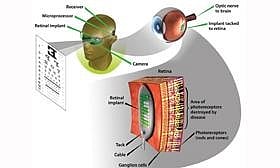
Researchers at Weill Cornell Medical College in New York can make blind mouse retinas see and they're moving as fast as they can to do the same in humans
bdnews24.com News Service
bdnews24.com
Published :
25 Aug 2012, 04:33 AM
Updated :
09 Aug 2022, 04:10 PM
Dhaka, Aug 25 (bdnews24.com)— Two researchers at Weill Cornell Medical College in New York have made a breakthrough that may lead them to develop a device that they hope will allow the blind humans to see.
They have deciphered a mouse's retina's neural code and coupled this information to a novel prosthetic device to restore sight to blind mice, according to Science Daily.
The researchers say they have also cracked the code for a monkey retina -- which is essentially identical to that of a human -- and hope to quickly design and test a device that blind humans can use.
"It's an exciting time. We can make blind mouse retinas see, and we're moving as fast as we can to do the same in humans," the Science Daily quoted the lead researcher Dr Sheila Nirenberg, a computational neuroscientist, as saying.
The study's co-author is Dr Chethan Pandarinath is currently a postdoctoral researcher at Stanford University. He was a graduate student with Dr Nirenberg, a professor in the Department of Physiology and Biophysics and in the Institute for Computational Biomedicine at Weill Cornell.
Any pattern of light falling on to the retina had to be converted into a general code -- a set of equations -- that turns light patterns into patterns of electrical pulses, Dr Nireberg told the Science Daily.
"People have been trying to find the code that does this for simple stimuli, but we knew it had to be generalisable, so that it could work for anything -- faces, landscapes, anything that a person sees," the daily quoted her as saying in an article published on Aug 14.
"This is the first prosthetic that has the potential to provide normal or near-normal vision because it incorporates the code," she explained.
The invention
The eureka moment came when the researchers were working on the code for a different reason, the Science Daily reported.
Dr Nirenberg realised what she was doing could be directly applied to a prosthetic, it said.
She and her student Dr Pandarinath immediately went to work on it and implemented the mathematical equations on a "chip".
They combined it with a mini-projector. The chip, which she calls the "encoder", converts images that come into the eye into streams of electrical impulses, and the mini-projector then converts the electrical impulses into light impulses.
These light pulses then drive the light-sensitive proteins, which have been put in the ganglion cells, to send the code on up to the brain.
The entire approach was tested on a mouse, the Science Daily said.
In a rigorous series of experiments, the researchers found that the patterns produced by the blind retinas in mice closely matched those produced by normal mouse retinas.
Trial needed
Dr Nirenberg said her retinal prosthetic will need to undergo human clinical trials, especially to test safety of the gene therapy component, which delivers the light-sensitive protein, the Science Daily said.
But she anticipated it would be safe since similar gene therapy vectors had been successfully tested for other retinal diseases, it added.
"This has all been thrilling," Dr Nirenberg said. "I can't wait to get started on bringing this approach to patients."
The breakthrough was reported in the Proceedings of the National Academy of Sciences (PNAS), the Science Daily further said.
bdnews24.com/ost/bd/1017h