


Published : 13 Nov 2017, 09:16 PM
Updated : 11 Apr 2022, 09:24 PM


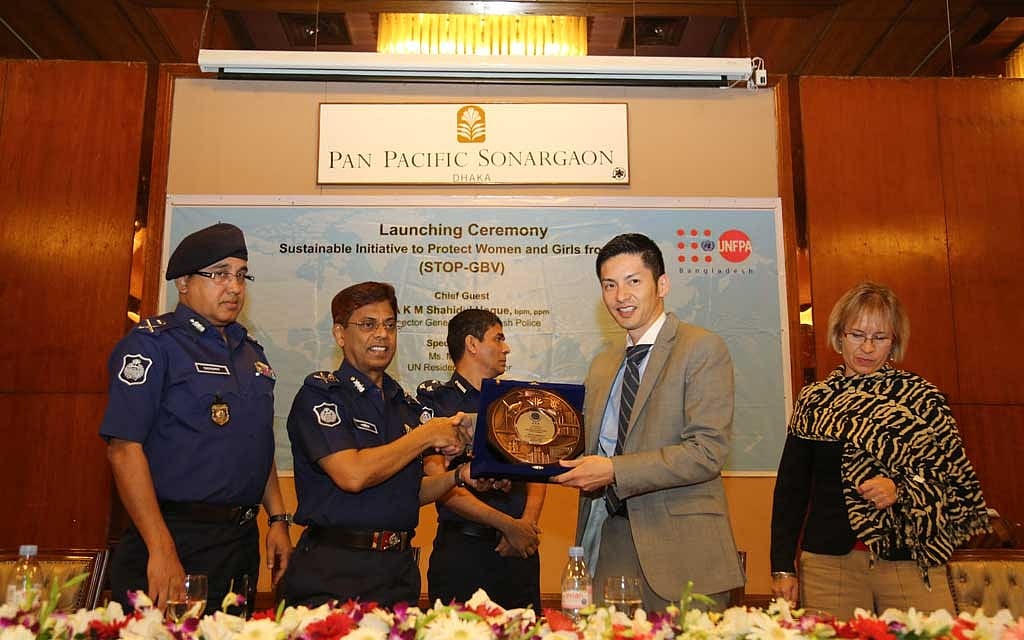
The STOP-GBV project is launched under UNFPA’s new Country Programme for Bangladesh from this year.
This is the first project UNFPA has directly partnered with Bangladesh Police, not through the home ministry. The project will continue until 2020.
“I am aware that gender-based violence cannot disappear overnight. This is a global problem,” UNFPA Bangladesh Acting Representative Iori Kato said at the launching.
“The project will also help the government and people of Bangladesh to achieve Agenda 2030 including the Sustainable Development Goals which contain a specific target on eradicating violence against women and girls,” he said.
Inspector General of Bangladesh Police AKM Shahidul Hoque, UN Resident Coordinator in Bangladesh Mia Seppo, Additional Inspector General Md Mokhlesur Rahman and STOP-GBV project Director AFM Masum Rabbani were also present.
According to the latest national Violence against Women Survey conducted by Bangladesh Bureau of Statistics in 2015, three out of four ever-married women in Bangladesh experienced some form of violence by their husbands.
In the last 12 months before the survey was conducted, one out of four married women suffered from sexual or physical violence.
Among those women and girls who are not yet married, one out of three suffered physical or sexual violence.
But only 2.6 percent of them took legal action after experiencing partner violence because those survivors fear that their dignity, privacy, confidentiality, safety, security and protection from harm or retribution will not be upheld.
“This is how in Bangladesh, unfortunately, still a “culture of silence and impunity” is prevailing,” the Acting Representative said.
“Each of these survivors is somebody’s daughter, somebody’s sister, somebody’s wife, somebody’s mother,” he said.
“No single sector or office can sufficiently address gender-based violence. The two most critical contact points for women and girls to seek support in cases of violence are health services and the police,” he said.
“And this is why UNFPA started partnering with the Ministry of Home Affairs and the Police in Bangladesh back in 1996, to assist the Police in further developing their capacity."
"It also worked to ensure women and girls are able to report cases of violence, treated with confidentiality and dignity, and to guarantee that cases are managed with efficiency and effectiveness.”
With that partnership, Standard Operating Procedure (SOP) to address survivors has been developed.
Bangladesh Police also incorporated Gender Based Violence in police Crime Data Management System (CDMS) in a separate interface.
Moreover, 15 Women Help Desks (WHD) were established in 15 selected police stations in four districts and Dhaka to address those cases.
Community outreach programmes have been carried out to increase the awareness about police services among community people.
“We in UNFPA believe that this new project will help consolidate those excellent achievements from the last phase, and scale it up for the sustainability for the police, also in collaboration with other partners like UNDP,” the UNFPA representative said.













