


Published : 09 Sep 2015, 09:18 PM
Updated : 19 Oct 2022, 06:56 PM


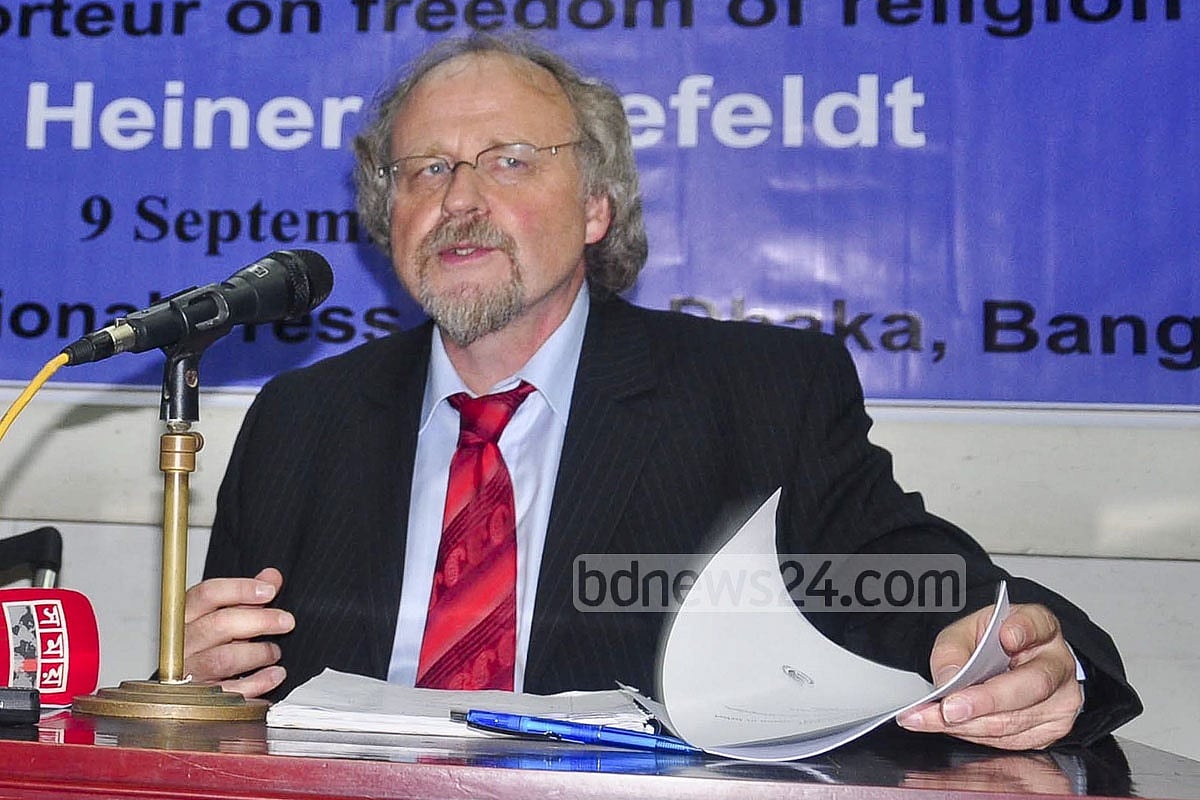
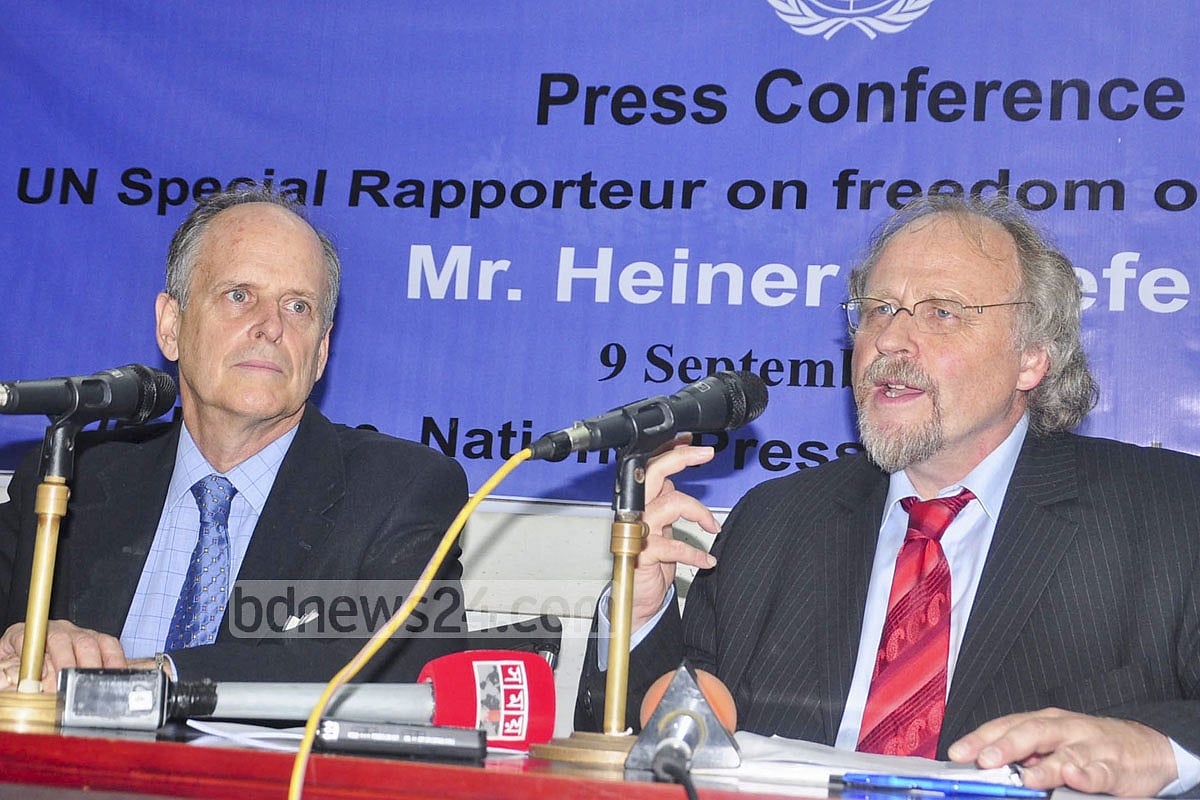
“Inconsistencies can be found at the level of the constitution itself, which, in article 2A, proclaims Islam as the State religion,” Heiner Bielefeldt said at a press briefing on Wednesday before wrapping up his 10-day visit to Bangladesh.
He was the first UN official of that position to visit Bangladesh and assessed the state of freedom of religion or belief after May 2000.
He met government representatives, civil society activists, members of religious communities, and many other interlocutors during his stay.
He would file his final report to the UN human rights council in March next year.
Bielefeldt said the Bangladesh Constitution enshrined the principle of secularism, but at the same time proclaimed Islam as the official State religion.
He believed that it gave “rise to ambiguities that have a direct impact on human rights in the country, including the protection of religious minorities”.
“Secularism in Bangladesh represents a commitment, entrenched in the Constitution, to create and uphold an open and inclusive space for religious diversity, free from fear and discrimination.
“Such an ‘inclusive’ understanding of secularism requires the State authorities to take concrete action and make long-term investments in education, civil society development, minority outreach programmes and other activities,” he said.
He said during his discussions with the government representatives he sensed a general commitment to upholding secularism.
“In practice, however, things are more ambiguous,” he said.
“Even civil society activists who, in principle, agreed with the secular political agenda of the current government have expressed feelings of alienation and frustration,” Bielefeldt said.
The special rapporteur acknowledged the government efforts to improve freedom of religion and belief in the country and noted that specific measures had been taken in favour of religious minorities, who feel themselves under pressure.
However, the UN human rights expert observed “worrying trends towards compromising the principle of secularism, possibly with the intention of appeasing religious militants”.
“For instance, a number of official statements on the recent murders of online activists were ambiguous,” the UN expert said.
“While condemning the threats and acts of violence, government representatives also admonished individuals expressing critical views on religion, asking them not to go ‘too far’ in their criticisms.”
“While trying to fight the ‘instrumentalisation’ of religions, the government itself should refrain from using religion to achieve political goals,” said the independent expert.
He called upon the State authorities to bring the existing norms and practices in line with everyone’s right to freedom of religion or belief and freedom of expression as enshrined in the country’s Constitution.
Bielefeldt is Professor of Human Rights and Human Rights Politics at the University of Erlangen-Nürnberg.
From 2003 to 2009, he was Director of Germany’s National Human Rights Institution.
Bielefeldt’s research interests include interdisciplinary facets of human rights theory and practice, with a focus on freedom of religion or belief.
Bielefeldt said during his discussions with the stakeholders a “broad range of perspectives” emerged, as freedom of religion or belief had “manifold facets”.
He said the most salient was the declining number of Hindus in the country, dropping from 23 percent at the time of independence in 1971 to only 8 percent of the total population at present.
Asked whether he would call it a failure of the government to protect them, the UN expert said, there were “serious short-comings and also systematic short-comings and lack of initiatives to counter-act”.
He said every country was facing religious fundamentalism at this moment, but added violence did not form the essence of religions.
“You (might be abusing religions for political gains or other gains,” he said.
Bielefeldt, however, warned that “if people lose faith in public institutions, police and the judiciary, they may fall back on their small networks.”
“Without public institutions we don’t have public space, public safety”.
Replying to a question, he said, freedom of belief also covers atheists.
He, however, said the killing of bloggers or online activists had nothing to do with atheism, “it’s not the main issue. The agenda may be much broader”.
The UN expert said the ‘shrinking space for civil society’ and the ICT Act were the “main” issues discussed with human rights activists, journalists, academics and independent intellectuals.
“In discussions with religious minority communities, ‘indigenous’ people and civil society organisations, I often sensed feelings of anxiety and insecurity,” he said.
He said such insecurity has different “political, legal and social dimensions which may affect individuals and groups in various ways”.
Bielefeldt also mentioned that one particular issue that added to the general feeling of vulnerability in some communities was religious conversion.













