Tribunal asks Sangram reporters to admit mistake
ICT-1 chairman says news reports should not carry suggestive headlines and directs the Jamaat mouthpiece to carry a corrigendum by Monday
bdnews24.com News Service
bdnews24.com
Published :
23 Sep 2012, 09:22 AM
Updated :
09 Aug 2022, 04:17 PM
Dhaka, Sep 23 (bdnews24.com) — The first war crimes tribunal of Bangladesh on Sunday directed reporters of the Jamaat-e-Islami mouthpiece daily Sangram to have a corrigendum published by Monday admitting their mistake regarding a certain report.
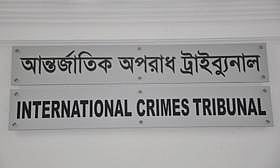
The three-judge International Crimes Tribunal – 1, set up to try crimes against humanity during the 1971 Liberation War, had taken exception regarding one news item covering a the court's proceedings.
The report carried a heading that was indicative of the witness, but was duly denied.
The tribunal had also observed that news reports should not carry suggestive headlines.
The tribunal had asked the reporter in question to be present in the court on Sunday and explain his action.
Addressing members of the press present, the tribunal chairman Justice Mohammad Nizamul Huq said that in a criminal case the lawyers could make any suggestion "as long as it is not insulting, of course."
Similarly the lawyers could suggest that the witness is accused of burglary or fraud, and the witness could then deny it. "This does not mean that the witness was indeed a thief."
Justice Huq said, "But if the heading suggests that witness was indeed guilty, then it is not fair."
"Moreover this tribunal is very touchy. Witnesses appear to be reluctant to come here because there is this threat of embarrassment," Justice Huq observed.
But such headings are also harmful because they do not present the witness' side appropriately.
The tribunal chairman then addressed the two reporters of the Jamaat-e-Islami mouthpiece daily Sangram, and asked Shamsul Arefin whether his reporting had been appropriate.
Currently the entire Jamaat leadership including its former chief, current chief, secretary general and his assistants, are behind bars on charges of war crimes.
The reporter admitted that his reporting was not appropriate and promised that a corrigendum would be published accordingly.
The judge said, "If you have a corrigendum printed by tomorrow with an admission that this wouldn't recur, it will suffice for now."
He indicated that for the time being such a corrigendum would be good enough. "Otherwise the law will take its own course," Justice Huq said.
The first war crimes tribunal saw deposition of two more seizure list witnesses in the case against former Jamaat chief Ghulam Azam.
Both the witnesses were from the Special Branch and submitted police intelligence reports from 1971 as exhibits.
With all the senior defence counsels absent on the day, due to a countrywide general strike called by the Islamist parties, the tribunal asked a junior counsel to take notes.
Justice Huq reassured the young lawyers Abu Bakr Siddique and GM Tamim that they would not be required to cross-examine the witnesses since their seniors were not present.
Before the proceedings began, Siddique explained that there were no private cars running on the streets and as such defence lawyers could not come to the court.
The tribunal had previously ordered the defence lawyers on May 17 to seek security from the prosecution if needed on such days.
Siddique told the tribunal that the judges and the prosecutors came with police security while the journalists could show their passes. "But the defence lawyers do not have that scope."
"Show them your IDs then," said the chairman. "We want to see one such case where the behaviour was not appropriate even after the cards were shown."
Despite the junior counsels' repeated submissions, the court refused to budge and continued with its scheduled proceedings and adjourned just before the lunch break.
bdnews24.com/ta/ano/1521h