



Published : 14 Aug 2015, 02:24 AM
Updated : 08 Aug 2022, 04:56 PM


The Supreme Court made the observations in the judgment on a contempt case against two editors of Bengali daily Janakantha on Thursday.
It said such proceeding could also be drawn for interfering with the administration of justice, or for any attempt to undermine public confidence in the judges and the justice delivery system.
The six-strong Appellate Division bench led by Chief Justice Surendra Kumar Sinha pronounced the verdict holding the newspaper’s Editor Atikullah Khan Masud and Executive Editor Swadesh Roy guilty of contempt of court.
The other members of the bench were justices Md Abdul Wahhab Miah, Nazmun Ara Sultana, Syed Mahmud Hossain, Md Imman Ali and Hasan Foez Siddique.
The verdict said, “All elements of grave contempt of court are present in the impugned article. Mr. Swadesh Roy, the writer and Mr Atiqullah Khan Masud (MA Khan Masud), editor, printer and publisher of the Daily Janakantha are found guilty of contempt. The contempt proceeding succeeds.
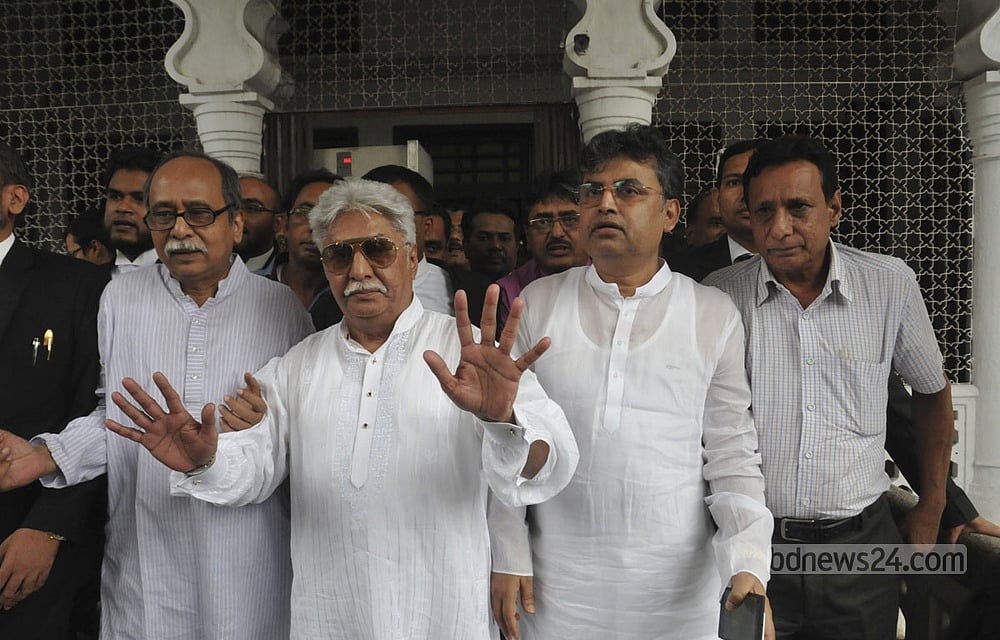
Daily Janakantha Editor Atikullah Khan Masud and Executive Editor Swadesh Roy leave the courtroom on Thursday after the Supreme Court found them guilty of contempt.
Advocate Salahuddin Dolan argued for the respondents while Attorney General Mahbubey Alam represented the petitioner.
Chief Justice Sinha read out the verdict for seven minutes in a crowded courtroom around 10am Thursday.
The two editors came to the courtroom around 9am. They remained in the courtroom until 1:15pm.
The Appellate Division also issued certain guidelines on contempt proceedings.
The judgment
“Since various questions arise in the mind of the people of the country, the litigants, the lawyers, persons in the print, electronic and social media regarding the power of this Court to punish for contempt of Court any citizen of the country, being the highest Court of the country, this Division feels it proper to give some guidelines which will be reflected in our detailed judgment,” it said.
“It is to be borne in mind that the Contempt of Courts Act, 1926, is not applicable in this Division and in that regard we have expressed our opinion in Mahmudur Rahman’s case.
“Even then, in different media, the civil society, including eminent lawyers, participated in various talk shows and pointed out that the Contempt of Courts Act is an obsolete law and it should be amended, meaning thereby, that the said Act is applicable to this Division.”
“At the outset, we would like to point out that though the Parliament is comprised of the People’s representatives and it can promulgate any law, including the amendment of the Constitution, such amendment is circumscribed by certain limitations. Parliament in exercise of its amending power cannot arrogate to itself the role of official liquidator of the Constitution.
“Our Constitution is a controlled Constitution par excellence. All institutions, including the Parliament and the Supreme Court of Bangladesh are merely creatures of the Constitution and none of them is its master.
“The Constitution must continue to be amendable without being alterable in its essentials.”
It pointed out, “Sub-article (2) of Article 7 of the Constitution clearly says: ‘This Constitution is, as the solemn expression of the will of the people, the supreme law of the Republic, and if any other law is inconsistent with this Constitution that other law shall, to the extent of the inconsistency, be void.’”
“Thus, the Parliament may amend the Constitution or promulgate any law but that amendment or law shall be subject to sub-article (2) of Article 7 that such amendment shall be void to the extent of its inconsistency with the Constitution.
“It is only this Court that has been given the authority to decide the issue of the vires of any amendment or enactment. This power has been given upon this Court by the Constitution itself and this power cannot be assumed by any other organ of the State,” it said.
“Article 39 of the Constitution has given freedom of thought and conscience to the citizens of the country but such freedom of thought and conscience is subject to reasonable restrictions imposed by law in the interest of the security of the State, decency or morality or in relation to contempt of Court.
“That is to say, any publication during the pendency of any matter in any Court of law, which tends to interfere with the course of justice in any substantial or real manner by prejudicing the mind of the public against persons concerned in the case before the cause is finally heard, is also contempt.”
“In determining this effect, the intention of the printer or author in the publication is not of any consequence. What we are concerned with is that we should not permit any one to poison the fountain of justice. This would be a grave interference with the administration of justice.”
“Scandalization, to express shortly, includes an attack upon any Judge in his public capacity for, such attack would be calculated to malign the Judge and to lower the authority of the Court over which the Judge performs his judicial function.
“At the same time, it also amounts to interference with course of justice and the proper administration thereof. Criticism of Judges of the highest Court in respect of acts done in their administrative capacity, which contain improper imputation, amounts to contempt.”
“If the Chief Justice is criticized for acts done in his administrative capacity this also amounts to contempt. The criticism should be fair and not made with oblique motive or with the object of maligning the justice delivery system and lowering the majesty of the law and dignity of the Court in the estimation of the public.”
It further said a litigant or judge was not entitled to have any say in the selection of any judge or judges who were to constitute a particular bench.
“It is the Chief Justice of Bangladesh in exercise of powers under Article 107(3) of the Constitution who is to decide such constitution of Benches,” the Appellate Division further pointed out in its verdict.
In the verdict there were also guidelines for the lawyers.
“A lawyer should not forget that his own dignity bas a lawyer obliges him to place before the Court in the traditional language of courtesy that is due to a Court of justice.”
“It is his duty to see that no statement is made to scandalize a Judge or Court by imputing to him motive or judicial dishonesty. He is expected at all times to maintain the dignity of the Court regardless of shortcomings of any individual Judge of the Court.”
It further said, “We are conscious that excessive authority, without liberty is intolerable, but excessive liberty, without authority and without responsibility, soon becomes equally intolerable.”













