


Published : 08 Mar 2016, 12:00 AM
Updated : 08 Aug 2022, 03:36 PM


The verdict has become the talk of the town with the chief justice expressing displeasure with the investigators and prosecutors of the International Crimes Tribunal, and several ministers demanding a rehearing of the appeal.
The five-strong Appellate Division bench led by Chief Justice Surendra Kumar Sinha on Feb 24 had set Mar 8 for the judgment.
Food Minister Qamrul Islam had recently called for a rehearing of the war criminal’s appeal, claiming a comment from Justice Sinha during the hearing had suggested that Mir Quasem’s death penalty might be commuted.
Islam also demanded that a new bench, excluding Chief Justice Surendra Kumar Sinha, should rehear the case.
After his and similar remarks from several others in the government, Attorney General Mahbubey Alam on Sunday urged all to be patient and avoid making controversial remarks on the issue.
After a recently retired High Court judge took over as counsel for Mir Quasem, Ganajagaran Mancha, the movement demanding maximum punishment for all war criminals, alleged that a ‘conspiracy to save the Jamaat leader’ was going on.
The platform also suspects that there is another conspiracy behind the demand for a rehearing.
Announcing a sit-in at Shahbagh crossway on Tuesday morning, the Mancha spokesperson Imran H Sarker declared their activists will stay there until the top appeals court upholds the death sentence.
Following all the ruckus, the apex court's website on Monday read that the appeal is the first case on the cause list of Justice Sinha-led bench for Tuesday.
The four other members of the bench are Justice Syed Mahmud Hossain, Justice Hasan Foez Siddique, Justice Mirza Hussain Haider and Justice Mohammad Bazlur Rahman.
The war crimes tribunal sentenced Mir Quasem, known as the financial backbone of the Jamaat, to death on Nov 2, 2014, for crimes he committed during the 1971 war.
He filed the appeal seeking acquittal on Nov 30 that year.
This is the seventh war crimes case set to be resolved by the Appellate Division.
After the top court wrapped up the hearing on Feb 24, Attorney General Alam had expressed hope that the death penalty would be upheld.
But chief defence counsel Khandker Mahbub Hossain anticipated his client would be acquitted based on the witnesses and evidence presented before court.
Mir Quasem was ordered to hang until death for two charges, after the ICT found him guilty of killing young freedom fighter Jashim Uddin Ahmed along with five unnamed others.
He was also given the maximum punishment on being found guilty for the murders of Ranjit Das and Tuntun Sen.
The Jamaat leader was given total 72 years in prison on eight other charges, too.
Under his command, local collaborators of Pakistan Army let loose a reign of terror to suppress the freedom struggle of Bengalis in Chittagong in 1971.
He pumped billions into the Jamaat since the mid-1980s to put it on a firm financial footing in Bangladesh.
Mir Quasem is said to have been the third man in vigilante militia Al-Badr’s command structure during the war.
The ICT in the verdict had described Dalim Hotel in Chittagong, where pro-liberation people were tortured and killed under Mir Quasem’s leadership, as the ‘death factory'.
It observed that Al-Badr members and Pakistani troops would take freedom fighters to Dalim Hotel to torture them until they were dead.
“It has been proved that the accused Mir Quasem Ali had been in steering and guiding position of the AB (Al-Badr) force headquartered at Dalim Hotel which was a ‘death-factory’ indeed,” it added.
Apart from Dalim Hotel, the Al-Badr, under his leadership, had set up camps for torture and killings at Dowsta Mohammad Panjabee Building - a leather depot at Asadganj, Dewan Hotel in Dewanhat area and Salma Manjil at Panchlaish.
The charges and sentences
Among 14 of the charges, the tribunal passed the death sentence with regard to two partially proven charges.
Eight other charges had also been proved. He was given total 72-year prison term for these charges.
Mir Quasem was sentenced to death by hanging on the charge of abduction and ordering the killing of freedom fighter Jashim on Nov 8, 1971. The young fighter’s body along with five other unknown dead was thrown into the Karnaphuli river.
The other charge for which Mir Quasem got death sentence was killing of Ranjit Das alias 'Lathu' and Tuntun Sen alias Raju at Chittagong’s Hindu-populated Hazari Lane.
He was given different terms in prison on charges of torturing Lutfar Rahman Faruk and ‘Seraj’, Jahangir Alam Chowdhury, Saifuddin Khan, Harun-or-Rashid Khan, Md Sanaullah Chowdhury, Habibur Rahman and 'Elias', Nuruzzaman and his six cousins, Md Zakaria, Md Salahuddin alias Chuttu Miah, Iskadner Alam Chowdhury, Md Nazim Uddin, Nasiruddin Chowdhury and several others.
The arguments
After the hearing ended, Attorney General Alam had said the defence did not deny that incidents of torture took place at Dalim Hotel.
The defence's main argument was that Mir Quasem was in Dhaka on the days of the incidents of murders and tortures, he said.
"But his sister said as a witness that Mir Quasem was in Comilla with their father. So their plea of alibi was not proved," he said.
Mir Quasem's lawyer Khandker Mahbub had said the convict was Chittagong Islami Chhatra Sangha general secretary from the beginning of 1971.
"But the charges over the incidents after November appeared suddenly to belittle him. There is no direct evidence," he claimed.
He had also claimed the defence proved from prosecution documents that Mir Quasem was in Dhaka during the incidents.
From Al-Badr to Jamaat hierarchy
Mir Quasem, a wartime terror of Chittagong, had gradually left the mark of his shrewdness in both politics and finance as he turned into the Jamaat’s financial backbone after becoming a key player in the party’s top brass.
He had also received government help after the Jamaat was rehabilitated during military dictator Gen Ziaur Rahman’s regime.
Born in Manikganj's Harirampur in December 1952, he was better known as 'Mintu' to the people of Chittagong during the war.
After passing matriculation from Chittagong Collegiate School in 1967, Mir Quasem enrolled at Chittagong College and passed the intermediate exams two years later.
In 1970, he became the president of the Islami Chhatra Sangha’s Chittagong College unit. The ICS was the erstwhile student wing of the Jamaat.
Up until Nov 6, 1971, he was the president of Chittagong ICS and the head of Al-Badr in the port city.
He was elected a member of the Pakistan Islami Chhatra Sangha’s provincial working council the next day and also made the general secretary of its East Pakistan wing during the war.
Another war crimes convict, Jamaat leader Ali Ahsan Mohammad Mujahid was the ICS president at the time.
Mir Quasem had played a leading role in the crimes against humanity that was rampant in Chittagong region in 1971 as a central commander of Al-Badr, Al-Shams and Razakar.
It is also said that he had ordered the massacre and murder at the Razakar camps there.
The Jamaat leader went into hiding after the Pakistan Army surrendered on Dec 16.
He became the founding president of the Islami Chhatra Shibir, a rechristened Chhatra Sangha, on Feb 6, 1977, two years after Gen Zia gave the Jamaat a chance to join politics again.
Mir Quasem was the convenor of NGO Rabita al-Alam al-Islami’s Bangladesh chapter when he started playing some role in Jamaat’s politics in 1980. He later went on to become the NGO’s director.
He was a former vice-chairman of Islami Bank Bangladesh Limited and chairman of the Diganta Media Corporation, believed to be pro-Jamaat.
He is also the founder of Ibn Sina Trust and a founding member of Islami Bank Foundation.
He became an executive council member of the Jamaat in 1985.
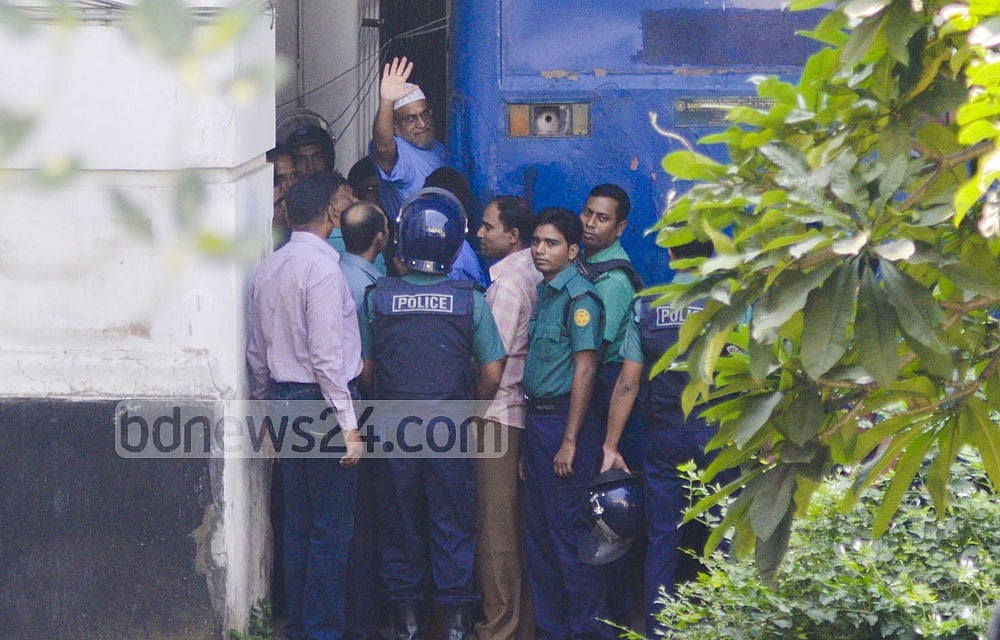
Police arrested Mir Quasem on Jun 17, 2013, from the offices of newspaper Naya Diganta less than two hours after the tribunal issued a warrant for his arrest.













