


Published : 07 Mar 2018, 11:51 AM
Updated : 19 Oct 2022, 02:08 PM


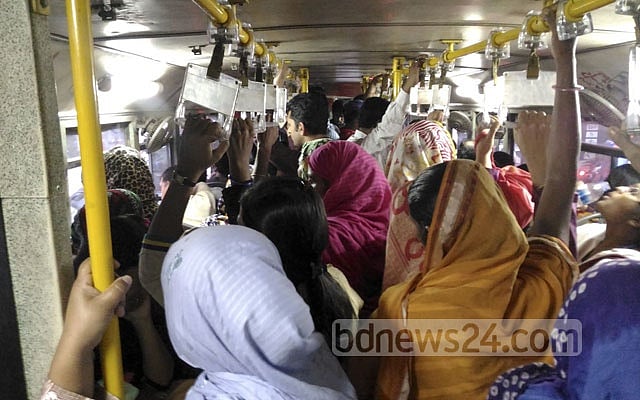
Some of the causes pointed out in the study are crowded and shady vehicles, and lack of monitoring and implementation of the law.
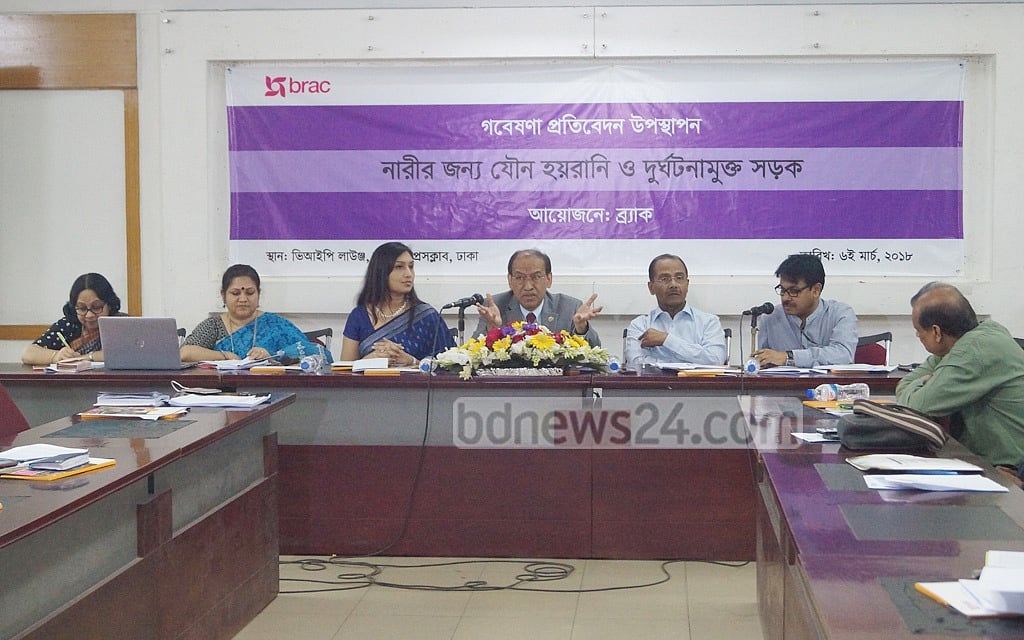
Research Associate Kabita Chowdhury and Hasne Begum, programme manager for Gender, Justice and Diversity at BRAC, presented the study at the National Press Club on Tuesday.
The study, Safe Roads for Women: Reducing Sexual Harassment, was conducted on 357 women between April and June 2017.
Students, working women, housewives who regularly use public transports in Motijheel, Mohakhali, Banani, Mirpur, Kalyapur, Gazipur, Birulia Union in Savar were surveyed.
A total of 29 male commuters, drivers and helpers were also interviewed.
Seventy-four percent of the women said they endured sexual harassment while commuting by bus, human haulier (locally known as tempo) and CNG autorickshaw.
Of the women in the survey, 26 percent said they face the harassment while walking down the streets.
Up to 66 percent said the perpetrators were men aged between 41 and 60.
“As much as 68 percent of women said they were verbally harassed. They faced obscene words,” Hasne Begum said.
According to the survey, 81 percent of the respondents said men stared at them in inappropriate manner. “This is something that women of all ages have faced,” she said.
The survey found that 81 percent women remained silent when being subjected to the harassment.
“They do so because there is nothing else to be done. Seventy-nine percent leave the scene, 55 percent try to point out the offence to the offender and 14 percent fight back physically,” said Hasne Begum.
The study has revealed that 46 percent of the women use hijabs as a safeguard against harassment.
Forty percent said they suffered road accidents at least once in their lifetime.
Hasne Begum said: “68 percent blamed daring driving, 13 percent said they got hurt while getting down from running vehicles and 25 percent pointed out untrained drivers as a cause.”
The study suggests boosting up advocacy and spreading awareness through youth, teachers, media workers, transport workers, and law enforcers. It also stresses raising capacity of law enforcers.
BRAC recommends measures from the policymaking level to train transport workers, ensure monitoring, and brief commuters on respect for women.
“The government talks about women’s participation in education and economic activity. But it is a risky deal, not only for women but the whole nation, if woman still need to think about sexual harassment every time they get out of home,” said Habibur Rahman, head of programme, Gender, Justice and Diversity at BRAC.
He suggested bringing in more female drivers on board to create gender balance and increase awareness. Also, the government must chalk out a policy to define code of conduct towards women in public transports, he noted.
BRAC University Vice-Chancellor Syed Saad Andaleeb and Ahmed Najmul Hussain, director of the road safety programme at BRAC, spoke at the event hosted by Nishat Sultana, coordinator for BRAC’s Gender, Justice and Diversity programme.













