Stronger shrimp sector holds 'big boost for Bangladesh economy'
A stronger shrimp sector with international standard quality and safety procedures could provide a big boost for Bangladesh economy, FAO country representative Ad Spijkers said following recent visits to the southern coastal areas of Khulna, Barisal and Cox's Bazar.
bdnews24.com News Service
bdnews24.com
Published :
11 Aug 2009, 06:10 AM
Updated :
12 Aug 2022, 01:36 PM
Dhaka, Aug 12 (bdnews24.com)—A stronger shrimp sector with international standard quality and safety procedures could provide a big boost for Bangladesh economy, FAO country representative Ad Spijkers said following recent visits to the southern coastal areas of Khulna, Barisal and Cox's Bazar.
Presently about 50,000 Black Tigers Shrimps are produced annually most of which are exported to the EU, USA and Japan.
Bangladesh has adopted a millennium action plan to increase earning (expected to earn US$1.5 billion by 2010) from this sector by tripling its present production to introduce a shrimp seed certification system in the form of public-private partnership in the country though joint efforts between the department of fisheries under the ministry of fisheries and livestock and FAO, Spijkers said in a statement on Monday.
Brackish water aquaculture especially shrimp aquaculture is the third largest foreign currency earning sector of Bangladesh, after manpower and garments, on which more than a million coastal rural people depend for their livelihood.
Black Tiger Shrimp is the main culture species of coastal shrimp farming contribute about 60 percent of the cultivable species.
FAO is providing support through a Technical Cooperation Project (TCP)—"Developing a National Shrimp Certification System".
The main objective of the assistance is to develop and promote a government and private sector based participatory programme of shrimp brood stock (mother shrimp) management and seed certification facility for the department of fisheries in collaboration with the private sector in Cox's Bazar.
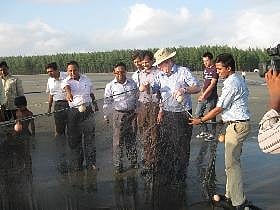
An FAO field mission, led by country head Spijkers, visited the on-going activities of the project and the leading hatcheries that are playing very important rile for shrimp seed production.
The visit from Aug 8-10, explored the potentials and risks of the sector and its future prospects.
Spijkers emphasized on ensuring the quality of the shrimps for the international market and also on Standard Operating Procedures (SoP) that could increase the potentials and yield of approximately 218,000 hectres of coastal tidal lands of Bangladesh that are presently used for shrimp cultivation.
His visit was also timed to coincide with the programmes of the just concluded National Fisheries Week.
bdnews24.com/rah/1223h