


Published : 17 May 2014, 02:34 PM
Updated : 08 Aug 2022, 06:46 PM


The relationship had often been described “at its best” in the last five years when Delhi provided a $ 800 million line of credit and $200 million in grants to Dhaka.
That was touted as a major component of the emerging bilateral relations.
It was the largest ever one-time assistance offered by India to any country ever.
According to the Indian High Commission in Dhaka, 15 projects had been approved so far and they will use up $751.95 million of the credit.
The remaining nearly $50 million will be used for the extension of the Khulna-Mongla railway link.
Dhaka has already received $150 million in grants in three tranches -- only $50 million more will come in another tranche.
The line of credit agreement signed initially was pegged at $1 billion in 2010, but later India converted $200 million of them into grants.
The interest rate was initially fixed at 1.75 percent, but later was brought down to 1 percent.
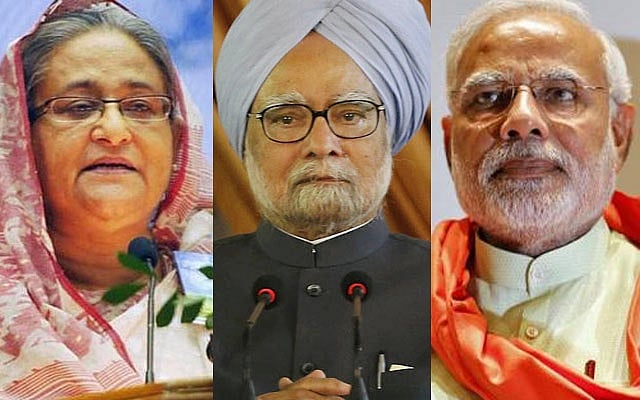
The deal has been signed following Prime Minister Hasina’s visit to India in 2010, followed by Manmohan Singh’s visit in 2011.
Five projects were completed while six were under execution, three under tender and one was awaiting tender, according to Indian High Commission in Dhaka.
Twelve of these projects worth $704.11 million were for developing the railways, which was unfortunately targeted severely during the pre-poll violence last year.
290 double-decker buses, 88 single-decker buses and 50articulated buses have been delivered by June last year worth $36.85 million to improve Bangladesh's road transport.
Bangladesh also received the delivery of 180 bogie oil tank wagons and six brake vans last year in May using $17.38 million credit.
Indian High Commissioner in Dhaka Pankaj Saran had earlier said that India’s foreign policy would not change with the change of regime, allaying Dhaka’s concerns.
He had also said that the relationship with the Awami League and India had ‘a historical context’, referring to the 1971 war of independence, though he said India always deals with the government of the day.
The Awami League was in the forefront of Bangladesh’s Liberation War and its leaders have wide contacts in India.
On eve of a regime change in India, foreign minister Abul Hasan Mahmood Ali said on Friday that India-Bangladesh relations had “withstood the test of time” and become “increasingly interlinked”.
“The engagement is intense at all levels, from highest political leadership to officials down to common people,” he had said.
Also Read:
India deals with govt of dayAlso Read:
Modi for 'good relations' with DhakaAlso Read:
The last advice












