S Asia becoming 'centre of gravity' for terrorism: experts
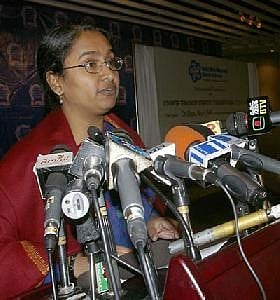
A two-day counter-terrorism conference began in the city Tuesday, on concerns that South Asia has become the "centre of gravity for terrorism".
bdnews24.com News Service
bdnews24.com
Published :
24 Feb 2009, 09:49 AM
Updated :
12 Aug 2022, 12:40 PM
Dhaka, Feb 24 (bdnews24.com)—A two-day counter-terrorism conference began in the city Tuesday, on concerns that South Asia has become the "centre of gravity for terrorism".
"It is very unfortunate that there is such low-level of cooperation among South Asian countries in this regard," foreign minister Dipu Moni told the opening session of the international meeting.
Experts from six South Asian countries, the USA, Canada, Germany, Norway, Spain, Australia, and Singapore were attending the event in the backdrop of Bangladesh's campaign for a regional anti-terrorism task force.
Dipu Moni affirmed the present government's plan to work closely with partners in the region and beyond to counter terrorism and militancy.
She also stressed that it was not productive to point the finger at any particular religion for harbouring terrorism.
Speaking to newsmen later, Dipu Moni said there was no framework or timeline yet for the planned regional task force. "It is still at an 'idea' stage."
She, however, added that they had received positive responses from the neighbouring states.
"The issue may come up in the upcoming foreign ministers' conference in Colombo," she said.
The conference on 'Counter Terrorism Strategy for South Asia' was being hosted by Bangladesh Institute of Peace and Strategic Studies, at the Radisson Water Garden Hotel.
BIPSS head ANM Muniruzzaman warned that South Asia was now "the epicentre for global terrorism".
"The long history of enmity and unresolved issues … between the nations has caused this," he said.
He also said that the current level of terrorist activity in Bangladesh gives signs of "radicalisation".
The opening session's key-note presenter Laila Bokhari focused on the importance of "de-radicalisation and rehabilitation of religious terrorists".
Bokhari, a research fellow at the Norwegian Institute of International Affairs, said terrorism has changed considerably since 2001, with much more radicalisation
and recruitment occurring through the Internet.
"Operational planning is also happening at a local level rather than being centralised and controlled by a recognised leadership."
Several states have already begun to develop programmes to counter the appeal of militancy, changing attitudes and bringing repentant terrorists back into society, said Bokhari.
"These programmes are increasingly seen as essential elements of an integrated counter-terrorism strategy."
She however, added in almost all cases it is still too early to judge their long-term impact.
Touching on the mechanisms of such initiatives targeting detained terrorists, she emphasised the role of "go-betweens" such as family members and local religious leaders that could influence the terrorists' thinking.
"Most importantly, there should be social measures like facilitating economic and social reintegration of repentant terrorists and some form of continued monitoring to avoid recidivism", added Bokhari.
The inaugural session attended by foreign envoys, former and present ambassadors.
The conference will hear 12 papers presented by experts from South Asian countries and three more from Singapore, Spain and Norway.
The topics include militancy and terrorism in Federally Administered Tribal Areas of Pakistan, Maoist insurgency in India and Nepal and activities of the banned militant outfit Jama'atul Mujahideen in Bangladesh.
The event will also host sideline-meetings between country delegations and experts.
The South Asian Regional Research Forum, a network on security and strategic issues launched by BIPSS in Dhaka last October, is also joining in the conference.
bdnews24.com/rhn/rah/1519hours