


Published : 08 Jul 2021, 09:36 PM
Updated : 08 Apr 2022, 01:03 PM


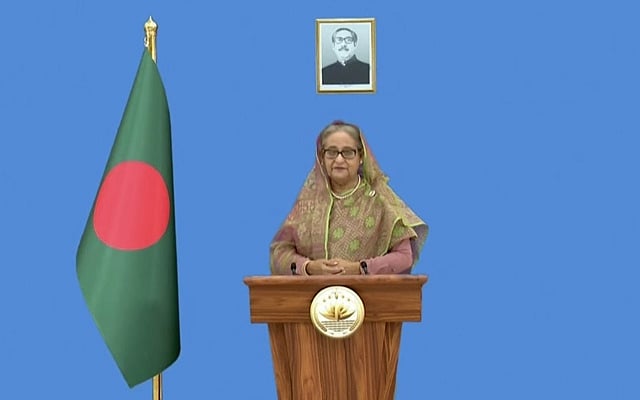
This was among five proposals she placed in her opening remarks as the president of the Climate Vulnerable Forum at the first Climate Vulnerable Finance Summit hosted virtually by Bangladesh on Thursday.
Financial support is needed to introduce smart insurance premium subsidies and the capitalisation of insurance products for the countries vulnerable to the effects of climate change, she said.
The prime minister said every country must pursue an ambitious target to curb greenhouse gas emissions to keep global temperature-rise below 1.5ºC.
Developed nations should facilitate the green recovery of the countries in the Vulnerable Twenty Group of Ministers of Finance of the Climate Vulnerable Forum with dedicated support to reduce the cost of capital and encourage private sector participation, she said.
“Flow of funds must be predictable, balanced, innovative and incremental. Development partners and international financial institutions should adopt a user-friendly process of fund allocation and disbursement. There must be synergies amongst various climate funds.”
Finally, Hasina said, every vulnerable country may actively consider adopting a 'climate prosperity plan' like Bangladesh’s 'Mujib Climate Prosperity Plan.'
“I request the international community to provide all out support to realise our plans.”
“Our planet Earth is in a dire state threatening our very existence. We must be sensible in our actions,” remarked the president of CVF.
“Let us work together to build a strong climate resilience world. I would like to urge the finance ministers, development partners, international financial institutions, and multi-lateral development banks to find out innovative financing solutions for climate prosperity,” she added.
Hasina noted that the 48 countries under CVF-V20 account for only five percent of the total global emission, but they are the worst victims of the man-made crisis.
In addition, she said, the ongoing COVID-19 pandemic has added new miseries claiming lives and affecting livelihoods of millions.
“At this critical juncture of human history, we must forge unity and extend cooperation to face the ongoing and future crises.”
“The world community should recognize the vulnerability of our people, our common aspirations, the need for technology transfer, and additional funding to tackle the impacts of climate change and the Covid-19 pandemic. The international community and the developed countries should play their historical responsibilities and, their moral and legal obligations.”
According to the Climate Risk Index 2020, Bangladesh is ranked seventh among the worst victims of climate change.
The COVID-19 pandemic and, prolonged floods and the Cyclone Amphan in 2020 took a heavy toll on the lives and livelihoods of millions in Bangladesh.
But the country is a global leader in disaster management, adaptation and mitigation measures, the prime minister said, describing steps taken by her government to tackle the climate change crisis.













