


Published : 15 Dec 2015, 03:19 PM
Updated : 19 Oct 2022, 07:05 PM


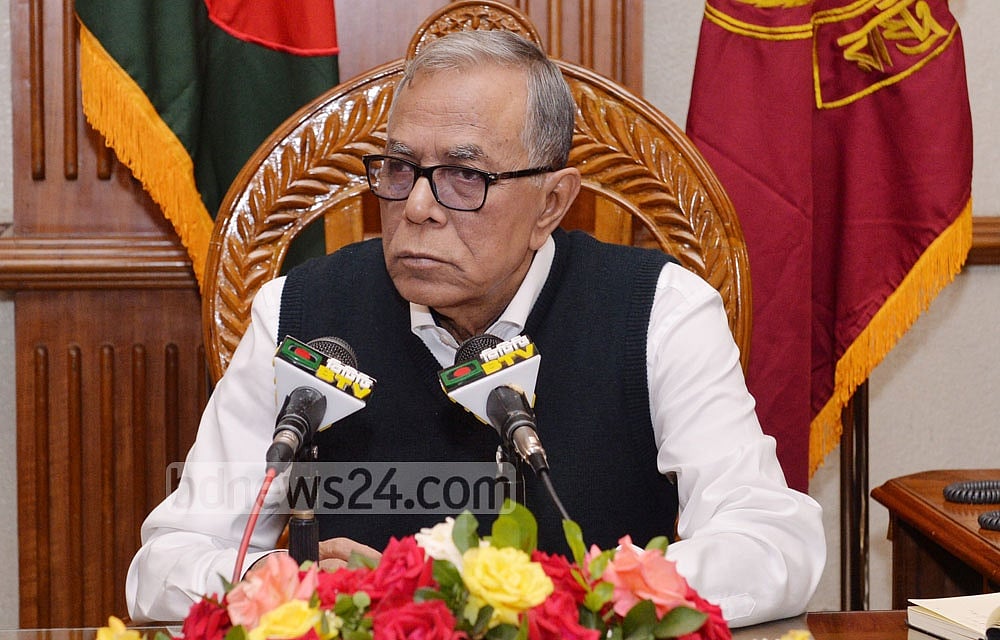
Now Tayebuddin’s son Md Abdul Hamid is president of Bangladesh.
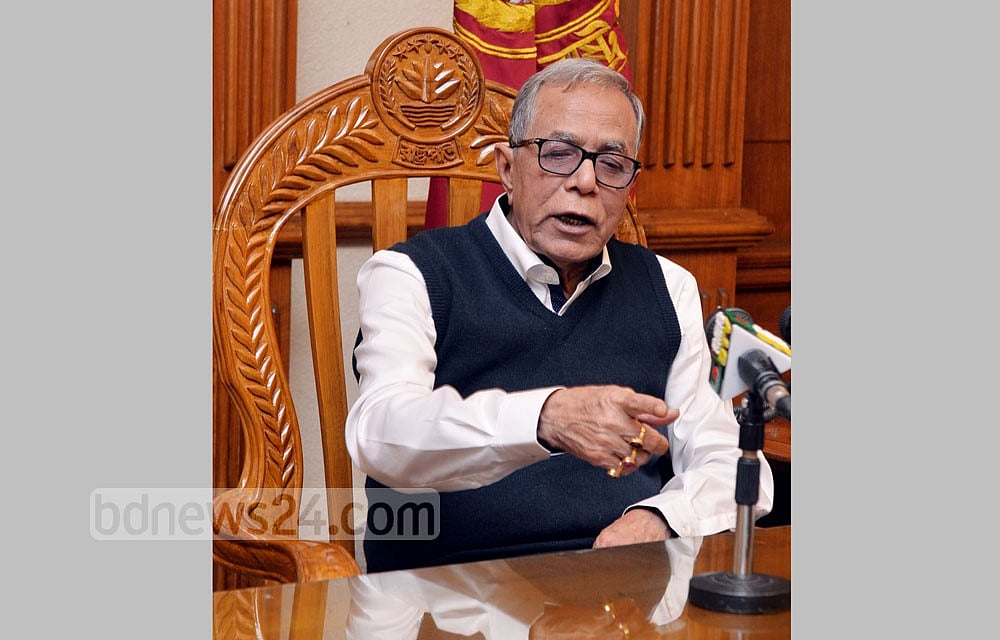
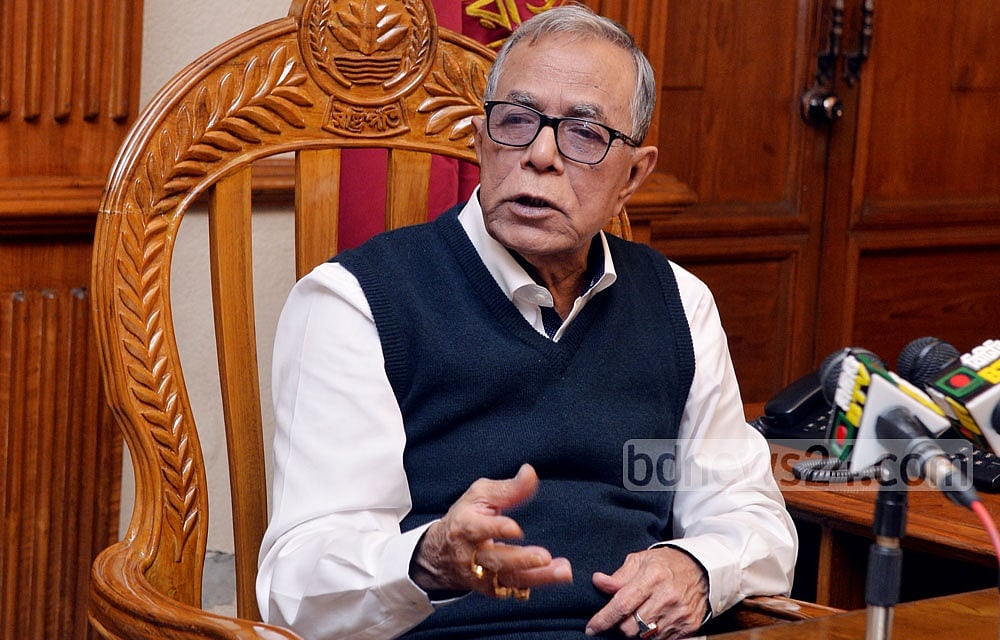
In an interview with bdnews24.com (three other mediapersons were present as well), President Hamid, on the eve of the 'Victory Day', recalled his days as a student leader, a liberation war organiser and a politician.
He was twice elected Speaker of the Bangladesh Parliament and never lost an election since winning a seat in the Pakistan national assembly in the historic 1970 elections.
Seventy-two-year old Abdul Hamid joined the Chhatra League while still in school and he participated in the Education Movement of 1962.
He was first arrested on Dec 31, 1962, while trying to disrupt a rally in Kishoreganj that was to be addressed by Pakistan’s acting President Fazlul Quader Chowdhury (Salauddin Quader Chowdhury’s father).
When the Liberation War erupted, he turned up at a camp of freedom fighters in Agartala. Hamid was sub-sector commander of the Bangladesh Liberation Force (Mujib Bahini) for the Kishoreganj-Sunamganj zone.
He was honoured with the Independence Medal in 2013 for his contributions during the Liberation War.
“My father took shelter in India with many others from the village. He returned home in Nov 1971, a month before Bangladesh became independent. He was dragged to the Razakar camp and tortured. He died on his return home,” President Hamid recalls with deep regret.
Excerpts from the Interview:
bdnews24.com: What inspired you to join the Liberation War? Any specific incident?
Abdul Hamid: I joined the Chhatra League as a school student in 1959. On completing school, I joined college in 1961 and participated in the Education Movement in 1962. When Bangabandhu called for an agitation to secure the 6-point demand for autonomy in 1966, the students had already started talking of independence. Student leaders like me had started saying ‘either 6 points’ or ‘one point’, meaning independence. We would say that in our speeches. The Awami League was not yet saying that, but whenever they allowed a student leader like me to talk, we would allude to independence. The demand for autonomy was slowly graduating to a movement for independence.
bdnews24.com: When did you first meet Bangabandhu?
Abdul Hamid: In 1964. I was a district level student leader and had no contact with the Awami League’s central leadership. Bangabandhu was to address a party meeting in a cinema hall in Kishoreganj. Local Awami League leaders told us that students would not be allowed into the party meeting. Nowadays, this might not work and students may forcibly enter the venue. But in those days, the directive of the party leadership was sacrosanct. So we did not enter the party meeting addressed by Bangabandhu, but I waited outside the venue together with another 200-250 students. When Bangabandhu emerged from the meeting, I walked up to him and introduced myself as the Chhatra League president of Kishoreganj.
Bangabandhu’s personality was inspiring and his enthusiasm was infectious. He told us that students were the lifeblood of his movement. He patted me on the back and blessed many students, placing his hand on their heads. We were impressed with his warmth. We stood there talking for 15-20 minutes only, but I will remember the meeting for the rest of my life.
bdnews24.com: You were talking of the preparations for the Liberation War...
Abdul Hamid: I was elected to the Pakistan National assembly in the historic 1970 elections. The Awami League swept the polls in East Pakistan. We wrested almost all the seats in both the national Parliament and the regional council. The Parliament was supposed to convene on March 3. But Pakistan’s President Yayha Khan suddenly put off the Parliament session in a speech delivered around 1 o’clock in the afternoon. I had come to Dhaka for the oath after the elections. In a mass oath ceremony at Dhaka’s Race Course, we pledged to continue the struggle for autonomy. Then I returned to Kishoreganj and came back for the Parliament session. Some 10-12 MNAs from West Pakistan had also arrived.
With the Parliament session abruptly adjourned, Bangabandhu organised a press conference at Hotel Purbani and the party MNAs were called. I don’t remember the exact date. Already thousands of people armed with sticks had taken out processions. Bangabandhu addressed the conference and then spoke to us individually. He called me aside and told me to rush back to Kishoreganj immediately. The train had left, but he insisted that I depart as soon as possible. On March 17, I finally organised a meeting at Rathkhola field in Kishoreganj, where the Pakistan flag was pulled down and the flag of Bangladesh was raised.
bdnews24.com: Where were you during the historic March 7 speech?
Abdul Hamid: Bangabandhu had asked only those who were around Dhaka to attend the rally, considering the problems of travelling from distant areas. I did not come to Dhaka that day. I was waiting to listen to him live on radio. But it was not aired. In the evening, we heard about the speech from Debdulal Bandyopadhyay from Kolkata and the BBC. East Pakistan Radio broadcast the speech the following day. In the speech, Bangabandhu categorically said, “It is my instructions that will have to be followed from now on.”
bdnews24.com: How did you come to know about the declaration of independence?
Abdul Hamid: I was an MNA (member of the national assembly). I received a telegram from Bangabandhu. “We have declared independence. We will not stop the struggle as long as even one of us, the Bengalees, is alive. We have to win this fight.” The message in Bengali contained something to the effect. I had it with me for a long time. I am not sure if I can find it now. The MNAs received it.
bdnews24.com: When did you get the message?
Abdul Hamid: The message was issued on March 25 and I got it on the 26th. I had no war experience. I ordered machetes, sticks and swords from the blacksmiths. I had 50-60 swords and machetes and 500-700 Molotov cocktails made. We planned to attack the Pakistani army from the rooftops of the buildings if they came.
One of us – Jahangir -- was a captain in the army. He came to Kishoreganj. Then came Major Shafiullah, who later became the army chief of independent Bangladesh.
bdnews24.com: There was perhaps an incident of bank heist…
Abdul Hamid: That was on April 6-7. The National Bank of Pakistan had three branches: one in Kishoreganj, another in Bajitpur and the other in Bhairab Bazar. There was Tk 117.88 million in the three branches. We were asked to go to Brahmanbarhia with the money. They said a liberated zone had been created there and the money was needed. We were confused and worried. What if somebody came to rob us?
Then they said two of the MNAs or MPAs (members of provincial assembly) would have to go. Any two. But no one was coming forward. Then that army officer said, “Are you scared?” I volunteered for the job. I would have to go to prove that we were not scared. There was a boy named Sagir with me. A freedom fighter. He too went with me. We took a .22 bore rifle and the bags of money with us. After we deposited the money at a bank in Brahmanbarhia, the soldiers went away.
I spent April 8 at the Zila Parishad bungalow. In the meantime, I received the news that some MNAs and MPAs from Chittagong, Comilla and Noakhali had gone to Agartala (in India). I too thought of going there. Without knowing the way, I somehow managed to get there. I found 36 MNAs and MPAs there.
Among those I knew were Khandaker Mushtaque (laughs a bit), and MR Siddiqui and Zahur Ahmed Chowdhury from Chittagong. Malek Ukil had not yet arrived. We discussed what form of government Bangladesh would have. Bangabandhu would be made the president and Syed Nazrul Islam his deputy. Since Bangabandhu was not in the country, he [Syed Nazrul] would be the acting president. And Tajuddin Ahmed would be the prime minister. That was as far as our discussion went. Further talks were probably held in Kolkata – about who would be the ministers etc. I returned to my area on the 14th.
In the morning of April 19, we heard that the Pak army would come to Kishoreganj from Bhairab. I started on foot and walked through the croplands. When I reached Mithamoin, it was late in the afternoon. I heard that the army was already in Joshodal, some 3-4 km from Kishoreganj. This means Kishoreganj had fallen to the Pakistan army while I was in Mithamoin.
Since I was at home, people there feared that the army might raid the village. On the 25th or the 26th, fighter jets bombed our village. The elderly people told me that if I stayed in the area, the army would surely come. They told me to leave; my father also asked me to leave.
[With slight laughter] They were all set to say goodbye to me. In the meantime, I gathered some seven boys, including Sagir. It was May 1. I wanted to go to Agartala via Baniachong, Ajmiri and Habiganj. While in Baniachong, we heard the Pak army was coming there. We took shelter in a village and left for Ajmiri the next day. A day later, we set out on a boat and rowed for three days to Tahirpur. From there, we first went to Tekerhat on foot and then walked another 34 miles to Balat [in India].
bdnews24.com: When was this?
Abdul Hamid: Around 7-8 [May]. I cannot recall the exact date now.
bdnews24.com: You were the sub-sector commander of the BLF [Bengal Liberation Force, also known as Mujib Bahini]...
Abdul Hamid: I will come back to that. I found no place to stay in Sunamganj. We had tea at a tea-stall run by a Khasi man. We also had him cook food for us. We spent the first night on a bamboo platform in a local market. Then we went to the Khasia man and asked him to leave the door of his shop unlocked at night so that we could sleep inside. We would sleep there on the floor. I was a late riser, so the Khasi man, sweeping the shop floor in the morning, would nudge me with his broom and say, “Hey Bangaal [Bengali], get up.”
Waves of refugees came until May 10-15. I went to Shillong. There was a ‘gorgeous’ bungalow where Mir Shawkat Ali [commander of Sector 5] was staying. He was a lieutenant colonel back then. I asked him about the war. He replied, “You are civilians. War is our affair.” I said, “How will you fight the war without the help of the civilians? What rubbish is this? We do not know the status of the Liberation War. Tell me what is happening.”
There was a zonal committee chaired by Dewan Farid Gazi. Any MPA or MNA going there would become a member of that committee. There were many, including Suranjit Sengupta. We had a meeting in Shillong and decided to set up a youth reception camp in Balat. When we did that, the Khasis were upset that so many Bengalees were coming to their area. They thought we’d come for good. Some 100-150 boys came to take training to become freedom fighters. We sent them to a training camp. I myself saw them off when they left in trucks.
Another camp was set up 10 km from Balat. I came across Razzaq [Late Awami League leader Abdur Razzaq] and we talked about the BLF. I was the chairman of two camps. I was first in the Netrakona-Sylhet-Habiganj sub-sector, which was later divided into two sub-sectors: Mymensingh-Netrokona and Sunamganj-Kishoreganj. I commanded the latter. My responsibility was to directly induct those who wanted the BLF training. As for the other freedom fighters, I would send them for training and sector commanders were responsible for their induction. We were under Sector 5, commanded by Mir Shawkat Ali.
bdnews24.com: What about your training?
Abdul Hamid: I trained for two days only. At a cantonment near Assam’s Guwahati, I was taught how to shoot with a pistol. The situation made it impossible for me to go elsewhere and spend a month training. I was organising [camps] … If I were away, everything would be affected. I used to carry a .38 bore revolver. I would walk 5-7 miles into Bangladesh to ‘induct’ freedom fighters.
bdnews24.com: Where were you when the Pak army surrendered on December 16? When did you return home?
Abdul Hamid: When India recognised Bangladesh, we realised it (war) would end soon. It was almost evening on December 16 when we heard the news of the surrender. We had heard of it earlier on wireless radios, but we were not sure. In the evening, we were convinced.
Many started returning home, but I could not. There were about a million refugees in Balat and Mylam. They were living under horrible conditions. I had to look after them. After the country became independent, I held a rally in Mylam. But they were not interested to come back to Bangladesh. They were afraid. We went to other refugee camps and asked them to return home. My wife was sick. My father returned home in November and Razakars tortured him to death that very month. After sending everyone home, I left India on the 7th [of January] and reached my area on the 10th. Bangabandhu, too, returned home that day.
bdnews24.com: How do you feel when you see in the news the stories of freedom fighters living a deplorable life and the distortion of history?
Abdul Hamid: The number of such freedom fighters is not high. But it is true that some are in misery. The present government has increased the allowance for freedom fighters from Tk 5,000 to Tk 8,000. There are plans to make it Tk 10,000 soon. Then there are other facilities already in place. Their children and grandchildren are getting special facilities in government recruitment. We must remember that it is through their sacrifice, their efforts that the country has become independent. I think the government should do more for them if possible.
bdnews24.com: What are your expectations from the young generation?
Abdul Hamid: The only thing I expect from them is that they know the real history of our liberation, and that they are not influenced by distorted versions of history. They should cherish the ideals and values of the Liberation War. We have a bright future if the next generation is also inspired by the ideals of 1971.
bdnews24.com: How did you feel when you came to know that you were chosen for the Swadhinata Padak [the highest state award of Bangladesh]?
Abdul Hamid: Any recognition is a matter of joy. From the very beginning of my political career and the Liberation War, I knew we would have to liberate the country. It was like a promise, something we had to do, come what may. On many occasions, I had to stay without food. But not once did I give up on my mental resolve.
bdnews24.com: Thank you, Honourable President, for giving us time.
Abdul Hamid: Thank you too.













