


Published : 02 May 2017, 01:55 PM
Updated : 11 Apr 2022, 09:04 PM


“We have restored the power supply to most of the areas,” said Masum-Al-Beruni, managing director of the Power Grid Company of Bangladesh or PGCB.
“The areas that are still experiencing outages will get back power soon,” he told bdnews24.com by phone.
Power transmission in Barisal, Khulna, Rajshahi and Rangpur has been cut off as production came to a halt at the 27 plants in the regions.
"Efforts to repair the broken lines are ongoing. We hope power transmission will resume by the evening," PGCB spokesman ABM Badruddoza Khan had said earlier.
The national grid's Ashuganj-Sirajganj line was damaged due to a storm on Monday, he said. "The Ghorasal-Ishwardi line tripped around 11:30am during repair work."
According to the Power Development Board, there are 27 plants with the capacity of producing 2,249 megawatts of power in Barisal, Khulna, Rajshahi and Rangpur.
Another 500MW of power comes from India via a trans-border grid, which enters Bangladesh through Kushtia.
Almost half of Bangladesh’s population lives in the four zones comprising 32 districts.
Faridpur and some other districts outside Dhaka experienced power outages, bdnews24.com correspondents have reported.
ABM Badruddoza Khan said the government formed a four-member panel to investigate the cause of power outage. The team will have to submit its report within five days.
How it started
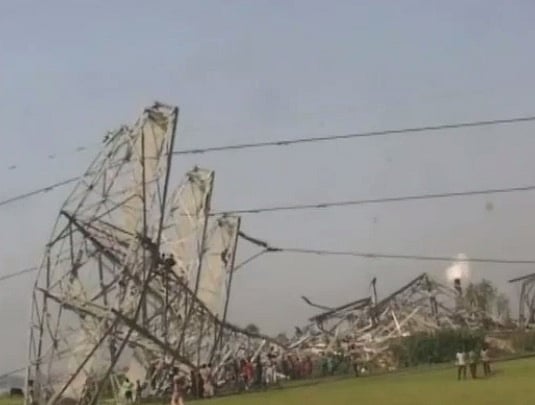
A transmission tower collapsed in Kishoreganj’s Kalipur when a storm cut its path through Monday night, damaging 230-kilovolt lines.
There are 3,185 circuit kilometres of 230KV transmission lines throughout Bangladesh under PGCB.
Power supply broke down in many districts around 11:20am when the Ghorasal-Ishwardi line tripped, Badruddoza said.
PGCB Managing Director Beruni said there are two 230KV lines to transmit electricity from eastern to western districts -- one from Ashuganj to Sirajganj and the other from Ghorasal to Ishwardi.
The authorities tried to transmit electricity from Ghorasal to Ishwardi instead but that line also tripped due to an overload around 11:30am leading to outage in almost all the areas in the zone, he said.
Power Division officials explained that power plants automatically shut down when there is an overload on a transmission line. The power generated is immediately supplied to different zones through the national grid.
Power is needed to run power plants as well. It means power shortage occurs in the total system when one plant or transmission line trips.
In such circumstances, the authorities try to balance the load by controlling power flow.
The generator may turn off automatically at a power plant if too much pressure is created. The supply is reduced when one more plant shuts down leading to the shuttering of more plants.
A major power outage hit the country in 2014 after Bheramara transmission centre in Kushtia collapsed. India’s power transmission was delinked from the national grid.
Living without power
People in the affected zones suffered a long spell of power outages. Hospitals ran on generators.
Sirajganj PDB’s Residential Engineer Alamgir Mahfuzur Rahman said electricity went out in his area at 11:55am and returned at 2:45pm but outages continued until 5pm due to insufficient supply.
PGCB Jhenaidah Circle’s Executive Engineer Uttam Kumar Sadhu said residents of all the districts on the west side of Padma River suffered.
Kushtia PGCB Bottoil Station’s Deputy Assistant Engineer Abu Taleb said power supply snapped at 11:24am and returned at 12:03pm. Another blackout occurred around 1pm and continued for one hour.
Similar reports came from Pabna, Khulna and Jessore.
West Zone Power Distribution’s Superintending Engineer Ikhtiar Uddin said the line tripped in Barisal around 11:30am and 22-24MW of electricity was supplied from Bhola.













