


Published : 30 Apr 2022, 11:21 PM
Updated : 25 Oct 2022, 09:51 AM



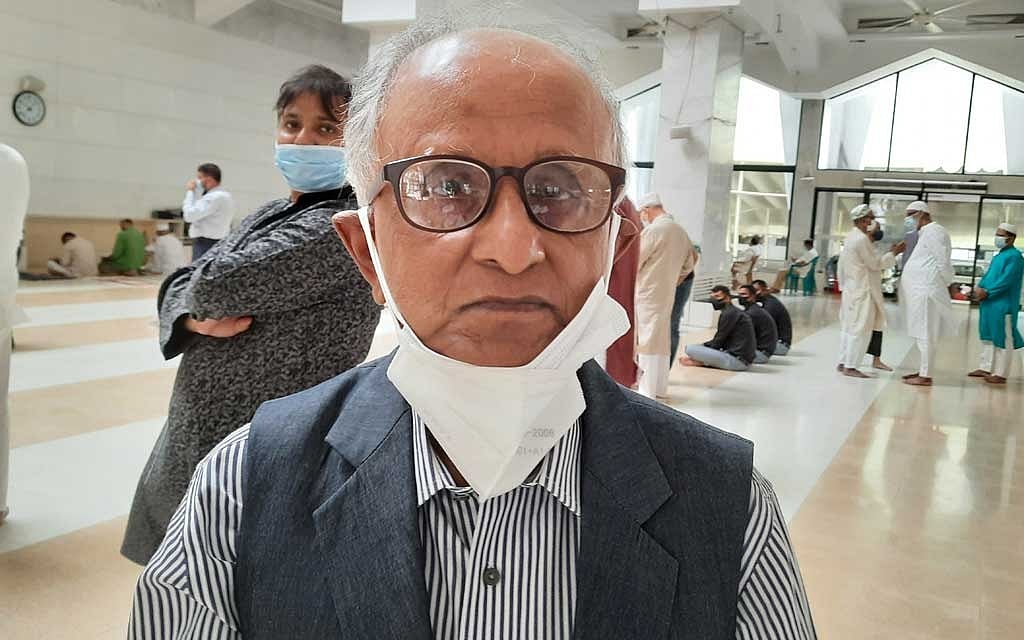
A week ago, Syeduzzaman visited his ailing friend and held hands for all the while talking to him, which has now become a memory he is having troubles letting go of.
Syeduzzaman spoke of his sorrow while mourning Muhith at his funeral prayers on Saturday at Gulshan’s Azad Mosque, which people from all walks of life took part in to say their final goodbyes.
“I visited Muhith at his home [Apr 23]. He could not take his eyes off me but couldn’t say a word. I held his hands, still not a word. The touch of his hands still stir up emotions in me,” the former finance minister remembered.
The two were friends since their student days at Dhaka University and both of them resided at Salimullah Muslim Hall. Later they were also colleagues as public servants.
“Our friendship goes way back. We spent our days at Salimullah Hall from 1951 to 1955. Muhith studied in English Department while I studied physics. He became first in IA [humanities stream] and I stood first in ISC [science] the same year. You can say we were friends for life.”
“Muhith studied in MC College and I was in Dhaka College. Later in 1956, we both passed the Pakistan Civil Services exams. Our bond shared many similarities.”
Akin to their close ties, their principles also resembled each other’s, Syeduzzaman said. They both stood down from the cabinet of Hussein Muhammad Ershad’s government due to their disagreements with the regime.
Along with being the finance minister of Awami League’s last two regimes, Muhith was also the minister of finance and planning in Ershad’s government in the 1980s. Syeduzzaman then followed suit and took his charge as the finance minister.
“When Ershad became the president, Muhith joined as the first of his finance ministers. But that was for less than a year,” Syeduzzaman said.
“I was then at the World Bank in Washington and returned to the country in October 1982. Ershad asked me to take up the position of finance minister. Before travelling to Washington, I was the secretary to the Ministry of Finance for five years…”
“[Muhith and I] had many similarities in advising the government by following the rules of the government policies. Because we had been public servants for a very long time. Muhith later turned to politics.”
“But we always abided by the government policies. You see, I’ve never associated myself with politics. I stepped down from Ershad’s cabinet because I didn’t agree with him on many important policies and issues.”
Muhith took up resposibility as finance and planning minister for the first time during Ershad’s government in 1982-83. Then he worked for different agencies of the World Bank and the United Nations as an advisor before returning to the country to actively take part in politics with the Awami League
During the Liberation War, Muhith took office at the embassy in Washington, said Syeduzzaman.













