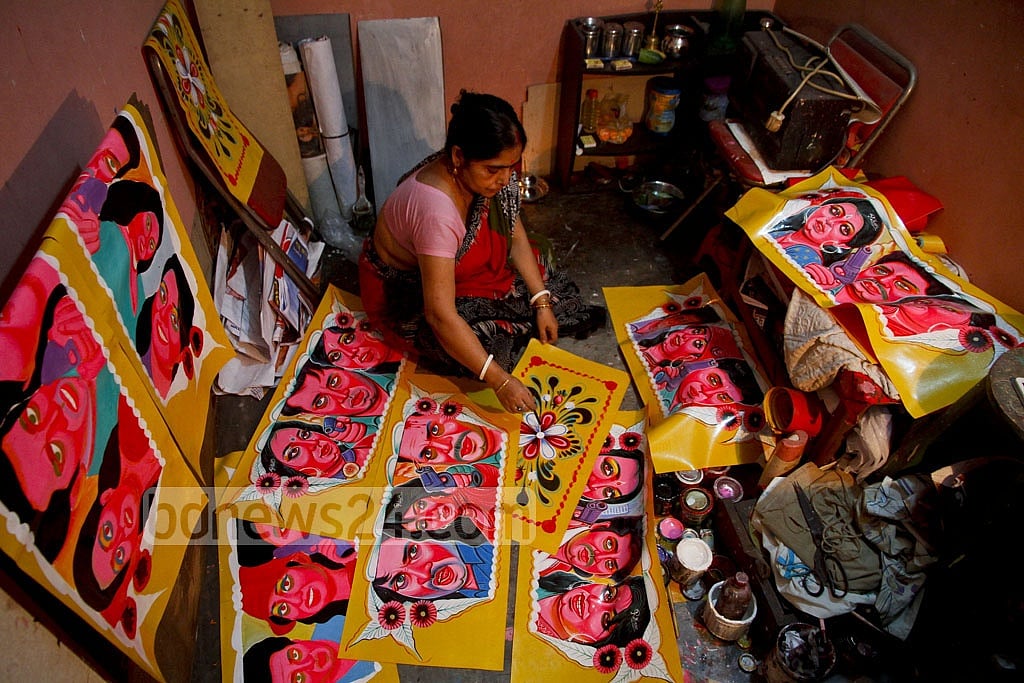
Almost 600 pieces of rickshaw and ‘baby taxi’ art were put on display at Dhaka’s Alliance Francaise in 1999. But in the modern era of digital signs and corporate advertisements, only a few practitioners still remain.
Swapan Kumar Das learned to paint from his father, Raju Kumar Das. As a child he would help his father with his rickshaw paintings and, at the age of 22, he entered the business himself.
The main goal of rickshaw art was to arrest the attention of passengers and passersby through the interplay of vibrant colours. The most popular subjects were famous movies, actors and actresses, but scenes from the Liberation War, the Arabian Nights, imaginary cities and designs of birds and flowers also made their way into the paintings.
Swapan says his most common subject has been the movie ‘Nishan’, starring Javed and Bobita.
Swapan’s wife, Dipali Rani Das, has also learnt the art.
Now she does most of the preliminary work on setting the design and helps with much of the other work involved in the paintings.
Swapan receives Tk 300 for a set of paintings for a rickshaw. About Tk 50-60 goes toward covering the costs. Only two sets of pictures can be finished in a day.
Swapan’s rickshaw art has been displayed at the Alliance Francaise and other galleries. Foreign visitors have also bought his paintings.
Swapan’s father, Raju Kumar Das, began his rickshaw painting business in 1953 in Old Dhaka. He was given prizes from the German and French embassies for his work. His artist’s signature – RK Das – could be seen on the back of many rickshaws.
The rise in popularity of digital printing has, however, eaten away at the demand for rickshaw paintings. But some glimpses can still be seen on the streets of the capital.
It is difficult to live on these small earnings, says Swapan. But he hopes to keep his father’s memory alive and wants to keep working on the paintings until his death.