


Published : 11 Feb 2021, 06:27 PM
Updated : 08 Apr 2022, 12:46 PM


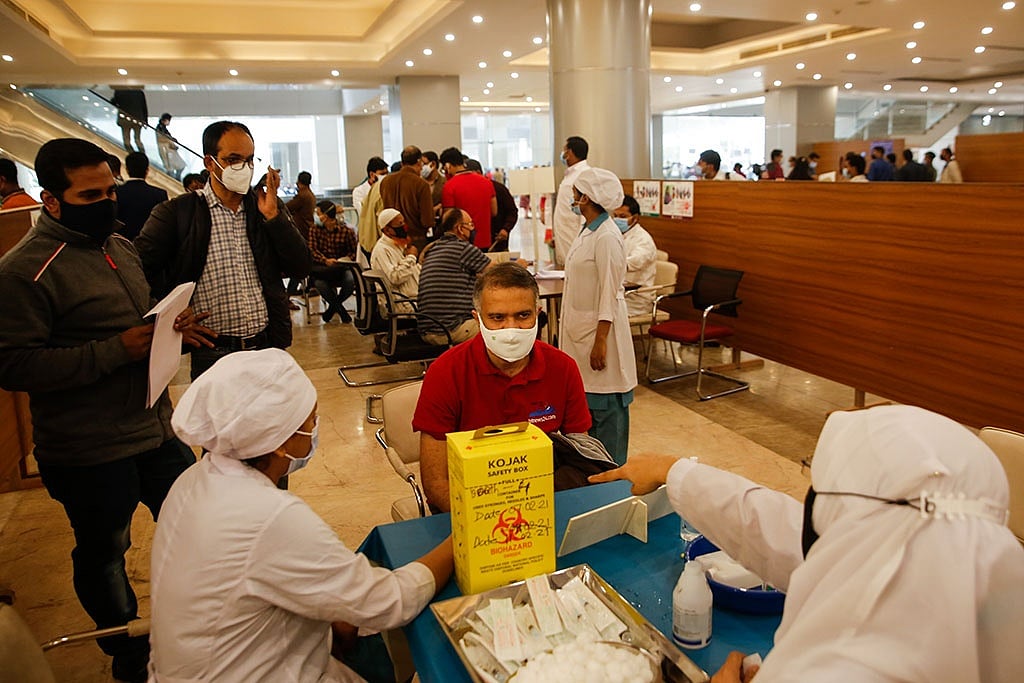
It was important for people to get vaccinated to help the country and society recover from the impact of the coronavirus crisis, Khalidi said on Thursday after receiving his vaccine jab at Bangabandhu Sheikh Mujib Medical University on the fifth day of the nationwide immunisation drive.
Asked about the rumours surrounding the vaccination process afterwards, he pointed out that there was a political narrative against India which was driving the anti-vaccine campaign, particularly as the doses were purchased from the neighbouring country.
"It's true that the vaccine came from India, but it was invented by researchers at Oxford University,” he said.
The University of Oxford partnered with the British-Swedish company AstraZeneca to develop and test a coronavirus vaccine. Clinical trials found that the vaccine had an efficacy of 82.4 percent when two doses were given 12 weeks apart.
UK scientists are now working on new versions of the vaccine, to keep up with a virus that will inevitably keep mutating.
The Oxford vaccine is based on the virus’s genetic instructions for building the spike protein. But unlike the Pfizer-BioNTech and Moderna vaccines, which store the instructions in single-stranded RNA, the Oxford vaccine uses double-stranded DNA.
The researchers added the gene for the coronavirus spike protein to another virus called an adenovirus. Adenoviruses are common viruses that typically cause colds or flu-like symptoms. The Oxford-AstraZeneca team used a modified version of a chimpanzee adenovirus. It can enter cells, but it cannot replicate inside them.
“Those who are spreading rumours about the vaccine are doing it for no reason. Not just in Bangladesh, such rumours have been circulating in different other countries, including the United States,” Khalidi said.
Right-wingers have tried to say that there is no need for vaccination. Some are against wearing masks. “Look at what the supporters of Donald Trump did. Many have been engaging in activism in the US. They have taken to the streets and even behaved violently while refusing to wear masks, claiming that their rights were being taken away,” he said.
Khalidi also highlighted the criticism that Bill Gates, the founder of Microsoft, was subjected to for his observation on the virus and vaccination in The Economist, an international weekly newspaper.
Gates lamented the politicisation of the response to the virus in America, and the spread of conspiracy theories—some implicating him—both of which have slowed efforts to contain the disease’s spread. But he offered reasons for hope in the medium term, predicting in August that by the end of 2021 a reasonably effective vaccine would be in mass production, and a large enough share of the world’s population would be immunised to halt the pandemic in its tracks.
But many on social media viewed it as his scheme to make money from the vaccine.
“It is another matter for businessmen to do business. But it [the vaccine] is said to be given as a public good. Many companies say they do not want to do business with vaccines. More countries will achieve 'herd immunity' if more people are vaccinated.”
Quoting Anthony Fauci, the top infectious diseases expert in the US and chief medical adviser to President Joe Biden, Khalidi said herd immunity can be achieved if at least 80 percent of the population can be vaccinated.
"In Bangladesh, our researcher Dr Mushtuq Husain told me that we also need to vaccinate a similar number of people for herd immunity at a national level so that we can go back to normal life and resume normal economic activities."
“One is the issue of personal health and the other is that collectively the whole country, the society, has to be active and go back to work. We all have to go back to work,” Khalidi said.
Khalidi arrived at BSMMU around 9:30 am on Thursday. After getting vaccinated at the designated booth, he spent half an hour under observation. He later commended the efficiency of the vaccination process and said: “It took a few minutes from entry to getting the jab. It’s a good example of efficiency and service, a rather unusual commodity in Bangladesh’s public sector, especially in healthcare.
“No complaints at all.”













