Published : 13 Nov 2022, 02:14 AM
Updated : 13 Nov 2022, 02:26 AM


Hasna Begum is a rough sleeper. Usually, she finds some space on some pavement or on a footbridge to spend the night.
During the day, she either resorts to vagrancy or collects papers and plastics dumped by fly-tippers so that she can sell them for petty cash.
So, where does she go when she needs to use the bathroom?
Hasna was visibly uncomfortable when she was talking about her lavatory routine.
“I hardly drink anything during daytime so that I don’t need to use the toilet. When night falls, I usually use a roadside sewerage drain to relieve myself.”
According to a 2011 study conducted by BRAC, at least 9.3 percent of Dhaka’s rough sleepers are in a similar situation to Hasna and do not have access to any sanitation and lavatory facilities.
Of the 2,264 people surveyed for the study, 62 percent depend on public toilet facilities while two percent use roadside dumpsters and sewage drains.
Hasna is one among these two percent.
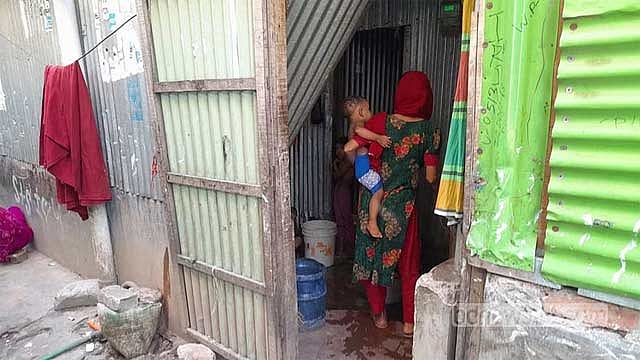
Slum residents are another demographic who have a place to sleep at night, but with extremely inadequate sanitation and lavatory facilities.
Among this group is rickshawpuller Anwar Hossain. He lives in a small room in Dhaka’s Korail slum, along with three other members of his family.
The house Anwar lives in has nine similar rooms and a total of 22 people from seven families reside there.
The entire house has only a single lavatory.
“My family members and I stand in long queues to use the toilet every morning," he said. "It’s so difficult, you know. But I have no other choice but to adapt.”
World Bank data estimates that at least 47 percent of Dhaka residents live in slums,
According to another World Bank-funded study, published in the Water International journal in 2020, at least 90 percent of the families living in slums in Dhaka use shared lavatory facilities, and each toilet is shared by at least 16 families.

The slum dwellers interviewed for this article pointed out three main reasons for the lack of facilities:
*Lack of space in the slums
*No monitoring of slums built on state-owned land
*Lack of interest in providing adequate lavatory facilities by the owners of slums on privately-owned lands.
Md Abdul Hamid Fakir, president of Nagar Daridra Basteebashir Unnayan Shangstha, or NDBUS, blamed both the city corporations for the lack of sanitation facilities in the slum.
“NGOs [non-governmental organisations] take initiatives to ensure proper sanitation facilities in slums [in Dhaka], but those initiatives aren’t enough. The city corporations should lend a hand in this effort,” he said.
Bangladesh needs to facilitate at least 90 percent of its population with proper sanitation amenities by 2030 to reach the Sustainable Development Goal or SDG.
Dibalok Singha, executive director of Dushtha Shasthya Kendra, does not believe Bangladesh will be able to achieve the SDG target if sanitation facilities for rough sleepers and slum dwellers do not improve drastically.
“The government needs to invest heavily if it’s looking forward to reaching the goal [SDG],” he said.
LIFE WITHOUT PROPER SANITATION FACILITIES
Mizan, who identified himself by his first name, has been living on the streets since 1973, mostly close to the Shahbagh area.
“When nature calls, I make a quick trip to facilities at the hospital,” he said, pointing to the nearby Bangabandhu Sheikh Mujib Medical University, Bangladesh’s lone specialised post-graduate institute for medical studies.
Access to proper lavatory facilities is not on the priority list for Rina Begum, a slum dweller in Korail.
“I ended up here [at Korail slum] because I lost my home to river erosion. I'm just surviving in this big, menacing city. I have to live with whatever I have,” she said.
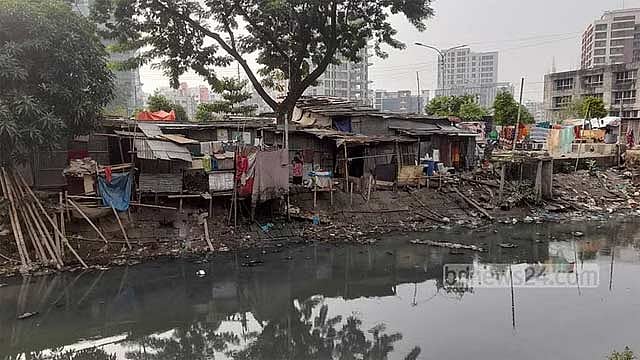
Lovely Begum, another resident from the same slum, took a similar tone.
“In my place, there are two toilets that service 12 rooms full of people with no running water. I have no option but to live this way,” she said.
Powerful land-grabbers erect slums in the city on state-owned lands. These grabbers are known as ‘landlords’ to slum-dwellers.
A large number of them alleged that these so-called landlords are only interested in collecting rent and hardly pay any attention to sanitation facilities.
One such slum is in the Shyamoli area, on the banks of the Kalyanpur canal.
The slum has only one toilet for 20 make-shift rooms, full of more than 50 people.
“We pay rent on time, but we don’t receive any sanitation or running water amenities. [The landlords] control the slums no matter who is in power,” said one resident of the slum, who did not want to reveal his identity.
Md Faruk, a rickshawpuller living at the Sher-e-Bangla Nagar slum, said: “At least 30 people have been using one lavatory. Disputes over access to toilets lead to massive fights almost everyday here.”
WOMEN AND CHILDREN SUFFER MORE
As there is no proper sanitation system for the homeless people or slum dwellers, women and children sleeping rough are the worst sufferers.
“Men can relieve themselves standing anywhere. It’s us, the women, who face all the trouble,” said Selina Begum, who lives on a pavement in Azimpur.
Mosammat Sukhi, a housewife living in a slum in Sher-e-Bangla Nagar, said that men queue to use the toilet in the morning before they head out to work, making it impossible for women to use it.
“It’s really a lot of trouble and also awkward for women since we can’t go [to the toilet] amid the big crowd of men. We need to hold it,” said Asiya Begum who lives in Sattala slum.
It becomes tougher when children get diarrhoea as the bathroom is not vacant all the time, said Kulsum Begum of Karail slum area.
Women confront severe problems due to the lack of water and proper toilets, especially when they menstruate.
“I have two grown-up daughters and I can’t tell you what troubles we face,” said Rina Begum, who lives in a slum in Sher-e-Bangla Nagar.
A FAULTY SEWAGE SYSTEM
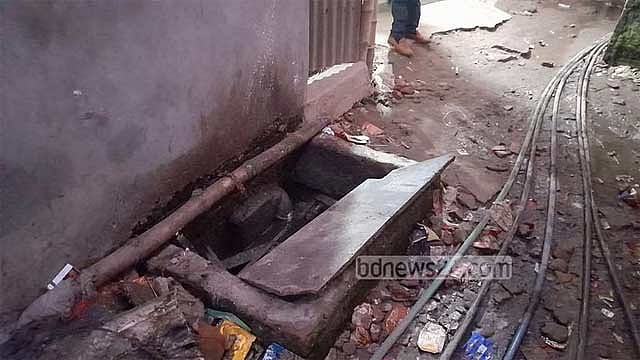
The lack of government initiatives to ensure a proper sewage system was evident in the Korail and Sattala slums. In Korail, sewage lines have been connected to the drains and they get blocked frequently due to heavy use.
“[The sewage] lines get blocked and we clear them by collecting funds as there’s no [financial support] from the government. We need to do everything by ourselves,” said Kamal Hossain, a vegetable trader living in Korail slum.
The situation at the Sattala slum is worse than in Korail. As there are not many drains inside the slum, the small tanks get filled up quickly and the sewage ends up seeming onto the street. People have no option but to walk through it.
At the Sher-e-Bangla Nagar slum, the sewage goes directly to the Kalyanpur canal.
“Those slums with houses erected over a waterbody are in a worse state. Dhamalkot, Rayerbazar and some slum areas in Mirpur have the sewage directly going to the water,” said Akhil Chandra Das, deputy director of Dushtha Shasthya Kendra (DSK).
MONSOON MENACE
Roshna Begum, who lives in Sher-e-Bangla Nagar slum, said all homes in the slum were inundated with water when cyclone Sitrang hit recently. “We were up all night while the toilet totally went underwater. Filthy water from toilets mixed with the rainwater and entered our houses,” she said.
“We took shelter at the house of a relative two kilometres away to avoid contact with the filthy water containing human faeces and urine,” her neighbour Rina Begum said.
“Every house is flooded on rainy days. The latrine lines are not constructed properly so it’s not possible to figure out whether the water is clean or dirty,” said Abu Yusuf Mridha, general secretary of Sattala Slum Development Committee.
HOW TO FIX THE PROBLEM?
Most of the initiatives to ensure proper sanitation for homeless people and slum dwellers are taken by NGOs. They have set up proper toilets in different slum areas of Dhaka.
“DSK has been working with WaterAid since 1996 to ensure safe water, sanitation and cleanliness for the people living in slums. We have set up community toilets and septic tanks [under the project],” said DSK Deputy Director Akhil Chandra Das.
A DSK project is ongoing to ensure better sanitation for 275,000 people living in 27 slum areas in the northern part of Dhaka, said Technical Officer M Rezaul Karim.
“The NGOs are working for us, but there’s no such initiative from the [Dhaka] city corporations, said Abu Yusuf Mridha.
But people living in the slums said that the ultra poor do not have access even to the toilets provided by NGOs.
“For a toilet provided by any NGO, people need to arrange land and also give a small fee. Those who can’t afford it can’t get the toilet,” said Md Sirajul Islam, a resident of the Sattala slum.
The Dhaka North City Corporation does not have a standalone sanitation programme for slum residents or the homeless, said Mohammad Mamun-ul-Hasan, chief social welfare and slum development officer of Dhaka North City Corporation.
“A project titled ‘Prantik Jonogoshthir Jibonman Unnayan Prakalpa’ funded by UK Aid has been setting up better toilets in the slum areas. We provide overall assistance to them,” he said.
Similarly, the Dhaka South City Corporation has no sanitation programme other than the UK Aid one.
“Most of the slums develop on land are assigned to government offices, who never complain when people begin to live there, but make a lot of noice when the city corporation takes any development initiative there. So we can’t do anything,” a DNCC official said on the condition of anonymity.
“I’ll note down the problem. We began to set up some public toilets and got government funds for it. Also, we have already set up 15 to 16 toilets on our own initiative. We’re trying our best to alleviate the situation as soon as possible,” said Muhammad Shakhir Ahammad Chowdhury, deputy director of the Department of Social Services.
[Writing in English by Adil Mahmood and Sabrina Karim Murshed; Editing by Shoumik Hassin]