


Published : 21 Jan 2016, 03:07 AM
Updated : 11 Apr 2022, 09:35 PM


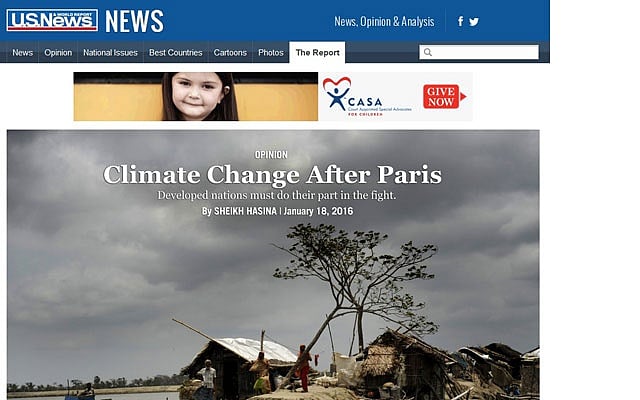
“Bangladeshis have fought for freedom, for democracy, for women’s rights and against terror and extremism on our own. But climate change is not a fight we can win alone,” she wrote in a US news portal.
Hasina is a 2015 recipient of the United Nations’ Champions of the Earth award for her leadership in climate change policy.
The Global Climate Risk Index ranks Bangladesh as one of the 10 nations most vulnerable to climate change.
The prime minister in her article titled ‘climate change after Paris’ in the ‘US News & World Report’ said climate change is a “huge threat” for Bangladesh.
As a result, she said, Bangladesh had made the fight against climate change and the protection of its citizens “a national priority on the same level as defence, security and economic growth”.
“That’s why Bangladesh is encouraged by – though not entirely satisfied with – the progress made at the United Nations climate summit in Paris last month”.
She said it was “vital that nations agree to work together to rein in man-made emissions that contribute to global warming”.
“In particular, the world’s richest nations must help the poorest ones pay for new technology that will enable them to generate more energy from renewable sources and also save energy by using energy-efficient appliances,” she wrote.
Another area of support from wealthier nations should come from the field of scientific research aimed at smarter and cheaper means of mitigation and adaptation.
“All nations, big or small, need to put their heads together to combat this global threat,” she said.
“Paris created a positive momentum – the newly concluded agreement features commitments to balanced financing, with rich countries contributing to the cost of battling climate change that affects developing countries”.
“In addition, the world’s leaders agreed to share and develop technology that will allow developing nations to move more quickly to sustainable energy sources such as solar and wind.
“Many developing nations, including Bangladesh, have actually been leading the battle against climate change in recent years.
“We are showing what can be done by embracing scientific facts, crafting smart policies and demonstrating political will,” she said, mentioning Bangladesh’s efforts to keep the emission level below average of the developing worlds.
Each year, Bangladesh spends $1 billion – or more than 1 percent of its GDP – fighting climate change.
“In 2009, we used our own money to create a $400 million Climate Change Trust Fund,” she said.
“At the same time, in all fairness, low-income, developing nations such as ours must depend on fossil fuel to increase our standard of living and sustain our peoples’ livelihood.
“Wealthier countries should assume a greater responsibility to reduce carbon output and help developing nations do the same by helping them build technological capacity to expand clean energy”.
The prime minister, however, said “at the heart of the climate change battle is the fight to ensure human rights, justice and fundamental freedoms, particularly for people at the bottom”.
“Climate change must be seen in the wider narrative as a global threat to peace, stability and prosperity”.
She said the world admires Bangladesh for its remarkable social and economic transformation and resilience since its independence in 1971, but all that will be at risk unless the world seriously tackles climate change.
“Bangladesh will do its part. We hope the world’s richest countries will do their part too,” she wrote.













