Published : 12 Mar 2016, 07:49 PM
Updated : 19 Oct 2022, 05:09 PM


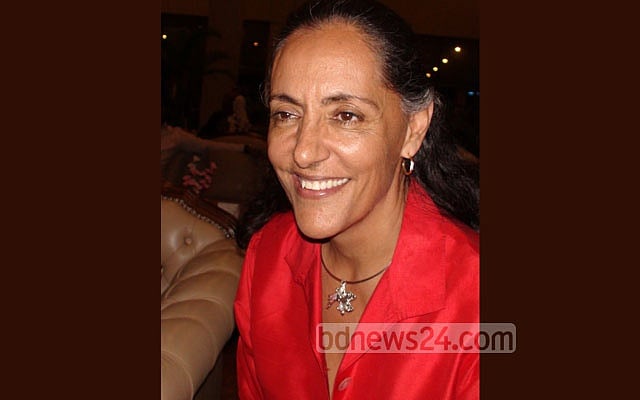
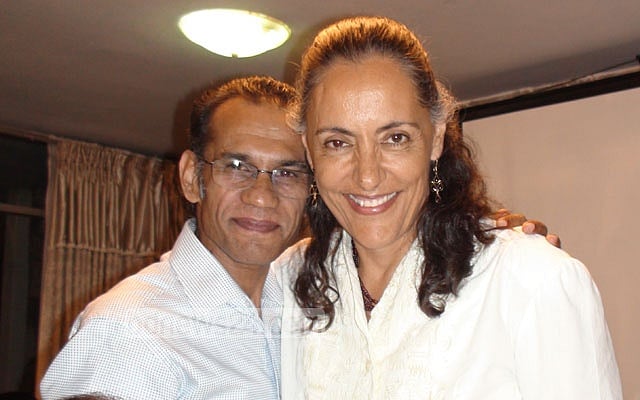
Pria sees the Dhaka traffic as a sign of prosperity rather than as a nuisance. She feels that the cultural dissimilarities are a greater factor to draw the peoples of Mexico and Bangladesh nearer. In an exclusive interview with Razu Alauddin, Editor of Arts at bdnews24.com at Sonargaon Hotel, Dhaka, on Mar 6, she also talks about how differently the two nations treat religion.
bdnews24.com: First of all, I would like to welcome you to Bangladesh. You have visited Bangladesh before. Do you see any qualitative changes in its economy now?
Melba Pria: Let me tell you two stories about Bangladesh when I was growing up. And then I (will come) back to today’s Bangladesh. The first time I heard the name, Bangladesh, when I was this size (showing the index figure). And my mother was holding me by the hand. In the other hand, she was holding a big sign that said ‘Free Bangladesh’. The second memory that I had very clear about Bangladesh when I was already in high school. So I was very tall and strong. My mother gave me a big pack of 10 kilos of rice and we went together because in Bangladesh there was a big flood at the time. So those are the two memories I had about Bangladesh growing up. Today, Bangladesh doesn’t only feed itself, but it feeds millions of people around the world. Today, Bangladesh has grown economically anything between 5.6 and 7 percent for the last 15 years. And many people think that Bangladesh will grow for the next 20 years in such numbers (at such rates). So Bangladesh is incredible. Do you have (a) problem that people don’t know about it? Now, having come to Bangladesh years ago and coming today; of course people talk about Bangladeshi traffic, because sometimes were are stuck for two hours in the Bangladeshi traffic. But let’s think why we have Bangladesh traffic. We have Bangladeshi traffic because people today can buy a car. We have Bangladeshi traffic because people today can buy a motorbike; because people can even buy a bicycle. So that means the people are more affluent. And therefore you have more vehicles on the road. Of course we could have bigger roads, and all of that is happening. But usually infrastructure goes slower. Then, what are people able to buy for themselves? So that’s what I thought about Bangladesh. It’s only good news.
bdnews24.com: So are you seeing all these as positive things?
Pria: Yes, of course.
bdnews24.com: Do you have any suggestion for further improvement of the economic and trade relationship between Bangladesh and Mexico?
Pria: Of course. Bangladesh is doing quite well in the trade with Mexico. You trade with us a little over a quarter billion dollars, mainly on apparels. We, on the other hand, only trade like 7 million dollars with you. So the difference is very, very big. There is (a) possibility of Mexico exporting some (crude) oil to Bangladesh if Bangladesh so decides, for the time being. And there are many opportunities. Mexico is the fourth largest exporter of vehicles in the world. And therefore the possibilities of Bangladeshi businesspeople to invest in specific trade sectors are very, very big. Mexico has the biggest Latin American investment in Bangladesh. We have a company here that is called Cemex that produces cement. It’s close to 30 million dollars and they have been here for (a) long time. So the relations are that you trade more and we have invested more. The relation is more about people-to-people. So the more people know each other, the more investment will come.
bdnews24.com: Among the Mexican writers, Jose Vasconcelos and Octavio Paz are known to be great fans of India as well as of Tagore. Do you think this fondness of theirs has been able to add any new dimension to Mexican culture?
Pria: Let me tell you that maybe it didn’t add a new dimension to the Mexican culture. But all of the Mexican children have a book that is called the national book. So everybody in Mexico gets their books free. And in the book of primary school, when we talk about (the world), we talk a little about India or South Asia. When we talk about world’s literature, we read Tagore. So every child in Mexico at a certain point of their life has read Tagore. I don’t know if every Bangladeshi child has read about Octavio Paz or Jose Vasconcelos. That I don’t know. But at least for us, Tagore is considered… let alone a Nobel prize or anything else, he is considered as one of the best writers of what we would call world literature. So that has given the Mexican children and therefore the Mexican adults always an idea of the sound of the Bengali literature; even if we only read it in Spanish. So the cadence of Bengali language has been in our ears regardless of what we read in Spanish. It is the cadence that we have learned through Tagore.
bdnews24.com: Octavio Paz and some other Mexican writers are held high in the minds of Bangladeshis. Mr Paz was also an active supporter of our independence movement. Through him, we believe, Mexico emerged as a friend of Bangladesh during the time of our need. We would like to know your feelings about this friendship.
Pria: I don’t know about the friendship of Octavio Paz and Bangladesh specifically. But I can tell you the friendship of my mother during the struggles of independence of Bangladesh. I walked with her on the street and she had a sign saying ‘Free Bangladesh, Free Bangladesh’. So the struggle of independence for Latin America is very important. Latin America as a whole and Mexico in particular… today in a seminar, there were two back principles that were talked about. So Mexicans believe in justice. That is very important. And the second is solidarity. In those years of struggles of Bangladesh regardless of if it was independence war or even natural disaster, the idea of having solidarity with Bangladesh was vital. So if it was Octavio Paz or if it was a person who was, maybe, not prominent, everybody was struggling and was asking for a freer Bangladesh. And of course in a certain need for a Bangladesh that would not have famine or disasters.
bdnews24.com: We are aware of the differences between the cultures of Bangladesh and Mexico. How can we come nearer to each other in spite of such differences?
Pria: That is what makes a relationship rich. If you encounter another person and that person would be the exact image of you, what is the point of meeting them? If you meet a country that is the exact image of your country, what would be the point of meeting? I don’t see it as a problem; I see it as richness. It is because you are different that I want to know you. It is because I am different that you want to know me. And then I’m very surprised – I come to Bangladesh and I see all these books of Mexican writers or Latin American writers are translated in Bengali. So someone is already doing the right thing. More and more (books) are coming.
bdnews24.com: Mexico earned its independence more than 200 years ago, and the Mexican Revolution took place one hundred years after the independence. What do you think about the benefits of that independence and revolution? Are the modern-day Mexicans reaping the fruits of these two historical phenomena?
Pria: We’re all children over here of a history. Maybe we inherit that independence. We speak Spanish, but why do we speak Spanish? So we can say many bad things and many good things about having been a colony of Spain. But we speak Spanish. So it’s a good thing to speak Spanish. Then, of course, revolution brought together many institutions that today confirm modern Mexico. But Mexico is far beyond independence and revolution. We’re a country that has come from our forefathers but that is being built every day by modern Mexicans.
bdnews24.com: Religious extremism is a worldwide problem now. How do you see the measures taken by the Bangladesh government to handle the religious extremism?
Pria: Religious extremism puts societies in very bad places because the time of God is never the time of people. And the reasons of religion are never the reasons of the people. In Mexico, we have separated the State and religion. We Mexicans believe each one is free to believe what they want. But the State and religion are separate. We hope for Bangladesh to have, in the measures they take, having looked at the reality Bangladesh lives, we hope that they find peace among themselves and that extremism doesn’t allow people not to live in peace with each other.