


Published : 18 Aug 2021, 08:17 PM
Updated : 08 Apr 2022, 01:08 PM


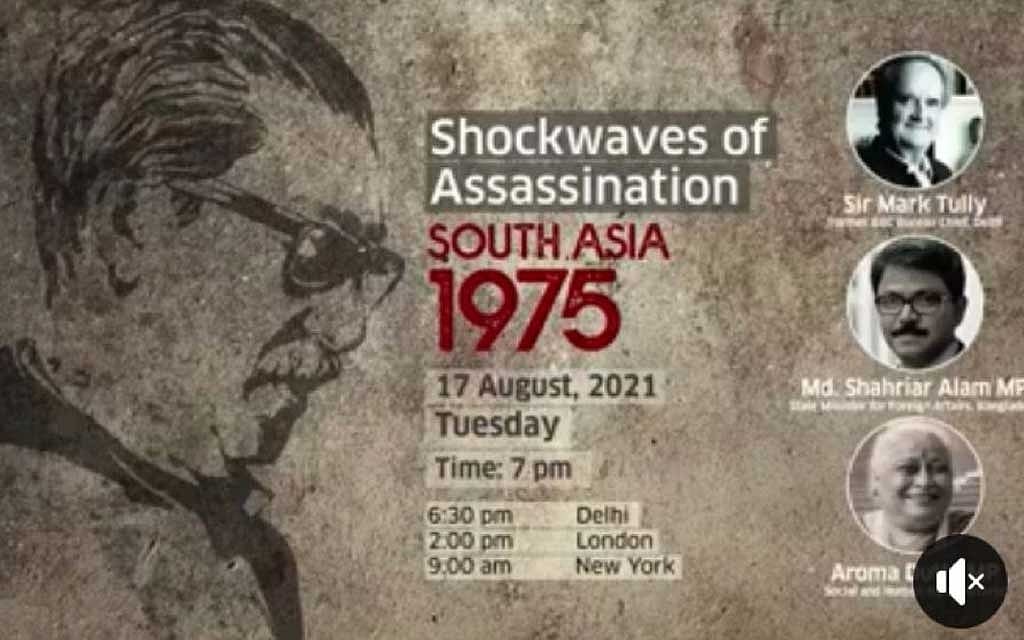
He discussed the 1975 coup at a webinar, ‘Shockwaves of Assassination: South Asia 1975’, organised by the Centre for Research and Information on Wednesday.
Journalists and history analysts have long been saying the assassins of Bangabandhu must have had international links.
The US, especially its intelligence station chief in Dhaka Phillip Cherry at that time had denied any involvement.
A group of army officers killed the Father of the Nation and most members of the family on Aug 15, 1975.
Earlier, Prime Minister’s International Affairs Adviser Gowher Rizvi in a separate programme said that there were at least seven plots and a long conspiracy behind the assassination of Bangabandhu and his family.
American journalist Lawrence Lifschultz had in a programme last year said the “connection” between Ziaur Rahman, who eventually became the first military ruler of Bangladesh after the Aug 15 massacre, and the United States behind the assassination of Bangabandhu should be investigated.
“The men who were behind it, they wouldn’t have moved without Ziaur Rahman’s backing. Ziaur Rahman would move with America’s backing. That needs further investigation,” he had said.
Tully was BBC's Indian affairs correspondent in 1971. During the war, the news media
controlled by the then Pakistani junta used to carry out coverage for the military and their affiliates. Tully's coverage of the war on BBC Radio was the people's chief source of authentic information.
Covering the Liberation War of Bangladesh was a high point in Tully’s career; that he did extensively for the BBC and had the fortune to watch the founding father of Bangladesh from close quarters.
Tully, who now lives in Delhi, on Wednesday said India was “very unhappy” with the assassination of Sheikh Mujib and his family members. “Relations nosedived sharply. But with his party (Awami League) and daughter (Sheikh Hasina) back in power, relations with India have improved sharply.”
“There are problems and there will be problems but the relations are basically very good," Tully said.
He also offered a glimpse into the post-1975 scenario of Bangladesh. “There were different streams – one stream was pro-Western economic way, anti-socialist, anti-Indian, and also there was a… what I may call…… an Islamic stream as well.”
"Language is a very emotive issue and Jinnah made a huge mistake by trying to impose Urdu on East Pakistan. The resistance was natural and it snowballed into a movement for independence.”
Tully said it was in the fitness of things that Bangabandhu addressed the UN in Bangla as the leader of the Bengali.
Bangladesh's “amazing” economic turnaround, its secularism and its inclusive growth, in Tully’s words, are the “great achievements” which struggled at birth with the devastation of war.
"I hope Bangladesh will remain secular as it is now. I am secular and I wish Bangladesh will remain secular," he said, noting that Bangladesh remaining secular and its economic growth assume significance in view of the Taliban takeover in Afghanistan.
Religious moderation, according to the leading British journalist and broadcaster, holds the key to national rejuvenation and economic growth. "What better example than Bangladesh!"
Tully also praised initiatives to strengthen connectivity between India and Bangladesh.
"I went to a Darjeeling boarding school. So when I hear a train will now connect Siliguri with Dhaka, it makes me very happy."
He said bilateral relations between Bangladesh and India are excellent at the moment, but they would hit a new high if the Teesta water-sharing agreement was signed.
State Minister for Foreign Affairs M Shahriar Alam said the Indemnity Ordinance passed to protect the assassins of the Father of the Nation has no precedence in history.
“It’s hugely embarrassing for the country. It left a rather long-lasting impact and they were given access to the state secrets in subsequent years," he said.
The state minister said the killers made friends overseas and “obviously that made our today’s job difficult locating them as we have a job to bring back the remaining killers and make them face consequences according to the court verdict”.
Shahriar also praised Prime Minister Sheikh Hasina for keeping her faith in the country’s legal system instead of resorting to a speedy trial. Some of the killers of Bangabandhu were hanged following a lengthy trial after the Awami League returned to power.
“Imagine you are the country’s prime minister and you know exactly who killed your father, your mother, your three brothers, sisters-in-law, and other relatives. Still, you have all the right to arrange a speedy trial or form a special court," said Shahriar.
In between the speeches, the webinar also featured some immediate reactions of global icons following Bangabandhu’s assassination.
“Bengalis can no longer be trusted after the killing of Sheikh Mujib,” as observed by Nobel Laureate Willy Brandt, was one of them.













