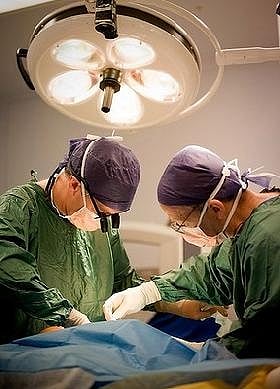
Marathon surgery starts to separate Bangladeshi twins
Australian surgeons embarked on a marathon operation to separate Bangladeshi conjoined twins, Trishna and Krishna, in Melbourne on Monday.
bdnews24.com News Service
bdnews24.com
Published :
16 Nov 2009, 09:57 PM
Updated :
12 Aug 2022, 02:05 PM
Melbourne, Nov 13 (bdnews24.com) – Australian surgeons embarked on a marathon operation to separate Bangladeshi conjoined twins, Trishna and Krishna, in Melbourne on Monday.
Doctors said it was too early to say if the surgery to divide the twins joined at the heads was going to be a success, but the operation that began at 8.30am local time at the Royal Children's Hospital and continued through the night was going as planned.
Late into the night Ian McKenzie, the hospital's director of anaesthesiology, told The Sydney Morning Herald that progress might appear slow, but it was going to schedule.
''It's all good news still. It's progressing fantastically. We're still in the phase of the neurosurgical part of it, so the brain is still being separated, but we are getting towards the end of that, we hope.''
He said most of the bone had already been separated but there was still a defining bone joining the twins. Dr McKenzie said surgeons would still be operating quite a few hours after the bone was separated.
Before the operation began, the Bangladeshi orphans were given only a 25 per cent chance of survival without harm. Experts estimated a 50 per cent chance some level of brain damage, and death was possible, according to the Australian newspaper.
The biggest risks in the operation were the concern about how Krishna's kidney would react to the operation, how the skin closure would come together, and how the twins' systems would respond to their separation, doctors told Australian reporters.
But surgeons were quietly confident ahead of the procedure, saying all the signs so far had been positive. ''Everyone was particularly optimistic and excited,'' plastic surgeon Tony Holmes said.
A last-minute angiogram, a scan showing the extent of the blood vessels in the area to be operated on, gave the best possible news, Dr Holmes said.
Previous operations separating blood vessels shared by the twins had been a success and no new connections had appeared.
''If the blood vessels started to reconnect we would end up with pressure problems, but those connections didn't seem to be major,'' he said.
For the first two hours in the theatre, anaesthetists worked to get the twins to the point where surgery could begin. The plastic surgeons then took over, led by Dr Holmes and Andrew Greensmith, stripping back the skin that has grown over plastic extenders to provide cover over the twins' finished heads.
About 1pm the neurosurgeons took over, cutting into the skull. Wirginia Maixner and Alison Wray began separating blood vessels and the brain matter that still linked the twins, while retaining enough of the bony bridge to keep the area stable.
By Wednesday, doctors will perform scans to see how the operation has gone, and if all seems well they will start to wake the twins up to their new, separate lives.
Moira Kelly from the Children's First Foundation, who brought the twins to Australia for the operation, said in a statement the medical and nursing staff at the RCH had been her "constant source of hope during some extraordinary and enormous challenges, when at times it seemed to be beyond the strength of two very little girls".
bdnews24.com/ha/pks/rah/1558h