


Published : 03 Nov 2014, 10:02 PM
Updated : 19 Oct 2022, 07:42 PM


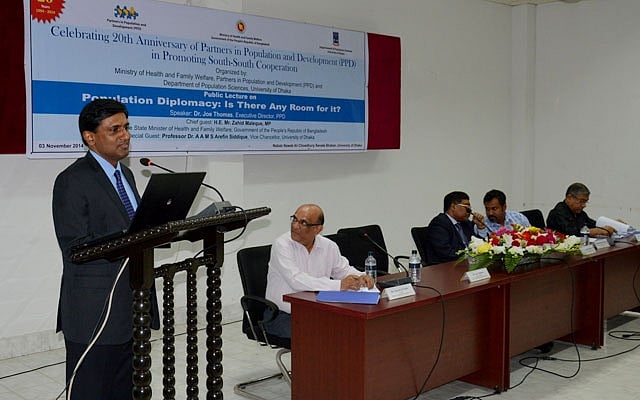
Joe Thomas, also a global leader in the area of public health, population and development, suggested that Bangladesh take “a leadership role” in this regard.
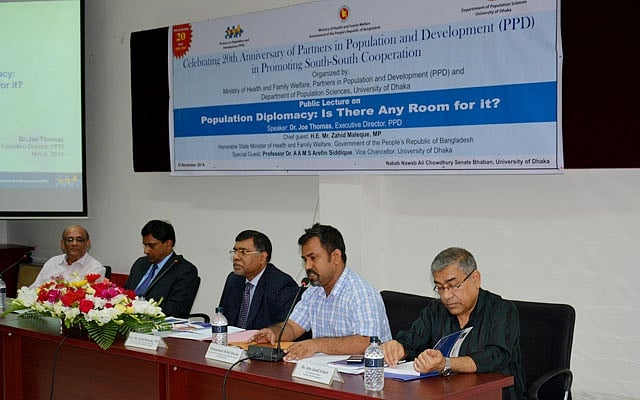
He was delivering a lecture on ‘Population diplomacy: is there any room for it?’ at Dhaka University on Monday, marking the 20 years of the 26-country organisation that promotes south-south cooperation.
Population diplomacy is a new idea. The US pursues global health diplomacy for which the state department trains its ambassadors.
Thomas said population at times forms a sub-sector of broader health issues. “Many countries may not be interested in population diplomacy, if it is not their problem.”
But he said Bangladesh might consider population as part of its official foreign policy. “There is a room for it,” he said.
Bangladesh is the eighth largest country in the world in terms of population.
But the population growth rate has been declined to 1.37 percent in 2011 from 3.00 percent during 1973-1978.
Maternal and under-five mortality has also declined at a rate that drew global attention.
Thomas said Bangladesh could tell those stories to the world, “how you managed the challenges and how you came to this so far”.
“Bangladesh is a land of thousand stories”.
Migration can be an issue for Bangladesh since nearly 10 million people live abroad, he said.
He said by putting population in foreign policy Bangladesh can share its knowledge, and help other countries in capacity building.
Besides, he said, transfer of technology, policy and advocacy dialogue, partnership and resource mobilisation could be other ways of cooperation.
PPD was formed after the 1994 International Conference on Population and Development (ICPD) in Cairo that adopted a 20-year Programme of Action focusing on an individual's needs and rights, rather than on achieving demographic targets.
It is headquartered in Dhaka.
State minister for health Zahid Malque endorsed Thomas’ concept and said the hosting of the PPD Secretariat to promote South-South cooperation was itself a diplomatic approach on the part of Bangladesh.
“We have wonderful stories to tell,” he said mentioning the fertility as well as population growth rate decline.
He said telling the story of success of Bangladesh in the field of population “to wider international community would be a key approach of population diplomacy”.
Ahmed Al Sabir, a former director of the government’s population research institute NIPORT, and Abu Jamil Faisel, Country Director of the EngenderHealth that also works of population and family planning issues endorsed the PPD executive director’s idea.
Chairman of the population sciences department Mohammad Bellal Hossain chaired the lecture session.
PPD says the lecture is arranged to provide tool to students and future policymakers “to analyse and conceptualise the contemporary politics and diplomacy behind population and development”.











