


Published : 30 Mar 2018, 11:36 AM
Updated : 05 Aug 2022, 06:37 PM


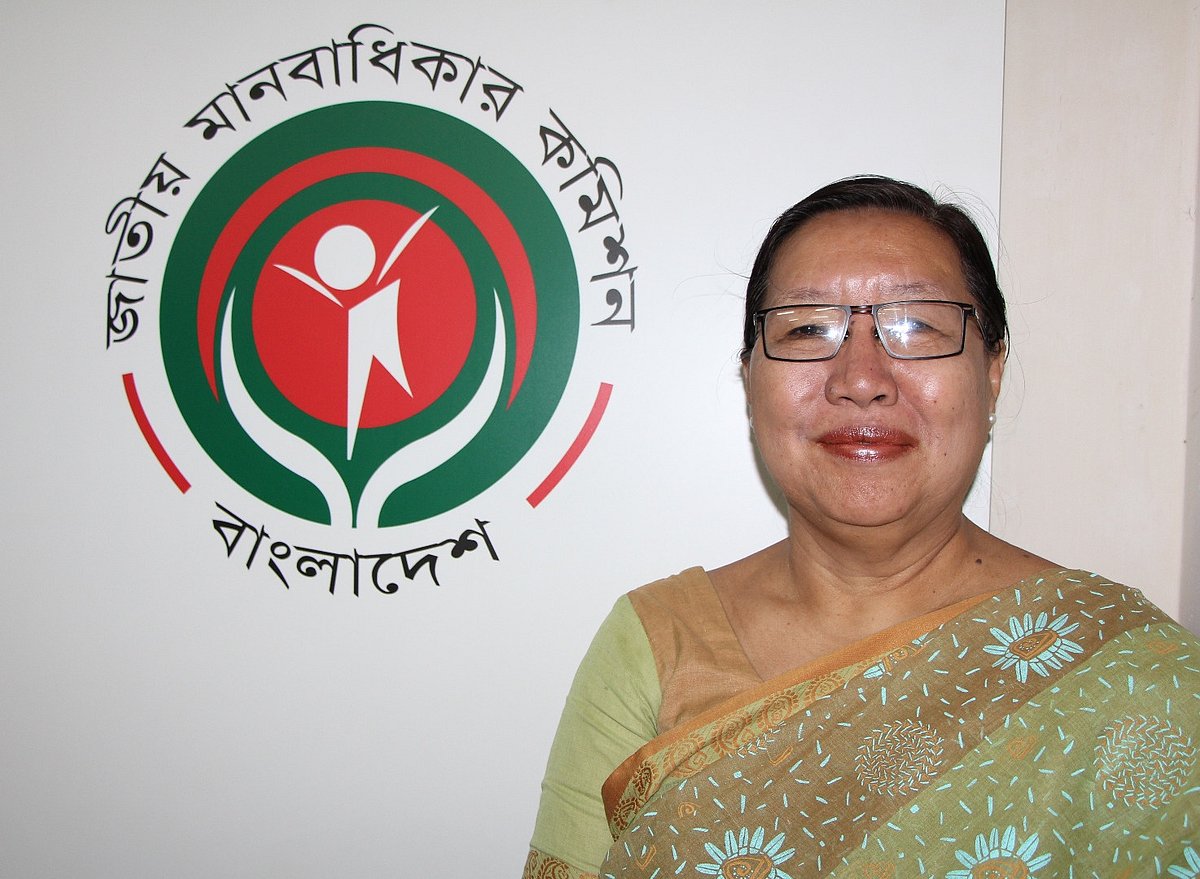
“People are unaware of a provision in the Human Rights Act that prevents any investigation against law-enforcement agencies for human rights abuses. We can only seek a report from the relevant ministry. This is the biggest hindrance,” she said.
“Law-enforcement agencies are mainly responsible for most human rights violations in the Chittagong Hill Tracts,” said Chakma.
The Human Rights Commission member was speaking at the launching ceremony of ‘Human Rights Report on Indigenous Groups in Bangladesh 2017’ organised by Kapaeeng Foundation in Dhaka on Thursday.
She suggested amendments to the law to improve the human rights situation.
Pallab Chakma, executive director of Kapaeeng Foundation, presented the statistics of human rights violations against different ethnic groups both in hills and the plainlands.
The executive director also mentioned that 1,200 Santal families were evicted from their homes after arson attacks and killings in Gobindaganj, Gaibandha, in 2016. They are yet to receive a ‘satisfactory solution.’
The report said at least 48 cases of violence against indigenous women occurred in 2017, with 12 cases of rape, nine cases of murder and murder after rape and nine cases of attempted rapes. Four indigenous women were gang-raped and eight were abducted.
It said 68 of the 75 accused in these cases were Bangalees.
Ushatan Talukder, member of Parliamentary Caucus on Indigenous People, raised the question on two Marma women being ‘house-arrested’ under police protection in a district administrator’s house. “What is the law behind it?” he said.
“We don’t know why they are still kept there. Nobody including the government is informing us about anything,” he said.
Commenting on the Gaibandha incident, Talukder said it was the police who were responsible for the arsons; and the officer in charge of police there was a Hindu. “He couldn’t save the other members of his community being a member of the minority group himself,” he said.
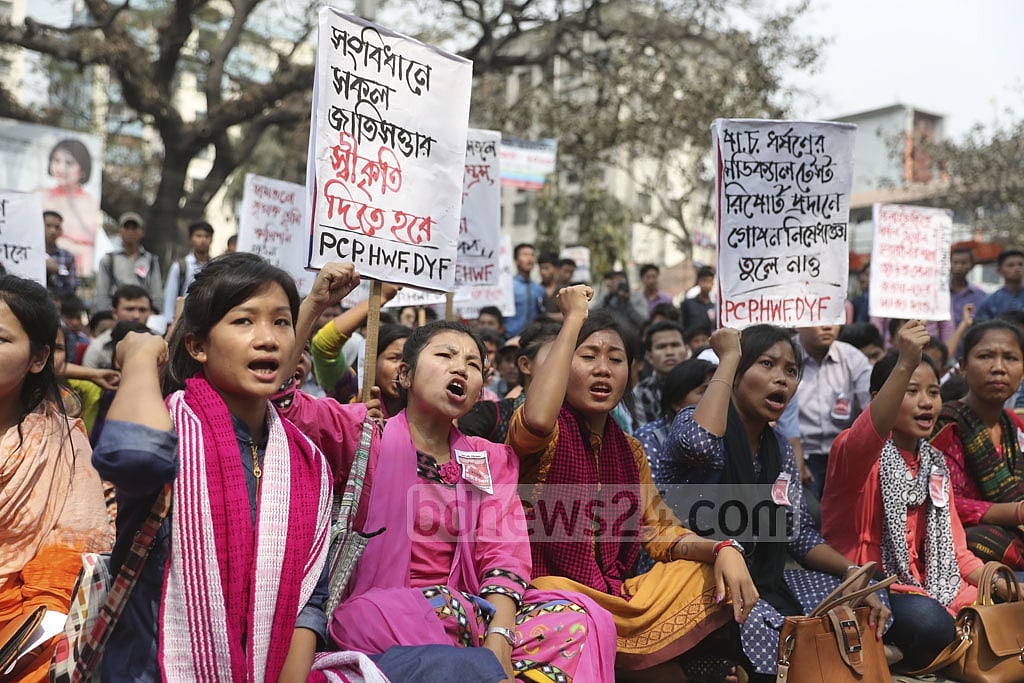
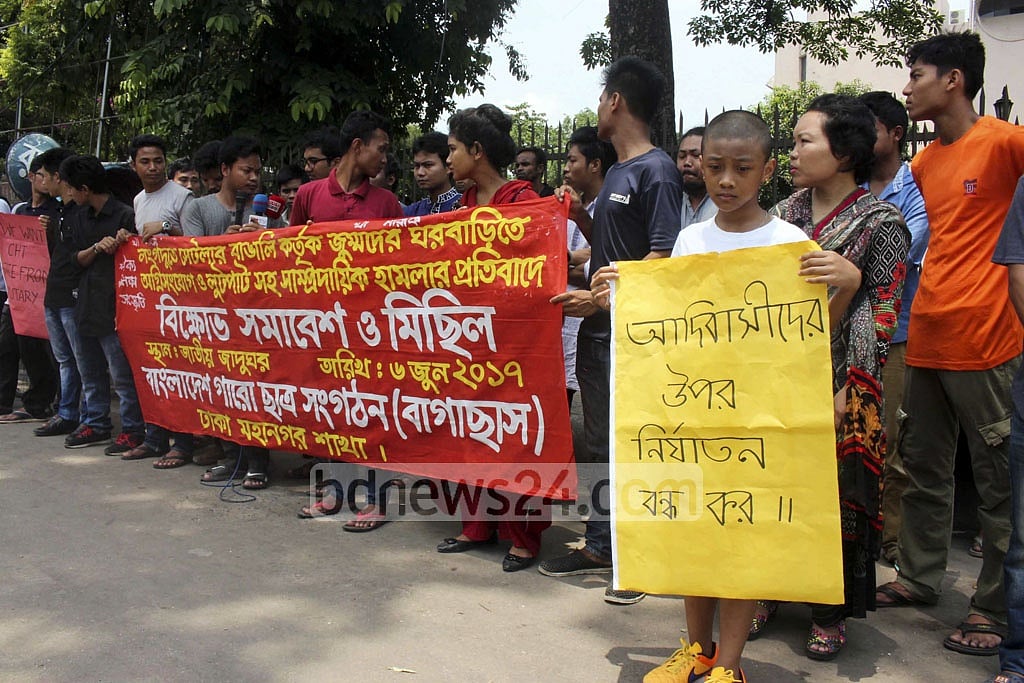
Activists hold a demonstration in front of the National Press Club in Dhaka on Thursday to demand punishment to the rapists of two Marma girls in Rangamati’s Bilaichhori.
“Reports are presented every year with no change in language and statistics which means there has been no remedy,” said Professor Sadeka Halim, dean of Social Science Faculty at Dhaka University.
She said the problem is not solved as the Chittagong Hill Tracts Peace Accord 1997 has never been implemented.
Prof Halim also commented that the situation may turn complicated due to an influx of Rohingyas.
“The demography has changed and now Rohingyas can spread out; their facial features will make it harder to distinguish them. They can be only spotted when they speak.”
Human right activist Sultana Kamal said the government is not taking enough measures to uphold the rights of indigenous people as well as others.
She claimed that many of the indigenous people were ‘silently leaving’ the country as their rights were violated which was reflected in a report, This Land Is Not Ours, the first by Chittagong Hill Tracts Commission.
Sultana Kamal also said the people responsible for implementing human rights always cite examples from developed countries to show human rights are also violated elsewhere in the world.
“Yes, it may have been violated elsewhere and they may not have done justice to it; but do we need to follow them?” she said.
“Those who are leading the country today claim all benefits just because they belong to Bangabandhu’s party. Then why don’t they fulfil their duties?”
“They say they are in politics to materialise the dreams of Bangabandhu. Then why can’t we see the similarity between their claims and deeds? They are answerable to us. This is our demand to the government,” she said.
The programme was presided over by Rabindranath Soren, chairperson of Kapaeeng Foundation. Sanjeeb Drong, general secretary of Bangladesh Indigenous Peoples’ Forum, and MB Akhter, programme director of Oxfam, also spoke.













