Published : 22 Oct 2022, 03:08 AM
Updated : 22 Oct 2022, 03:11 AM


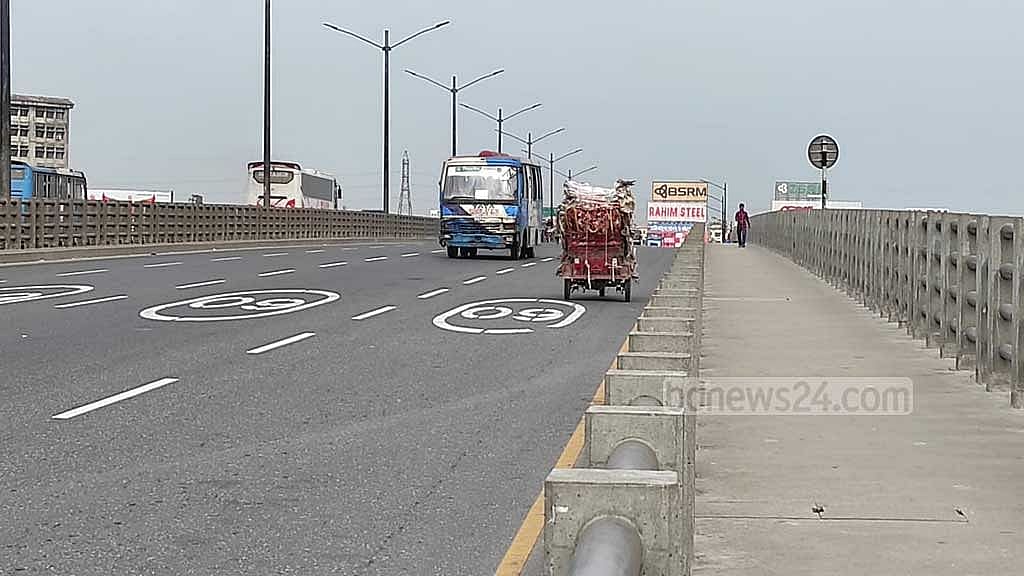
Bangladesh banned slow-moving vehicles on highways long ago as they often come in the way of high-speed buses and trucks and cause deadly accidents, but the three-wheelers appear to have become unstoppable.
More than 100 three-wheelers passed through the entrance of the highways to Sylhet and Chattogram from Dhaka in the span of an hour on Wednesday. Traffic on the Asian Highway, or Dhaka Bypass, is more or less the same.
Some drivers even took the wrong lane at a reckless speed. It seemed the stretch from Kanchpur bridge to the Dhaka-Chattogram Highway was specially made for the three-wheelers – from autorickshaws to rickshaw-vans – to take the wrong lane in the presence of highway police.
Narayanganj district has a significant portion of the highways leading to Chattogram and Sylhet after the border of Dhaka.
In a span of three days this month, seven people lost their lives in separate collisions between autorickshaws and buses or microbuses near Kanchpur bridge in Narayanganj.
Autorickshaw drivers plying these three major highways said they were aware of the ban on such vehicles on the highways. However, they still use the highways even “by paying police” because driving on the highways yields a better income.
However, the local highway police denied the allegation that they took payments from the autorickshaw drivers on a monthly basis.
Police said they are unable to stop the three-wheelers from running on the highways despite filing numerous cases against the errant drivers.
"The police do not take any advantage. It is wrong. We are constantly trying to keep the road safe,” said Nobir Hossain, chief of Kanchpur Highway Police Station.
The police personnel in charge of the area suggested building alternative roads along the highways for the locals living in adjacent areas.
‘DIFFICULT TO STOP’
According to Narayanganj district police, 23 of the 36 road crash victims in the district this year lost their lives on the three highways and 10 of them died in accidents involving three-wheelers.
On Aug 1, the driver and four school students were seriously injured when an autorickshaw fell into a ditch after being hit by a microbus requisitioned by the highway police in Narayanganj’s Araihajar. Enraged locals vandalised the microbus and set it on fire.
On Oct 9, five people, including the autorickshaw driver, were killed in a head-on collision with a microbus on the Dhaka-Chattogram Highway on the west side of Kanchpur bridge.
Three days later, an autorickshaw fell into a ditch on the Dhaka-Sylhet Highway at Adhuria in Rupganj, killing two people, including a college student.
The three-wheelers did not stop using the highways for a single day amid the accidents.
Md Babur, an autorickshaw driver from the Kanchpur bridge area, said police are making “a little trouble now” after an accident some days ago. “Police don’t say anything to those who are making monthly (payments)."
Mizanur Rahman, a rickshawpuller working in the area for the past 17 years, also takes Dhaka-Sylhet Highway sometimes. “Autorickshaw drivers use the highway by paying a monthly fee to the police. Police don’t bother once they receive the fee. However, when an incident occurs, they stop the vehicles and file an insignificant number of cases. These are all a show off,” he said.
Siddiqur Rahman, a bus driver on the Dhaka-Sylhet Highway, spoke about the risks of these slow-moving three-wheelers on the busy highway.
“Highway speed is different. It is very difficult to control the vehicle when a rickshaw or autorickshaw suddenly comes to the front. That's when the accident occurs. And then everyone blames the driver of the heavy vehicle. It’s not that the heavy vehicle drivers don’t make mistakes. However, many times bus or truck drivers have nothing to do,” said Siddiqur.
In August 2015, the government banned the three-wheelers and non-motor vehicles on 22 highways across the country.
Road Transport and Bridges Minister Obaidul Quader himself went to different parts of the country and took part in a drive to stop the slow-moving vehicles from the highways. But the efforts could not end the movement of these vehicles on the highways.
Kanchpur Highway Police Station is responsible for traffic control and order on the three highways adjacent to Dhaka. There are also two separate police camps under this police station at Bhulta and Shimrail.
Most of the autorickshaws transporting passengers from Narayanganj’s Signboard to Shimrail and from Shimrail to the other side of Kanchpur bridge were taking the wrong lane.
Some autorickshaws were waiting for passengers on the eastern slope of the Kanchpur bridge, just opposite Kanchpur Highway Police Station.
The three-wheelers did not move even as a wrecker of the highway police arrived.
A student wearing a college uniform was coming on an autorickshaw that took the wrong lane. Asked why he did not ask the driver to correct the course, he said he regularly uses the route and police never stopped him.
A policeman, however, came to the spot and asked the driver to turn around and take an alternative route.
Inspector in charge of Shimrail Camp of Kanchpur Highway Police Station.
Md Sharfuddin, an inspector in-charge of highway police’s Shimrail camp, claimed the police were performing their duties properly, but they have a lack of manpower.
He said autorickshaw drivers often move near the divider to avoid police. “The Dhaka-Chattogram Highway is so busy that there is a risk of an accident if you signal a vehicle to stop.”
“We conduct regular raids, file cases. Still, three-wheelers ply the highway. We are trying to stop it," said Nobir Hossain, chief of Kanchpur Highway Police Station.
He emphasised the need for alternative roads for the workers of the factories on the two sides of the highway.
Nobir refuted the claim that police were taking money from the autorickshaw drivers on a monthly basis.