Published : 04 Jul 2023, 10:00 PM
Updated : 05 Jul 2023, 03:04 AM


The Fire Service and Civil Defence has faulted “carelessness” of the shipping lines for recurrence of accidents like the blasts on an oil tanker in Jhalakathi.
Bangladesh Coast Guard says the company operating the tanker, Shagor Nandini-2, is not responding to calls for submission of fitness papers for inspection.
An explosion on the vessel on Saturday killed four crew members and injured five others near Padma Oil Company Limited’s depot at Rajapur in Jhalakathi.
As employees of the company and authorities were working to unload 900,000 litres of fuel oil from the devastated tanker, it caught fire following another explosion on Monday evening.
At least 14 people, including 10 police officers, were injured.
The Shagor Nandini-2 tanker had suffered a hull breach six months ago, causing a massive oil spill in Bhola.
Another vessel from the same company, the Shagor Nandini-3, suffered an explosion on Nov 12, 2021 in a similar spot on the Sugondha River. Six people were killed in the disaster.
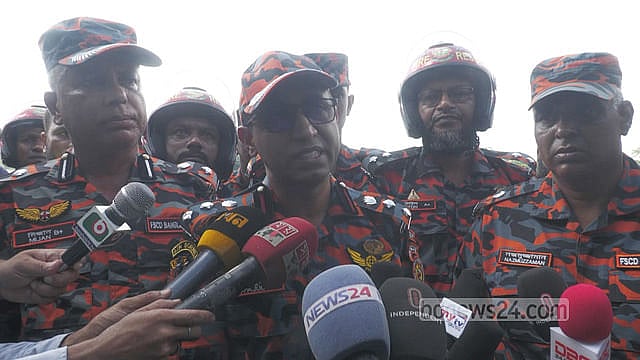
Lt Col Mohammad Tazul Islam, a director of the fire service, alleged the shipping lines call the firefighters only after accidents, not to prevent them with precautionary measures through safety checks.
“The ships in our country barely have fire safety systems. Such carelessness and lack of awareness might have caused the accident on Shagor Nandini-2. We’re investigating the matter.”
Speaking at a press conference in Jhalakathi on Tuesday, he said 12 teams of firefighters worked for more than 10 hours to douse the fire after the latest explosion.
He said it took long to tame the blaze because the firefighters brought thousands of litres of foam from Barishal and Khulna br to douse the fire as it is risky to use water to put out fire from fuel oil.
The authorities siphoned 500,000 litres of oil from the tanker before the second blast destroyed the rest, according to him.
At a separate press conference, Coast Guard’s Operations Officer for South Zone Lt Shafayet Hossain said the company operating the oil tanker was not assisting the authorities in preventing more accidents.
The shipping line did not provide fitness papers to the authorities, he said.
He also said the Coast Guard was using a vessel equipped with modern technology to skim the oil in order to save the environment.
BLAST INTENSITY ‘SURPRISING’
Officials at Bangladesh Inland Water Transport Authority and the fire service said the intensity of the first blast, which flung the master bridge of the tanker, had taken them by “surprise”.
Rescuers found three bodies inside the detached part of the tanker. The other dead victim was inside the engine room.
Md Selim, a BIWTA joint director who has been working at the scene since Saturday, said: “It sounds unbelievable that an explosion can fling such a big master bridge.”
“You get an idea how intense the explosion was as it hurled the master bridge 20 metres away. Investigators are working on the matter.”
Billal Hossain, assistant director of the fire service in Barishal, said, “I’m not an expert in explosions, but from my professional experience, I can say that it was a very strong blast.”
“People who work on explosions can say if gas accumulated [in the engine room] can cause such a blast,” he said and called for engineers’ opinion on whether there was a lack of supervision behind the disaster.
Shamsul Huda, who has been working on oil tanker manufacturing in Singapore for eight years, said: “The engine room does not have space for so much gas that can fling the master bridge. Flammable liquids may cause such a blast.”
Energy and Mineral Resources Secretary Md Khairuzzaman Mozumder said 380,000 litres of fuel oil remained in the tanker after the second blast. The district administration will supervise the work to remove the oil, he said.
The district administration and Bangladesh Petroleum Corporation formed two committees to investigate the accident after the first blast, according to the secretary.
An inter-ministerial investigation committee was formed after the second blast.