


Published : 13 Feb 2013, 07:24 AM
Updated : 09 Aug 2022, 10:13 AM


The amendment envisages providing equal rights of appeal to both defence and prosecution on verdicts pronounced by the war crimes tribunals.
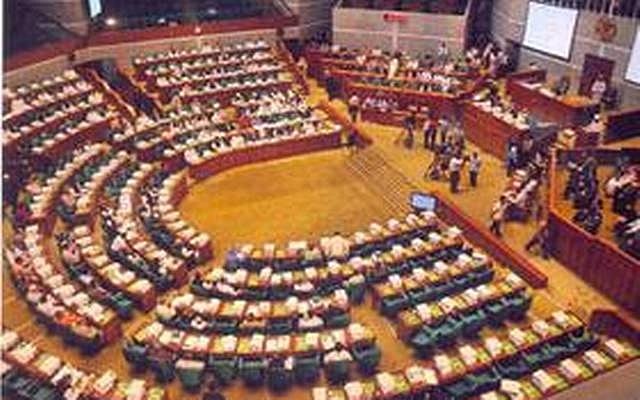
Discussion on the amendment bill has already been scheduled in the parliament's business for Wednesday.
The Law Minister Shafique Ahmed will be placing the bill, sources say. After placing the bill, he will request that it be sent to the standing committee for verification.
Parliament session is scheduled to commence from 4:00pm.
Later Education Minister Nurul Islam Nahid and Law Minister Shafique Ahmed will be placing a bill each.
Proposal expressing gratitude for President Zillur Rahman’s speech will be discussed at the end.
The leading opposition Bangladesh Nationalist Party (BNP) has not been participating in the parliament session.
The proposal would allow disposal of hearing after appeal within 90 days (60 days on first phase, and 30 more days in the latter), Law Minister Shafique Ahmed had earlier said .

“Both sides would benefit from the amendment. Not only prosecution, but also the defence can appeal against a verdict after the amendment,” he said.
Complications arose over the prosecution’s right of appeal after the second war crimes tribunal gave a life sentence to Jamaat-e-Islami Assistant Secretary General Abdul Quader Molla after a charge of murder could not be proved against him.
The bill is expected to be placed after the protests at Shahbagh entered the ninth day , demanding execution of all war criminals.
The protestors say Molla has got away with a "light sentence".
The original law, enacted in 1973, did not provide scope for the prosecution to appeal. Later a 2009 amendment allowed the prosecution the right to appeal but only against an accquital , not against a sentence.
Section 21 of the International Crimes Tribunal Act says: (1) A person convicted of any crime specified in Section 3 and sentenced by a Tribunal shall have the right of appeal to the Appellate Division of the Supreme Court of Bangladesh against such conviction and sentence.
(2) The Government shall have the right of appeal to the Appellate Division of the Supreme Court of Bangladesh against an order of acquittal.
(3) An appeal under sub-section (1) or (2) shall be preferred within [thirty days] of the date of order of conviction and sentence or acquittal.
Five of the six charges were proved against Quader Molla, while he was acquitted in one.
Chief Coordinator of the tribunal Additional Attorney General MK Rahman said the ICT had accquitted Molla because the prosecution could not prove his involvement in the Ghatarchar massacre in Keraniganj conclusively.
Therefore, he said, the prosecution could now only appeal against this charge number 4 that related to the Keraniganj massacre.
He said the prosecution would only appeal seeking a review of that part of the verdict, possibly by taking recourse to Article 104 of the Bangladesh Constitution that assures 'complete justice'.
Rahman further said the prosecution might seek a Supreme Court order on the whole verdict after filing an appeal petition.
Ghatak Dalal Nirmul Committee Legal Affairs Editor Tuhin Ahmed said appeal could be made to lessen the punishment, but not to increase it.
Meanwhile, the defence has said they would appeal against the verdict for reduction of the life sentence handed out to Molla.











