Published : 01 Oct 2018, 01:18 PM
Updated : 05 Aug 2022, 06:44 PM


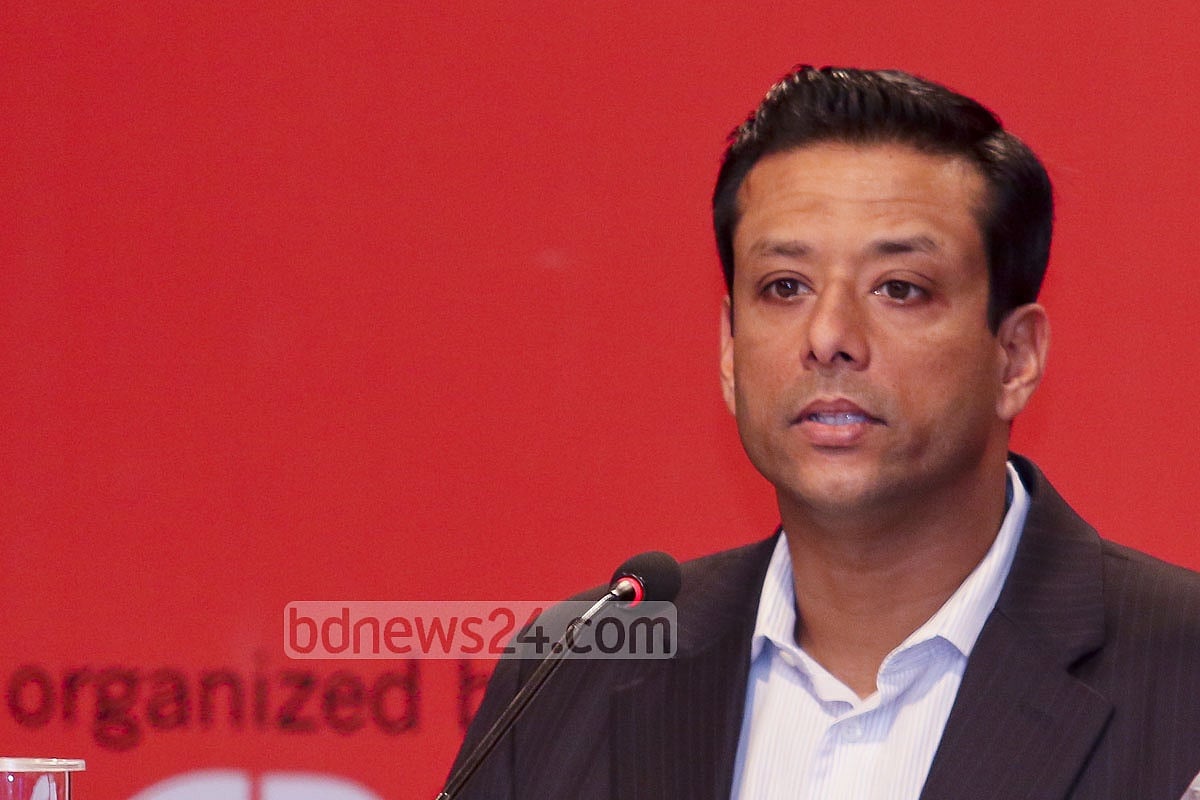
Sajeeb also defended the new law saying it was created to protect citizen data and privacy. “We did not have any specific laws against hacking and theft of data until this Act. How are we supposed to prosecute hacking and theft of your data without this law?”
In his detailed Facebook post, he also made remarks on the “ethics” of the Editors’ Council itself.
“In effect, the Editors’ Council is saying that they should be allowed to run smear campaigns against governments and try to topple politicians they don’t like with complete disregard for the truth. If they can do this to Sheikh Hasina, where does that leave the future of our country?"
Sajeeb attacked the critics of Section 25 of the Digital Security Act, saying that the Editors’ Council did not follow its own charter of ethics.
Sajeeb, the son of Hasina, turned up the heat particularly on Editors’ Council General Secretary Mahfuz Anam, editor of The Daily Star, and questioned his ethics.
“Neither the Press Club nor the Editors’ Council, indeed no media body, has ever enforced their own charter of ethics and conduct. The current head of the Editors’ Council is Mahfuz Anam, who confessed on television to running a false smear campaign against our Prime Minister Sheikh Hasina during the 1/11 dictatorship. “
The Daily Star had published a report on Hasina’s “corruption” during the reign of the military-backed caretaker government. Anam had later admitted in a television interview that the report had been unsubstantiated.
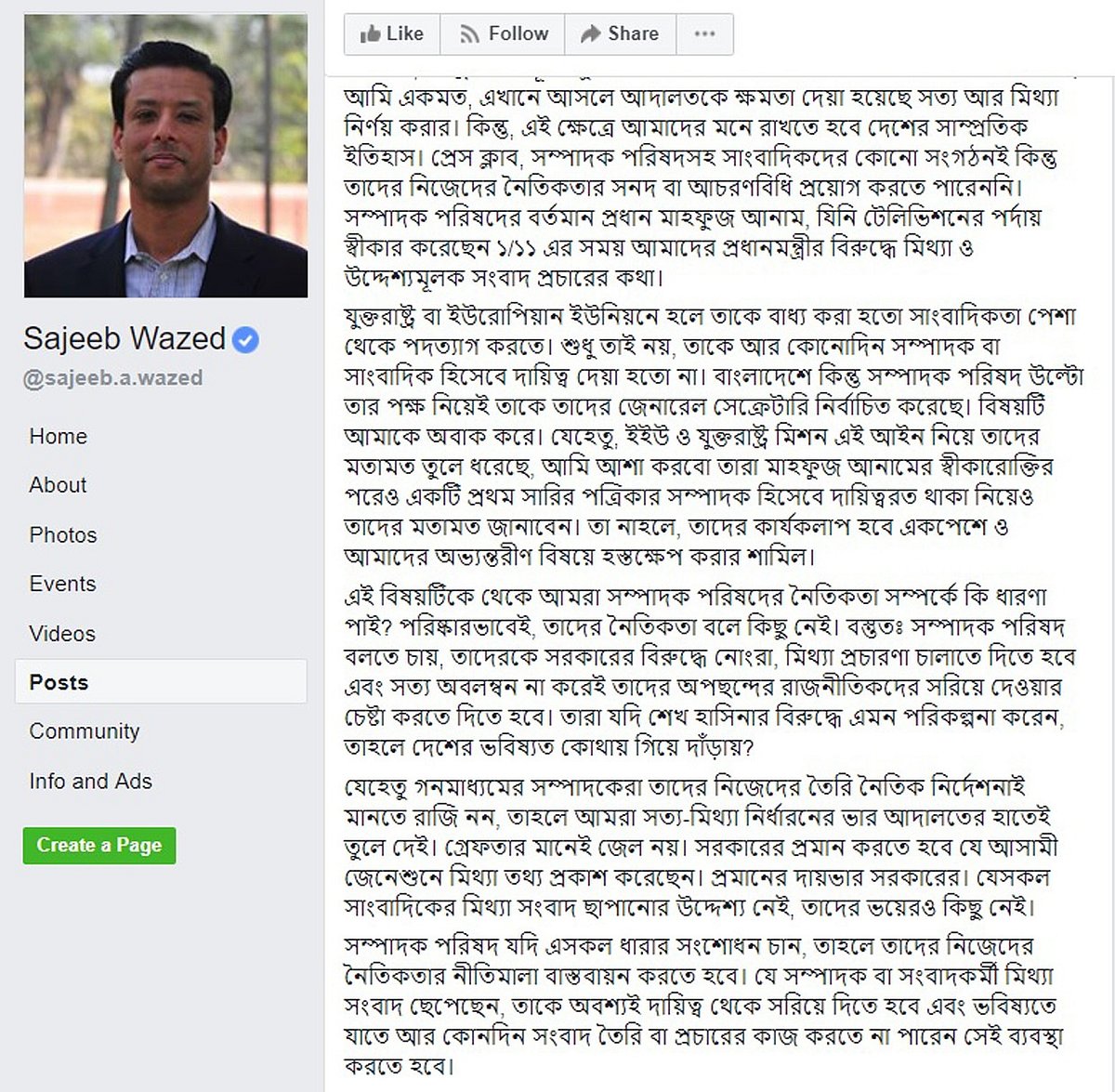
“By contrast in Bangladesh, the Editors’ Council jumped to his defence and has now even made him general secretary. I find this astounding.”
“Since the EU and US Embassy have issued their opinion on this law, they should also issue a statement on Mahfuz Anam’s confession as the editor of a major national newspaper. Otherwise, they are being partisan and interfering in our internal affairs. The hypocrisy is mind-boggling.”
Various media and journalist organisations, including the Editors’ Council, have criticised parts of the Digital Security Act since it was made public, stating that the law restricted the freedom of speech and the freedom of the press.
Ignoring their protests, the parliament passed the bill on Sep 19.
The council had called a protest programme om Sep 29 stating that the bill brings ‘serious threats to the freedom of expression and media operations’.
The programme was later stayed after a request for a meeting from the government.
On Sunday, the Editors’ Council met with Information Minister Hasanul Haq Inu, Law Minister Anisul Huq and Telecommunication and Information Technology Minister Mustafa Jabbar.
The discussion centred on the objections to sections 8, 21, 25, 28, 29, 31, 32, 43 and 53 of the law.
Explanations of these criticisms have been published by various media outlets.
Section 25 of the act says a person may face up to three years in jail or a Tk 300,000 fine or both if found to have deliberately published false or distorted information to harass or humiliate an individual or tarnish the image of the state.
Sajeeb criticised the interpretation of the law, saying that the courts had to be responsible for media reports if the media did not respect its own code of ethics. The burden of proof would be on the state to prove that the crime had been committed, he said.
The Digital Security Act had been written to protect the privacy and safeguard the personal information of citizens, he said.
“I understand this makes journalist’s job harder, but should journalists be allowed to hack and capture any information, including citizen data being discussed inside a government office, in order to expose someone corrupt?”
“No country in the world allows journalists to obtain data through illegal means, including the EU and the US. Covert surveillance inside any US government office is illegal, even for journalists. Journalists must obtain their information through other sources.”
He also bashed criticism of section 21, saying that distortions of the Liberation War had been used in the past to rehabilitate war criminals in Bangladesh.
“Anyone who is against this section cannot be a true Bengalee,” Sajeeb said. “They must be a hidden Jamaat supporter and Rajakar.”
He claimed that the idea was based on Holocaust Denial laws found in certain EU countries.
Sajeeb said that the sections of the law against inciting violence and religious sentiment are also based on those of other countries.
The Editors’ Council says that the Liberation War sections of the law are vague and can lead to misuse, persecution and harassment of journalists.
The group also said that section 43 can be used against journalists to search, seize and arrest them without a warrant.
On this, Sajeeb said that no warrants are needed when a crime is in the works.
“During the commission of a crime no warrant is needed for arrest or search. This is a basic criminal law in any country, including ours. If you call the police to report a theft, should they wait to get a warrant before arresting the thief and searching their belongings for the stolen items?
“Similarly, if the police track someone hacking online and locate them, should they wait for a warrant before stopping them?”
Following Sunday's meeting with the Editors' Council, Law Minister Anisul Huq had promised to bring their objections to the cabinet.